Subculture Reagent Kit
Trypsin/EDTA Subculture Reagent Kit
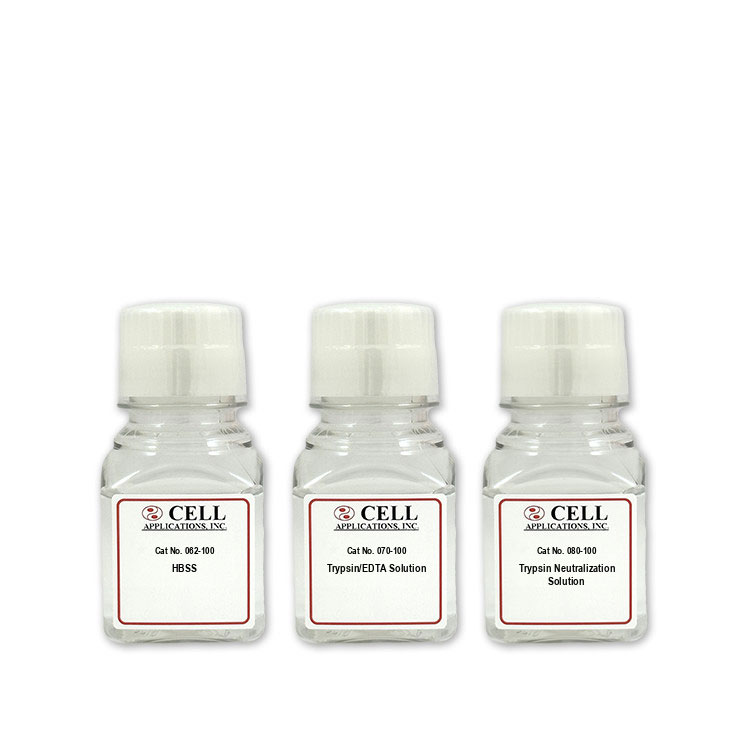
Subculture Reagent Kit: 100 ml each of HBSS, Trypsin/EDTA & Trypsin Neutralizing Solution
Price: $73.00
Description
The Trypsin/EDTA Subculture Reagent Kit is designed for the routine subculture of adherent primary cells and cell lines maintained in cell culture or tissue culture. The kit contains three coordinated reagents: HBSS (Hanks Balanced Salt Solution) for washing, Trypsin/EDTA for enzymatic dissociation, and TNS (Trypsin Neutralizing Solution) for stopping or inhibiting residual trypsin activity. Used together, these reagents support controlled cell detachment and may help maintain cell viability and reattachment capacity when used according to the recommended instructions.
The kit may be used with many adherent cell types, including endothelial cells, epithelial cells, fibroblasts, vascular smooth muscle cells, and other primary cells that grow as a monolayer on culture-grade ware. These cells are found throughout the body and perform diverse structural, barrier, transport, signaling, and tissue-maintenance functions. Endothelial cells line blood and lymphatic vessels, where they regulate barrier permeability, leukocyte trafficking, coagulation, angiogenesis, and inflammatory signaling, and modulate vascular tone. Epithelial cells cover external and internal body surfaces and line organs and ducts, where they provide protection and contribute to transport, secretion, and absorption. Fibroblasts are distributed throughout connective tissues, where they produce and remodel extracellular matrix. Vascular smooth muscle cells surround arteries and veins and contribute to vascular contraction, structural support, and vascular remodeling. Depending on the cell source and culture conditions, these cell types are used to study vascular biology, tissue repair, inflammation, fibrosis, drug responses, disease mechanisms, and tissue engineering.
During subculture, attached cells in a flask or other culture vessel are typically rinsed with HBSS to remove residual medium and serum-derived proteins that may inhibit trypsin activity. Trypsin cleaves proteins involved in cell–cell and cell–substrate adhesion, while EDTA chelates divalent cations such as calcium and magnesium that support some adhesion interactions. This combined action promotes cell rounding and, with appropriate exposure, causes cells to become detached from the culture surface. TNS is then added to inhibit residual trypsin activity and limit further proteolysis before the cells are collected, resuspended, counted, and replated.
Controlled trypsinization is important because excessive protease exposure can damage cell-surface proteins and impair post-passaging attachment or recovery. To help avoid over-trypsinization, use the reagents at room temperature unless the applicable product-specific protocol states otherwise, and do not warm them to 37 °C unless directed. Observe the culture under a microscope during dissociation and follow the recommended instructions for the specific cell type. When the cells appear rounded but remain loosely attached, gently tap the side of the flask with the palm of your hand to encourage them to detach, rather than unnecessarily extending the incubation. Do not over-trypsinize the cells, and use the recommended trypsin/EDTA concentration, exposure time, and TNS volume when these parameters are specified for the culture.
By combining HBSS, Trypsin/EDTA, and TNS in one coordinated format, the Trypsin/EDTA Subculture Reagent Kit helps support consistent transfer of adherent cultures between passages. Consistent subculture practices can improve reproducibility in cell number, morphology, viability, and attachment — important considerations for downstream assays and models. The kit may also be used with appropriate coating material and substrate reagents when cells require extracellular-matrix support or specialized culture surfaces. Because sensitivity to enzymatic dissociation varies with tissue source, donor, passage number, confluence, and culture conditions, users should optimize the procedure for their particular cells and maintain the recommended culture conditions.
The Trypsin/EDTA Solution is specially formulated for use with Cell Applications, Inc. adherent primary cells. We do not recommend the use of non-Cell Applications, Inc. Trypsin/EDTA and reagents for trypsinizing and subculturing procedures.
The Trypsin/EDTA Solution is available as part of a Subculture Reagent Kit, which also contains Hanks Balanced Salt Solution (HBSS) and Trypsin Neutralizing Solution (TNS). The ultra-convenient Subculture Reagent Kit helps ensure the health of your primary cell cultures.
Products are for research use only. They are not intended for human, animal, or diagnostic applications.
Details
Follow the following important guidelines when subculturing primary cells:
- All reagents should be at room temperature. Do Not Warm Any Reagents to 37 °C.
- Do not over-trypsinize. Strictly follow the trypsinization instructions in our protocol.
- Watch cells under the microscope during the entire trypsinization process. When the cells become rounded but are still attached, hit the side of the flask against your palm until the cells detach.
Learn more about how to properly apply Trpysin/EDTA and maintain the health of your cell cultures in the Cell Culture FAQ.
 Powered by Bioz