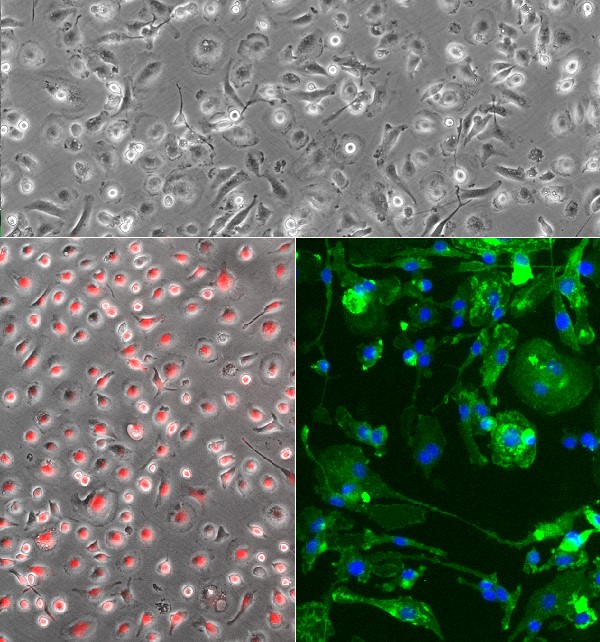
Cryopreserved Rat Macrophages: RMcp (top) cultured for 2 days. Bottom: DiI-Ac-LDL (in red) uptake in cryopreserved RMcp cultured for 3 days (R). Cryopreserved RMcp cultured for 4 days stained for CD11b/c (in green) and DAPI (in blue) (R).
Rat Macrophages: RMcp
Rat Macrophages (RMcp) are primary immune cells derived from the bone marrow or peritoneal cavities of normal rats.
Description
Rat Macrophages (RMcp) are primary immune cells derived from the bone marrow or peritoneal cavities of normal rats using standardized isolation methods. Belonging to the mononuclear phagocyte system, these mature myeloid cells develop from a precursor monocyte lineage. Unlike continuous immortalized cell lines, which often lose regulatory feedback loops and exhibit artifactual activation states, RMcp retain their native physiological responsiveness and phagocytic capacity in vitro.
When revived and cultured under recommended conditions, these fastidious primary cells readily attach to standard tissue culture-treated plastic to form an adherent monolayer. To guarantee experimental reproducibility and data integrity, standard quality control workflows include routine screening to ensure the culture is free of contaminants such as bacteria, fungi, and mycoplasma. Characterization of RMcp typically includes functional verification via fluorescently labeled acetylated low-density lipoprotein (DiI-Ac-LDL) uptake assays, alongside protein expression profiling. A standard flow cytometry analysis or immunofluorescence assay is routinely employed to confirm the presence of classic surface and intracellular markers, which typically includes positive staining for F4/80 and CD11b/c.
In vivo, macrophages are ubiquitously distributed across almost every tissue in the rat anatomy, positioning them as essential sentinels for host defense and tissue homeostasis. They exist either as resident populations that colonize specific organs during embryonic development — such as Kupffer cells in the liver or alveolar macrophages in the lungs — or as transient cells recruited to peripheral sites.
During an inflammatory response or tissue injury, circulating monocytes migrate out of the vasculature, cross the endothelial barrier, and infiltrate the affected tissue space. Within these microenvironments, local cytokine gradients, chemokines, and extracellular matrix components dictate their differentiation and polarization status. This anatomical and functional diversity allows them to tailor their biological response to the exact requirements of their host tissue.
The primary function of RMcp is to orchestrate innate immunity and maintain tissue homeostasis by identifying, engulfing, and digesting cellular debris, apoptotic cells, and foreign pathogens through the process of phagocytosis. This critical clearance mechanism prevents the accumulation of cytotoxic materials and limits the spread of infectious agents.
Beyond acting as professional phagocytes, these cells play a central role in modulating adaptive immunity and tissue remodeling. Upon encountering a pathogen, macrophages process foreign proteins and execute antigen presentation to help prime and activate naive T cells. Concurrently, they secrete a sophisticated profile of pro-inflammatory or anti-inflammatory cytokines, chemokines, and growth factors that recruit and instruct other immune cells. However, if this regulatory balance is chronically disrupted, sustained macrophage activation can contribute to pathological tissue degeneration, chronic inflammatory diseases, or create a permissive microenvironment that supports tumor progression and metastasis.
In biomedical and translational research, RMcp serve as a useful in vitro model system to investigate inflammatory cascades, wound healing kinetics, and host-pathogen interactions. They are utilized in phagocytic assays, cytokine secretion profiling, and cytometry analysis to evaluate how the innate immune system responds to novel therapeutic candidates, biomaterials, or environmental toxins. Researchers frequently use these primary cells to study the phenotypic switch between pro-inflammatory (M1) and pro-resolving (M2) polarization states (a simplification), mapping the specific signal transduction pathways that govern tissue repair and fibrosis.
A significant volume of immunology literature relies on RMcp to evaluate advanced diagnostic and therapeutic delivery platforms. For example, scientific references document using rat macrophages to evaluate the biocompatibility and intracellular uptake of target-specific nanoparticles, tracking cellular internalization and changes in marker expression levels via flow cytometry. This targeted application isolates distinct macrophage behaviors from systemic variables under controlled conditions, driving the development of novel anti-inflammatory drugs, vaccine adjuvants, and regenerative medicine strategies.
Details
| Tissue | Normal healthy Rat bone marrow |
|---|---|
| QC | No bacteria, yeast, fungi, mycoplasma |
| Character | Positive for F4/80 and CD11b/c |
| Bioassay | Plate, spread on CC ware & uptake DiI-Ac-LDL |
| Cryovial | 1M RMcp frozen in Macrophage & Microglia Cell Freezing Med (043-50) |
| Kit | Cryovial Frozen RMcp (R8818-10a), Culture Medium Kit (R620K-100) |
| Doublings | N/A - Blood cells don't proliferate in vitro |
| Applications | Laboratory research use only (RUO). Not for human, clinical, diagnostic or veterinary use. |
Resources
FAQs
Need More Help?
Visit our comprehensive FAQ page for detailed answers to common questions.
Need More Help?
Visit our comprehensive FAQ page for detailed answers to common questions.
Primary Cell FAQs Powered by Bioz