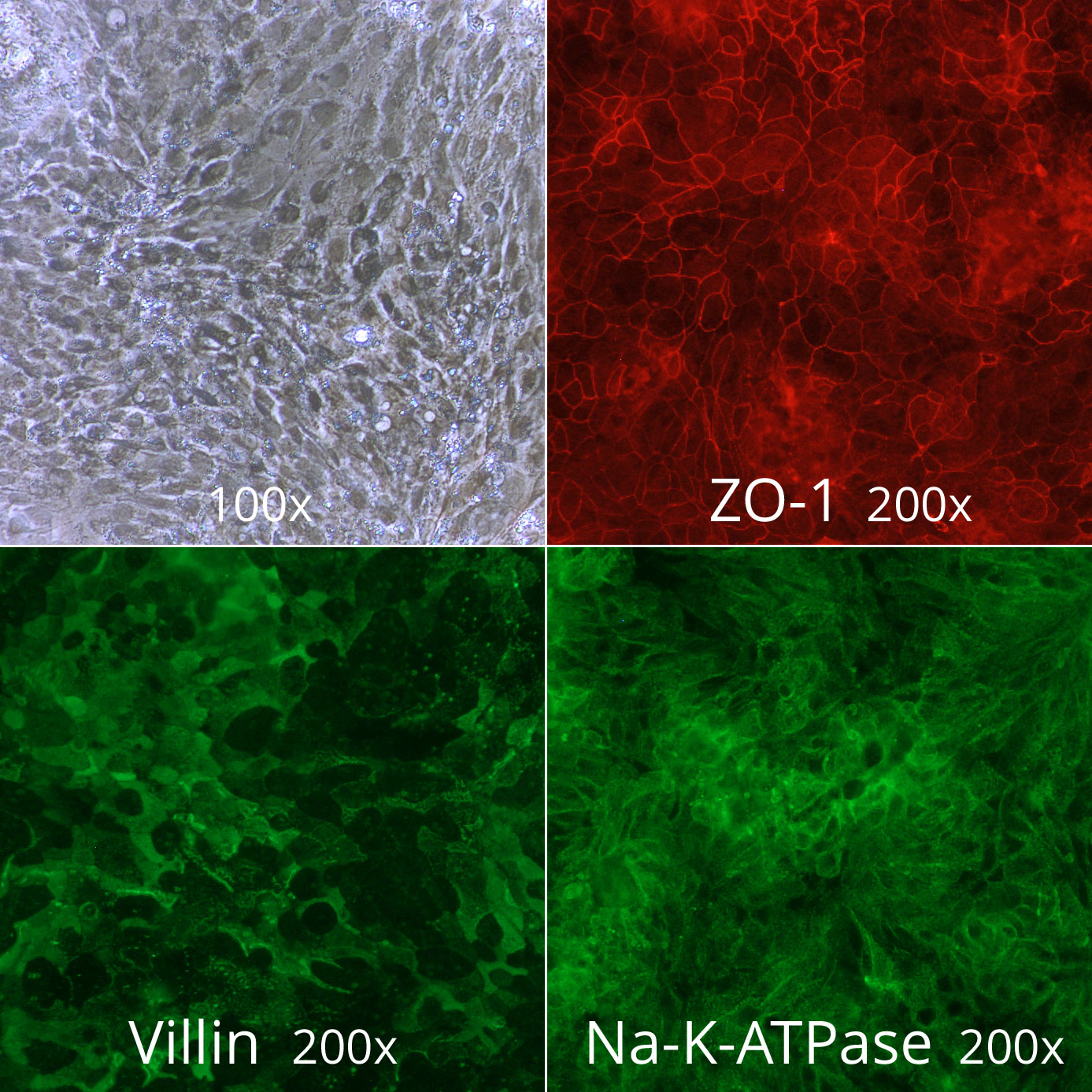
Crohn’s Disease Gastrointestinal Epithelial Cells, Naive (HCnEpC-CD-N): phase contrast 100x, immunostained for ZO-1 (red), Villin (green) and Na-K-ATPase (green), 200x.
Crohn’s Disease Gastrointestinal Epithelial Cells, Naive
Crohn’s disease (CD) gastrointestinal epithelial cells isolated from the intestinal epithelium from naive donors.
Description
Crohn’s disease (CD) gastrointestinal epithelial cells isolated from naive donors provide a critical, unaltered window into the early pathophysiology of Inflammatory Bowel Disease (IBD). In clinical and research contexts, “naive” denotes cells harvested from a CD patient whose disease exhibits non-stricturing, non-penetrating behavior (Montreal Classification B1) and who has not yet undergone standard treatments like anti-inflammatory steroids, immunosuppressants, or biologics.
These cells form the intestinal epithelium, a single-cell layer that acts as a crucial barrier lining the gastrointestinal tract. Harvested from specific regional locations of the intestinal mucosa — most commonly the small intestine (specifically the ileum), the colon, and the rectum — these cells are central to understanding how primary barrier dysfunction drives chronic inflammation before therapeutic interventions alter the cellular landscape.
The intestinal epithelium is a dynamic, rapidly self-renewing tissue maintained by intestinal stem cells residing at the base of the crypts. These stem cells differentiate into specialized lineages that orchestrate mucosal homeostasis, nutrient absorption, and immune defense:
Goblet Cells: Responsible for secreting mucus into the intestinal lumen, forming a physical shield that keeps the dense gut microbiota from directly contacting host tissue.
Paneth Cells: Primarily localized in the crypts of the small intestine, these cells secrete antimicrobial peptides. In Crohn’s disease, Paneth cell dysfunction is a well-documented hallmark linked to genetic susceptibility.
In a healthy state, these intestinal epithelial cells manage selective permeability, preventing the translocation of luminal antigens into the underlying lamina propria. However, in patients with Crohn’s disease, the breakdown of this barrier allows luminal contents to breach the epithelium, triggering an aberrant, chronic immune response. This underlying pathology manifests clinically as severe abdominal pain, chronic diarrhea, and systemic weight loss. If left unchecked, the progressive inflammation can lead to structural complications like strictures or fistulas (B2 and B3 phenotypes), shifting the patient out of the naive categorization.
Primary gastrointestinal epithelial cells from naive donors are invaluable for translational research because they lack the confounding transcriptional artifacts induced by immunosuppressive drugs. Scientists utilize these cells to investigate baseline gene expression profiles to determine which genes are inherently dysregulated at the onset of the disease.
Researchers utilize flow cytometry to isolate, immunophenotype, and characterize distinct epithelial subpopulations from biopsy tissues. A primary focus of this research is examining how epithelial cells communicate with neighboring immune cells in the lamina propria. Deeper mechanistic studies focus on the bidirectional signaling between the disrupted epithelium and mucosal T cell populations, which drive the downstream inflammatory cascade.
These cells are frequently grown in 3D organoid models to study early-stage barrier breakdown, cytokine responses, and mucosal healing. To ensure data integrity and accurate MeSH terms indexing in scientific literature, these primary cultures undergo rigorous quality control to confirm the absence of adventitious agents like mycoplasma virus or bacteria.
By comparing the differential expression of tight junction proteins and inflammatory biomarkers in naive CD cells against healthy controls or ulcerative colitis samples, researchers aim to identify novel therapeutic targets capable of halting Crohn’s disease before it progresses to irreversible structural damage.
Crohn’s Disease (CD) is an inflammatory bowel disease (IBD) that causes chronic inflammation of the gastrointestinal tract. While Crohn’s Disease most commonly affects the ileum and colon, the disease can affect any part of the GI tract from the mouth to the anus. An estimated 3 million Americans are affected by IBD. While genetics (positive family history for IBD is the greatest known risk factor) and immune response play a role in the disease, the cause of the disorder is unknown. And while standard treatment (anti-inflammatory steroids and immunosuppressants) can slow progression of disease, there is no known cure.
To better understand the disease and how to treat it, Cell Applications offers researchers access to an unprecedented biobank of Epithelial Cells from Crohn’s Disease cases. The Cell Applications biobank includes a diverse cohort of disease age, location, and behavior. Sample locations include colon (Cn), ileum (Il), Rectum (Re). CD cells are categorized as untreated (naive) and Treated Crohn’s Disease. Generally, naive cells are from Crohn’s Disease cases exhibiting non-stricturing, non-penetrating behavior (B1), while stricturing (B2) and penetrating (B3) CD patients have sought treatment.
For your convenience, the Epithelial Cell Total Kit includes all the reagents you need for gastrointestinal epithelial cell culture. Along with a cryovial of 500,000 diseased epithelial cells, the Total Kit includes optimized cell culture medium, thawing medium, and coating solution. Cells can be cultured up to 7 days. Cells cannot be passaged and should be plated directly into the experimental system.
Details
| Tissue | Human colon (Cn) or ileum (Il) of untreated Crohn’s Disease. | |
|---|---|---|
| QC | No bacteria, yeast, fungi, mycoplasma, virus. | |
| Bioassay | Attach, spread, in Culture Medium. | |
| Cryovial | 500,000 HIlEpC-CD-N HCnpC-CD-N in Freezing Medium. | |
| Kit | Cryovial frozen HIlEpC-CD-N (732Il-CD-N-05a) or HCnEpC-CD-N (732Cn-CD-N-05a), with Culture Med (716DC-50), Coating Solution (025-05), Thawing Solution (716T-20). | |
| Cultured | Shipped in flasks or plates in medium. | |
| Doublings | Cells can be cultured up to 7 days. Cells do not divide, and cannot be passaged. | |
| Applications | Laboratory research use only (RUO). Not for human, clinical, diagnostic or veterinary use. |
Resources
FAQs
Need More Help?
Visit our comprehensive FAQ page for detailed answers to common questions.
Need More Help?
Visit our comprehensive FAQ page for detailed answers to common questions.
Primary Cell FAQs