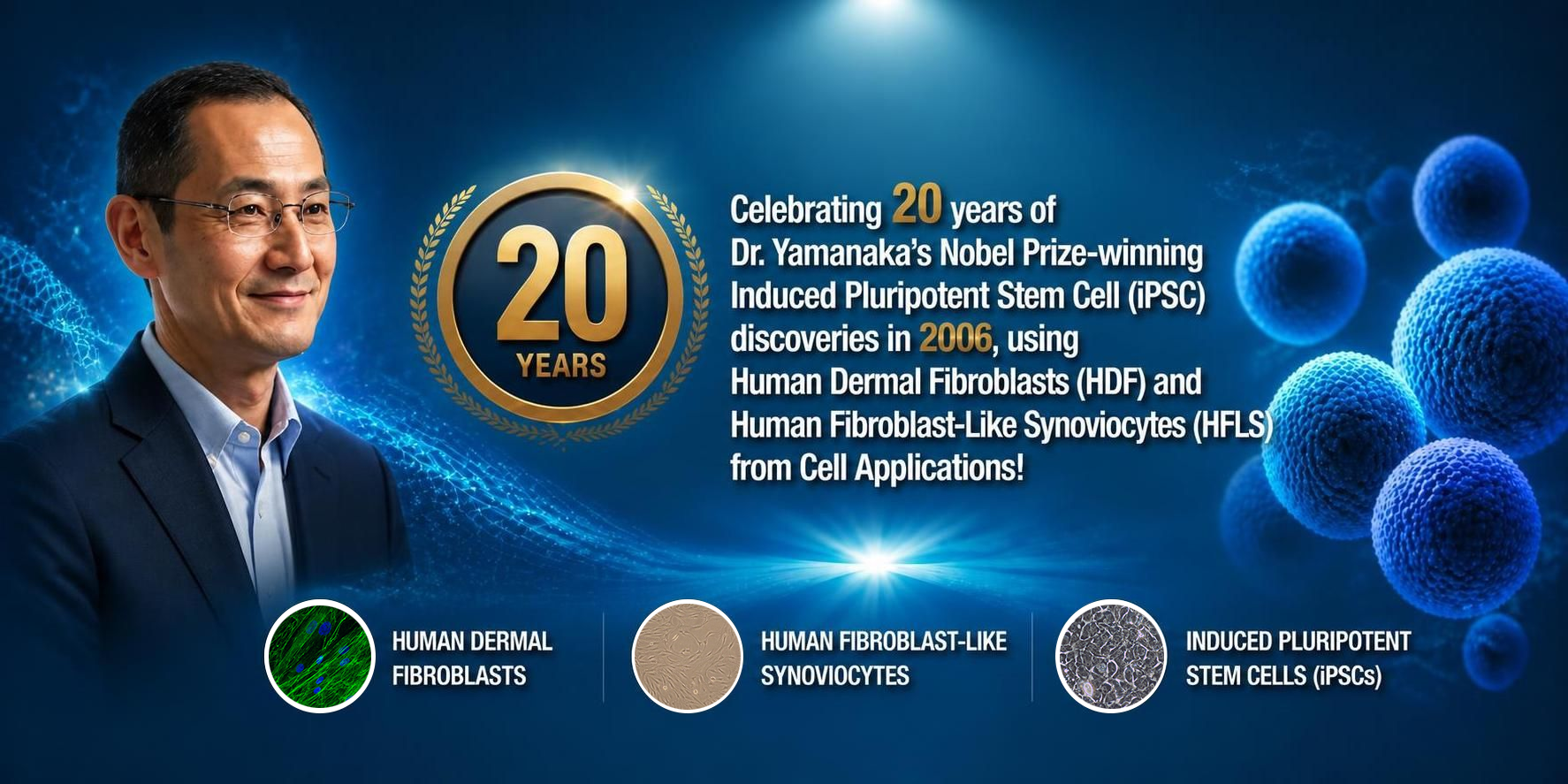
Watch our new video celebrating the 20th anniversary of iPSCs and how Cell Applications’ primary cells helped power Dr. Yamanaka’s Nobel Prize-winning breakthrough.
Two decades ago, stem cell biology underwent a monumental shift. In 2006, Dr. Shinya Yamanaka and his team at Kyoto University demonstrated that mature adult cells could be reprogrammed back into a pluripotent state using just four transcription factors—a discovery that earned the 2012 Nobel Prize in Physiology or Medicine.
Today, we are thrilled to announce the official release of our commemorative video:
“Celebrating 20 Years of iPSC: Dr. Yamanaka’s Nobel Prize-Winning Discovery and Cell Applications.”
Inside the Video: A Breakthrough 20 Years in the Making
When ethical debate and funding constraints restricted embryonic stem cell research in the early 2000s, the global scientific community urgently needed a new pathway to pluripotency.
Our new video explores:
- The Search for Pluripotency: How Dr. Yamanaka’s team narrowed down 24 candidate genes to the core “Yamanaka Factors”—Oct4, Sox2, Klf4, and c-Myc.
- The Human Translation: How Dr. Yamanaka’s team utilized Cell Applications’ adult Human Dermal Fibroblasts (HDF) and Human Fibroblast-Like Synoviocytes (HFLS) in 2007 to prove human adult cells could be successfully reset into iPSCs.
- The Nobel Legacy: The path from initial reprogramming to the 2012 Nobel Prize in Physiology or Medicine, shared with Sir John Gurdon.
- Modern Impact: How iPSCs remain an indispensable platform for disease modeling, high-throughput drug screening, 3D organoids, and regenerative therapies today.
Power Your Stem Cell Research with Proven Primary Cells
Cell Applications is proud to have provided the biological foundation for landmark scientific breakthroughs for over three decades. If your laboratory is developing iPSC reprogramming protocols, tissue models, or regenerative therapies, explore the primary cell lines featured in Dr. Yamanaka’s historical research:
Watch the full video, share it with your lab members, and leave your thoughts in the comments on YouTube!
Thank you for being an integral part of our research community and for continuing to push the boundaries of biomedical science.
No Comments yet!