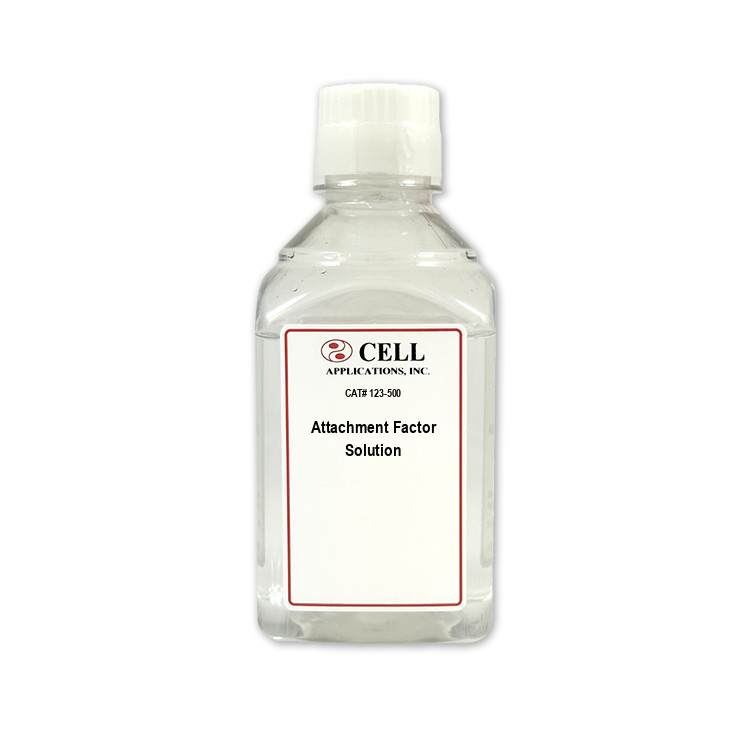
Attachment Factor Solution
Attachment Factor Solution
Attachment Factor Solution (AFS) and ECM Attachment Factor Solution
Description
Attachment Factor Solution (AFS) and ECM Attachment Factor Solution (ECM AFS) are sterile-filtered cell culture coating preparations engineered to promote the attachment, spreading, and structural integrity of anchorage-dependent cells, particularly endothelial cells, on tissue-culture plastic and glass surfaces.
- Attachment Factor Solution: Contains porcine gelatin and is used to coat culture flasks, dishes, and multi-well plates for endothelial cell plating and spreading. It provides a consistent protein substrate to support the initial establishment, adhesion, and routine maintenance of primary endothelial cell culture models.
- ECM Attachment Factor Solution: Contains bovine fibronectin and gelatin formulated in phosphate-buffered saline. It is engineered for primary cell culture workflows that require enhanced extracellular matrix support — such as recovering sensitive cryopreserved endothelial cells, coating cell culture inserts, or preparing chamber slides and coverslips for high-resolution immunostaining. Surfaces coated with ECM Attachment Factor Solution ensure cells firmly adhere and remain anchored during fluid flow and mechanical shear stress studies.
In human physiology, endothelial cells form the continuous single-cell inner lining of blood and lymphatic vessels. They actively regulate vascular permeability, leukocyte trafficking, hemostasis, vascular tone, and localized tissue homeostasis. Positioned directly at the blood-tissue interface, endothelial cells sense fluid shear stress and mechanical cues, which drive nitric oxide signaling, junctional organization, and angiogenic sprouting.
Because endothelial cells are obligate anchorage-dependent cells that normally rest on an extracellular-matrix-rich basement membrane, they require adhesive ligand support in vitro. Coated matrix factors engage cell-surface integrins, promoting rapid focal adhesion, cell spreading, and stable monolayer formation — preventing detachment and anoikis during culture.
Attachment Factor Solution and ECM Attachment Factor Solution support key endothelial research workflows, including:
- Primary Cell Plating & Monolayer Establishment: Promoting uniform cellular attachment, rapid spreading, and confluent monolayer formation across standard tissue culture plastic.
- Cryopreserved Cell Recovery: Providing an enriched matrix environment with ECM Attachment Factor Solution to help thawed cells adhere quickly and recover post-thaw viability.
- Fluid Flow & Shear Stress Assays: Anchoring endothelial monolayers in biofluidic or microfluidic channels so cells remain firmly attached under continuous fluid flow and shear forces.
- High-Resolution Imaging & Immunostaining: Stabilizing cells on glass coverslips and chamber slides during multi-step washing, fixation, and antibody staining procedures.
Cells adhere to one another and to the extracellular matrix during normal physiology and development, but also in pathological conditions such as chronic inflammation and tumor metastasis.
For example, during extravasation from blood vessels into the tissue space, leukocytes first weakly adhere to and roll upon vascular endothelial cells via cell surface receptors known as selectins. Subsequent, stronger adhesion ensues using other receptors and ligands, such as LFA-1 and ICAM-1. Transendothelial migration follows, where the leukocytes squeeze between the tight endothelial cell junctions. As a final impediment to entering the tissue space, the leukocytes encounter the basement membrane, a mixture of extracellular components that ensheathes the vessel. The leukocytes utilize still other receptors to bind ECM, and also secrete matrix-degrading enzymes to facilitate their passage. Unfortunately, tumor cells utilze a similar mechanism as they spread to distant parts of the body during metastasis.
Organs and tissues of the body also contain extensive networks of extracellular matrix, acting as structural scaffolding and regulating cell adhesion, migration and behavior. Finally certain cells, when cultured in vitro, behave more robustly when adhering to a cell culture vessel coated with an ECM analog, component or other attachment factor. Thus, the study of cell adhesion remains an area of particular interest to cell biologists.
Details
| Attachment Factor Solution | |
| Components: | Porcine Gelatin |
| Cell Types: | Various, especially Endothelial Cells (Required for microvascular ECs) |
| Applications: | Promotes attachment and spreading of endothelial cells |
| Collagen Coated T-75 Flask | |
| Components: | Bovine Collagen |
| Cell Types: | Various, including HFDPC |
| Applications: | For attachment and spreading of cells |
| Collagen Coating Solution | |
| Components: | Bovine Collagen |
| Cell Types: | Various |
| Applications: | For coating plates, flasks and dishes to promote cell attachment |
| EHS Matrix Extract (with and w/out Phenol Red) | |
| Componenets | Heterogeneous mix of extracellular matrix / basement membrane components: Laminin, entactin, collagen, HSPG, growth factors extracted from mouse Engelbreth-Holm-Swarm tumor |
| Cell Types: | Various |
| Applications: | For culturing cells where adhesion is dependent upon ECM-coated surface |
| Extracellular Matrix Attachment Factor Solution | |
| Components: | Bovine Fibronectin & Gelatin |
| Cell Types: | Various, especially Endothelial Cells |
| Applications: | Promotes cell attachment & spreading. Prevents endothelial cell monolayer from peeling under shear stress. |
| Extracellular Matrix Protein Coated T-25 flasks | |
| Components: | Bovine Fibronectin & Gelatin |
| Cell Types: | Various, especially Endothelial Cells |
| Applications: | For culturing cells where adhesion is dependent upon ECM-coated surface |
| Neuron Coating Solution I | |
| Components: | Poly-D-Lysine |
| Cell Types: | Neurons |
| Applications: | For the coating of cell cultureware to enhance adhesion |
| Neuron Coating Solution II | |
| Components: | Poly-D-Lysine |
| Cell Types: | Neurons, especially RDRGN & HBN |
| Applications: | For the coating of cell cultureware to enhance adhesion |
| Poly-D-Lysine & Laminin | |
| Components: | Poly-D-Lysine, Mouse Laminin |
| Cell Types: | Various |
| Applications: | For culturing cells where adhesion is dependent upon ECM-coated surface |
| Rat Tail Collagen Coating Solution | |
| Components: | Rat Tail Collagen |
| Cell Types: | Various, especially Endothelial Cells, Hepatocytes, Muscle Cells |
| Applications: | For coating plates, flasks and dishes to promote cell attachment |
| Rat Tail Collagen Solution | |
| Components: | Rat Tail Collagen |
| Cell Types: | Various, especially Endothelial Cells, Hepatocytes, Muscle Cells |
| Applications: | Enhances cell attachment and proliferation, or promotion of cell-specific morphology and function |
Need help choosing? See our Media Selection Guide
 Powered by Bioz