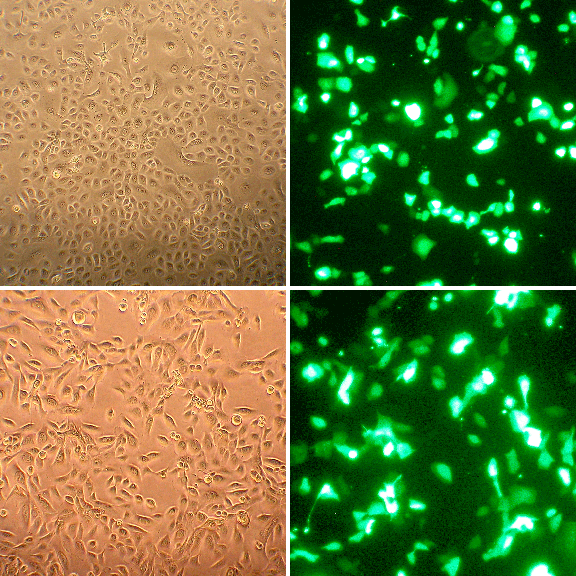
Transfection of HEK (Top) and HMEpC (Bottom) with a GFP-expression plasmid using the Cytofect™ Epithelial Cell Transfection Kit.
Cytofect™ Epithelial Cell Transfection Kit
The Cytofect™ Epithelial Cell Transfection Kit is a plasmid DNA delivery system optimized specifically for primary epithelial cells.
Description
- Gastrointestinal & Digestive: Human Ascending Colon (HCnAEpC), Colon (HCnEpC), Duodenum (HDuEpC), Gastric (HGaEpC), Ileum (HIlEpC), Intestinal (HInEpC), and Jejunum (HJeEpC) Epithelial Cells.
- Respiratory System: Human Bronchial (HBEpC), Small Airway (HSAEpC), and Tracheal (HTEpC) Epithelial Cells.
- Renal & Urogenital System: Human Renal Glomerular (HRGEpC), Renal Proximal Tubular (HRPTEpC), Bladder (HBlEpC), Prostate (HPrEpC), and Urethra (HUEpC) Epithelial Cells.
- Reproductive & Reproductive Support: Human Mammary (HMEpC) and Placental (HPlEpC) Epithelial Cells.
- Barrier Function & Permeability: Investigating tight-junction dynamics (e.g., claudins, occludins, ZO-1), paracellular flux, and inflammatory barrier disruption.
- Respiratory & Mucosal Pathology: Modeling microRNA-mediated gene regulation, mucin secretion, and ciliary mechanics in COPD, asthma, and interstitial lung disease.
- Renal & Metabolic Physiology: Analyzing transporter kinetics, solute handling, and oxidative stress pathways in proximal tubule and glomerular models.
- Host–Pathogen & Toxicology Assays: Evaluating epithelial responses to viral/bacterial pathogens, environmental toxins, inflammatory cytokines, and candidate therapeutics.
Transfection, the introduction of nucleic acid into mammalian cells, is a powerful technique used to study in vivo gene function and regulation. The Cytofect™ Epithelial Cell Transfection kit is a plasmid DNA delivery system specifically optimized to deliver DNA into a wide variety of epithelial cells. This kit contains Cytofect-1, Enhancer and Media for transfection and culturing cells. Viral Enhancer has the ability to complex with unmodified DNA via cationic Cytofect-1 and protect the transfected DNA from lysosomal degradation. This results in high transfection efficiency and viability for these traditionally hard-to-transfect primary epithelial cells.
#Wells / Rxns
96 / 620
24 / 124
12 / 62
The Kit contains all necessary reagents, media and optimized protocols to carry out successful transfection of epithelial cells with high efficiency (40%-70%) and viability (70%-95%).
Products are for research use only. They are not intended for human, animal, or diagnostic applications. *Viral Enhancer (VE) is a replication-deficient, Adenovirus-derived formulation that does not contain replication competent virus. TR1 and VE are manufactured by Targeting Systems.
Details
| Kit Contents: | Cyrofect-1 Viral Enhancer (VE)* Antibiotics-Free Growth Medium Transfection Medium Transfection Medium with Serum |
|---|
FAQs
Need More Help?
Visit our comprehensive FAQ page for detailed answers to common questions.
Need More Help?
Visit our comprehensive FAQ page for detailed answers to common questions.
Cytofect™ Transfection Reagents: Frequently Asked Questions (FAQs) Powered by Bioz