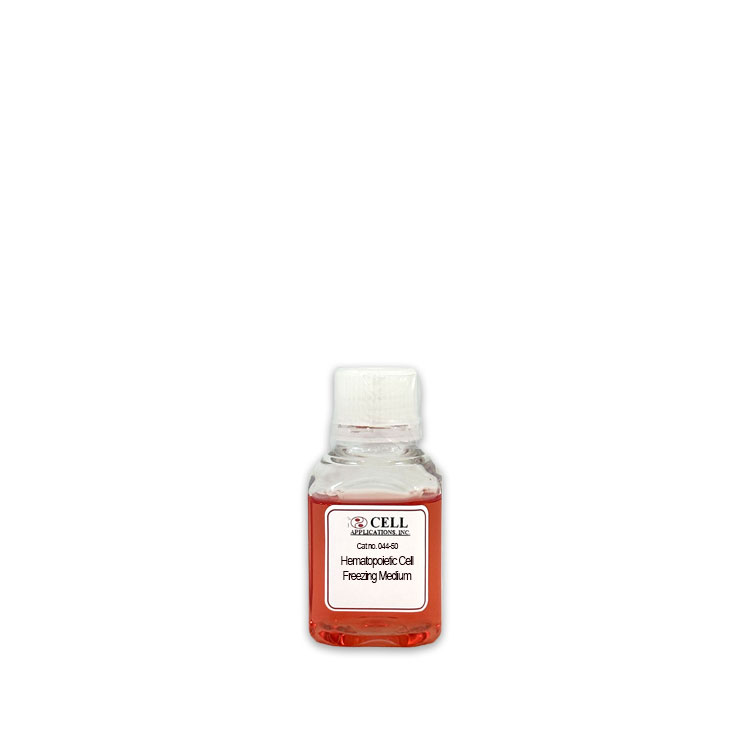
Hematopoietic Stem Cells CD34+ Freezing Medium
Freezing Medium for CD34+ Hematopoietic Stem Cells: Serum-free freezing medium optimized for CD34+ Hematopoietic Stem Cells (HHSC), Dendritic Cells-Peripheral Blood (HDC-PB)
Size: 50 ml
Price: $90.00
Description
Hematopoietic Stem Cells CD34+ Freezing Medium is a specialized formulation designed to help protect delicate human CD34+ cells during cryopreservation. It is intended to support post-thaw viability and recovery while helping preserve key cellular characteristics during storage in liquid nitrogen.
CD34+ hematopoietic stem and progenitor cells are found primarily in the bone marrow, and during development, also in the fetal liver and umbilical cord blood. These multipotent cells are defined in part by CD34 expression and contribute to hematopoiesis through self-renewal and differentiation into myeloid and lymphoid lineages, which give rise to mature blood and immune cells including erythrocytes, platelets, granulocytes, monocytes, and lymphocytes.
For stem cell banking, hematological disease research, immunology, gene therapy, and regenerative medicine workflows, dependable cryopreservation is essential. Hematopoietic Stem Cells CD34+ Freezing Medium provides a controlled environment to help reduce cryoinjury during freeze-thaw handling and support recovery of valuable cells for downstream applications.
Freezing Media (also referred to as cryopreservation media) is a specialized category of cell culture formulation engineered to protect cells from ice crystal formation and osmotic shock during the freezing and thawing processes.
The primary biological and physical function of freezing media is to manage the thermodynamic and osmotic transitions that occur during cooling. While CPAs do lower the freezing point of water modestly, their protective action is primarily colligative; they modify the concentration of solutes inside and outside the cell and fundamentally alter ice crystallization kinetics. As the extracellular environment freezes, ice crystals exclude solutes, creating a hyperosmotic extracellular fraction that draws water out of the cells. If cooling occurs too rapidly, intracellular water cannot escape fast enough, leading to lethal intracellular ice crystallization that shears the plasma membrane and organelle boundaries. Conversely, if cooling is too slow, prolonged exposure to severe hyperosmotic stress leads to excessive cellular dehydration and solute toxicity.
Freezing media minimize these dual mechanisms of injury. Permeating CPAs enter the cytoplasm to displace water and disrupt the ordered lattice structure of ice, while non-permeating components increase extracellular viscosity and stabilize lipids within the plasma membrane bilayer. This coordinated protection preserves critical baseline cell biology features, maintaining intact cell surface receptor baselines and functional enzymatic pathways.