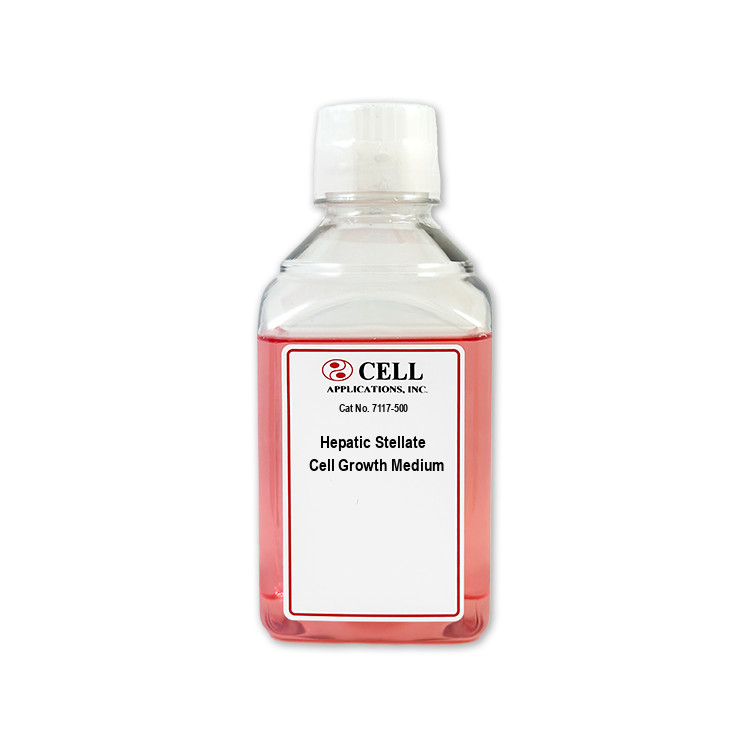
Human Hepatic Stellate Cells Media
Human Hepatic Stellate Cell Media
Human Hepatic Stellate Cells Growth Medium: All-in-one ready-to-use
Type: Growth Medium
Size: 500 ml
Price: $150.00
Description

Human Hepatic Stellate Cell Media is a specialized formulation developed to support the attachment, viability, and expansion of primary human hepatic stellate cells in vitro. The medium provides nutritional and biochemical components intended to support cell health and reproducible culture performance. Because primary hepatic stellate cells can undergo spontaneous activation during isolation and culture, researchers should evaluate activation status using appropriate morphological, molecular, and functional markers for their specific application.
In healthy liver tissue, hepatic stellate cells are resident mesenchymal cells located in the perisinusoidal space of Disse, between the sinusoidal endothelium and hepatocyte plates. They interact with hepatocytes, liver sinusoidal endothelial cells, and resident Kupffer cells. In their quiescent state, hepatic stellate cells are a major hepatic storage site for vitamin A, which is maintained primarily as retinyl esters in cytoplasmic lipid droplets.
Following liver injury or chronic liver disease — including viral hepatitis, alcohol-associated liver disease, and metabolic dysfunction-associated steatohepatitis (MASH) — hepatic stellate cells can become activated and acquire a proliferative, contractile, myofibroblast-like phenotype. Activation is commonly associated with loss or remodeling of retinoid-rich lipid droplets, increased expression of markers such as α-smooth muscle actin, and increased production of extracellular-matrix proteins, particularly collagens types I and III. Persistent activation contributes to excessive extracellular-matrix deposition, progressive hepatic fibrosis, and disruption of normal liver architecture.
Human Hepatic Stellate Cell Media provides a primary human-cell platform for investigating stellate-cell biology and liver disease mechanisms. Potential research applications include:
- In vitro disease modeling: Studying interactions among stellate cells, hepatocytes, liver sinusoidal endothelial cells, and Kupffer cells in co-culture or multicellular models of liver injury and inflammation.
- Fibrogenesis research: Evaluating signaling pathways that regulate stellate-cell activation, collagen expression, extracellular-matrix production and turnover, and lipid-droplet remodeling during fibrosis.
- Antifibrotic drug discovery: Assessing compounds that reduce stellate-cell activation, extracellular-matrix production, or fibrogenic signaling, and investigating whether treatments promote a more quiescent-like phenotype.
Medium carefully optimized for the characteristics and requirements unique to Human Hepatic Stellate Cells. Attention to detail ensures ideal cell health, viability, performance, physiology, morphology, consistency and data.
Use with:
Details
CAI media are tested for sterility in order to confirm no bacteria, yeast or fungi contaminate the solutions. The products undergo further quality control for correct pH, osmolality and lack of endotoxins. A panel of different bioassays affirm the media sustain a proper environment for expected cell-type-specific culture, growth, plating, karyotype, physiology, morphology, viability, population doublings, surface markers, cryopreservation, differentiation and/or induction.
Laboratory research use only (RUO). Not for human, clinical, diagnostic or veterinary use.