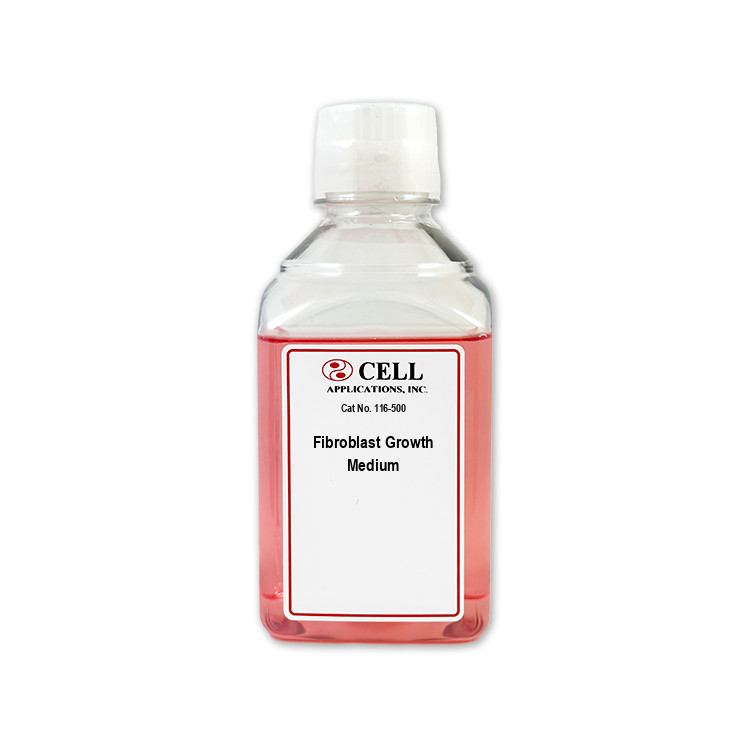
Human Dermal Fibroblast Media
Human Dermal Fibroblast Media
HDF Growth Medium: All-in-one ready-to-use
Type: Growth Medium
Size: 500 ml
Price: $144.00
Description

Human Dermal Fibroblast Media is a fibroblast growth medium formulated to support normal human dermal fibroblasts (HDF) — stromal connective tissue cells found primarily in the dermis of the skin. In vivo, fibroblasts are responsible for maintaining and remodeling the extracellular matrix (including collagen and other matrix components), regulating tissue mechanics, and contributing to wound healing responses, including coordinated changes in cell migration, matrix deposition, and cytokine/chemokine signaling. Because dermal fibroblasts also influence tumor microenvironments and tissue repair dynamics, they are widely used as biologically relevant cell models in cell biology and cell engineering tools for studying processes such as fibrosis and cancer research.
In cell culture, dermal fibroblasts are grown either as primary cell cultures (often derived from skin explants) or as immortalized or spontaneously immortalized cell lines and other stable cell line formats. Culture conditions — including the use of serum and carefully balanced media supplement components — affect fibroblast proliferation, morphology, viability, and functional outputs such as matrix production and responsiveness to stimuli. Well-matched Human Dermal Fibroblast Media helps provide a consistent culture media environment with appropriate nutrient composition and serum-containing support for expected fibroblast behaviors, which supports reproducible cell culture experiments from early passaging of primary cells through expansion into cell lines used for downstream assays. Such consistency is particularly important when researchers compare conditions across time points, treatments, or experimental batches, including studies that require overexpression cell lines, reporter cell lines, or other engineered fibroblast cell systems.
These culture-ready fibroblasts are used to model and test mechanisms relevant to multiple organ systems, because connective tissue remodeling is a common feature of many diseases. For example, fibroblast-driven wound healing and scarring pathways are directly studied using dermal fibroblasts to evaluate pro-regenerative versus pro-fibrotic signaling outputs. Fibroblast cells are also used in cancer research to investigate how stromal cells affect cancer cell invasion and growth, making them useful in cancer cell lines co-culture or conditioned-media workflows. In addition, immune system–linked pathways can be modeled when fibroblasts are stimulated with inflammatory cues or combined with immune cells, supporting translational workflows in vaccine research and hɑntavirus cardiopulmonary syndrome research contexts where host tissue responses are relevant. Researchers may also apply fibroblast basal medium strategies and premixed or individual supplements to tune experimental conditions for 3d cell culture, allowing dermal fibroblasts to form more physiologically organized matrix structures than standard monolayer systems.
Overall, Human Dermal Fibroblast Media contributes to research by improving cell health and performance of normal human dermal fibroblasts during cell culture and expansion, enabling robust experiments with primary cell and stable cell line formats, and supporting applications ranging from 3d cell culture and wound healing studies to fibrosis and cancer research. Engineered fibroblast platforms — including fibroblast growth kit workflows and individualized or premixed media supplement approaches — further support systematic experiments such as pathway perturbation and data collection from overexpression cell lines and reporter cell lines, helping generate reliable, interpretable outcomes across cell models and downstream assay readouts.
Medium carefully optimized for the characteristics and requirements unique to Human Fibroblasts. Attention to detail ensures ideal cell health, viability, performance, physiology, morphology, consistency and data.
Use with:
Details
CAI media are tested for sterility in order to confirm no bacteria, yeast or fungi contaminate the solutions. The products undergo further quality control for correct pH, osmolality and lack of endotoxins. A panel of different bioassays affirm the media sustain a proper environment for expected cell-type-specific culture, growth, plating, karyotype, physiology, morphology, viability, population doublings, surface markers, cryopreservation, differentiation and/or induction.
Laboratory research use only (RUO). Not for human, clinical, diagnostic or veterinary use.
 Powered by Bioz