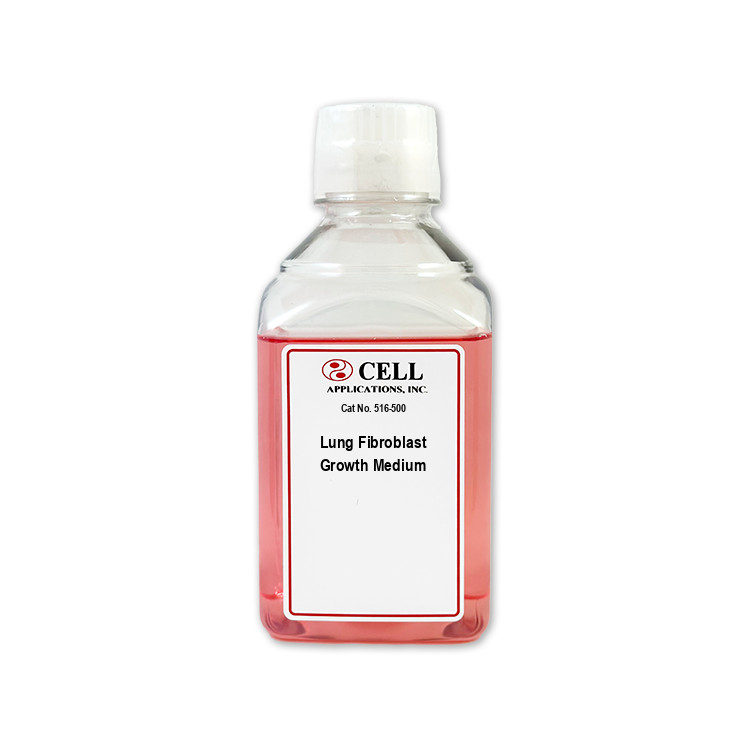
Human Lung Fibroblast Media
Human Lung Fibroblast Media
HLF Growth Medium: All-in-one ready-to-use
Type: Growth Medium
Size: 500 ml
Price: $136.00
Description

Human Lung Fibroblast Media are specialized fibroblast growth media designed to support the culture and expansion of human lung fibroblasts. It is intended for primary cells, including primary lung fibroblast cultures and other well-characterized human pulmonary fibroblast populations. The product is available as ready-to-use growth medium or as a basal medium and media supplement supplied separately to create the complete medium. Human lung fibroblasts are the intended cell type and quality is controlled for sterility, pH, osmolality, endotoxin, viability, morphology, growth, and cell-type-specific performance.
Lung fibroblasts are mesenchymal cells found throughout the connective-tissue compartments of the human lung, including the alveolar interstitium, airway wall, and regions surrounding blood vessels and airways. They are distinct from airway and alveolar epithelial cells, endothelial cells, smooth muscle cells, and immune cells, although these cell types communicate extensively in the lung. Lung fibroblasts contribute to the organization and maintenance of the pulmonary extracellular matrix by producing and remodeling collagen, elastin, fibronectin, proteoglycans, and other matrix components. They also release growth factors, cytokines, and lipid mediators that influence epithelial repair, vascular function, immune responses, and tissue remodeling.
In a healthy lung, fibroblasts help maintain the mechanical and biochemical properties of the tissue that allow a person to breathe and exchange oxygen and carbon dioxide efficiently. The lung must remain compliant while preserving the thin diffusion barrier between air and blood. Fibroblast-derived extracellular matrix contributes to tissue structure and mechanical support, but excessive matrix production or abnormal remodeling can increase tissue stiffness and impair lung function. Fibroblast activation is therefore relevant to pulmonary fibrosis, chronic obstructive pulmonary disease, asthma, pulmonary vascular disease, and repair after lung injury.
Human lung fibroblasts are useful models for studying extracellular-matrix synthesis, fibroblast proliferation and migration, wound repair, inflammatory signaling, myofibroblast differentiation, mechanotransduction, and responses to transforming growth factor beta and other growth factors. The fibroblast phenotype is influenced by the tissue region and disease state from which the cells are obtained. Fibroblasts from healthy lungs may differ substantially from those isolated from fibrotic or otherwise diseased tissue, and primary cultures may change with passage, substrate stiffness, serum exposure, and time in culture.
Human Lung Fibroblast Media provide nutrients and cell-supportive signals that help maintain cell attachment, viability, morphology, and reproducible growth in vitro. Supporting healthy cultures enables downstream cell culture applications, including gene-expression analysis, extracellular-matrix and collagen assays, cytokine-response studies, drug screening, toxicity testing, and co-culture models with epithelial, endothelial, or immune cells. Fibroblasts can also be incorporated into three-dimensional hydrogels, lung-on-chip systems, and selected organoid media workflows to investigate how matrix composition and stiffness affect pulmonary tissue repair and fibrosis.
The media are intended to support research involving normal human lung fibroblasts, disease-associated fibroblasts, and selected fibroblast cell lines. They are not universal media for all human cells or animal models. Mouse cells, rat primary cells, rabbit cells, and other species-specific fibroblasts may require different formulations. Likewise, epithelial cells, endothelial cells, smooth muscle cells, immune cells, tumor cells, primary hepatocytes, and stem-cell-derived lung populations have distinct nutritional and signaling requirements. Compatibility with these models—including cultures generated through custom cell isolation, cell biologics, or specialized cell-culture services—should be established experimentally.
Human lung fibroblast cultures can also be used in molecular biology workflows, including nucleic-acid delivery, CRISPR/Cas-associated genome editing, and reporter assays. While endothelial-specific vectors are better suited to endothelial models, fibroblast responses to endothelial-derived signals can be effectively evaluated using co-culture systems. For studies requiring cryopreservation, a validated cell freezing solution should be used rather than assuming that growth medium provides adequate protection during freezing.
Medium carefully optimized for the characteristics and requirements unique to Human Lung Fibroblasts. Attention to detail ensures ideal cell health, viability, performance, physiology, morphology, consistency and data.
Use with:
Details
CAI media are tested for sterility in order to confirm no bacteria, yeast or fungi contaminate the solutions. The products undergo further quality control for correct pH, osmolality and lack of endotoxins. A panel of different bioassays affirm the media sustain a proper environment for expected cell-type-specific culture, growth, plating, karyotype, physiology, morphology, viability, population doublings, surface markers, cryopreservation, differentiation and/or induction.
Laboratory research use only (RUO). Not for human, clinical, diagnostic or veterinary use.
 Powered by Bioz