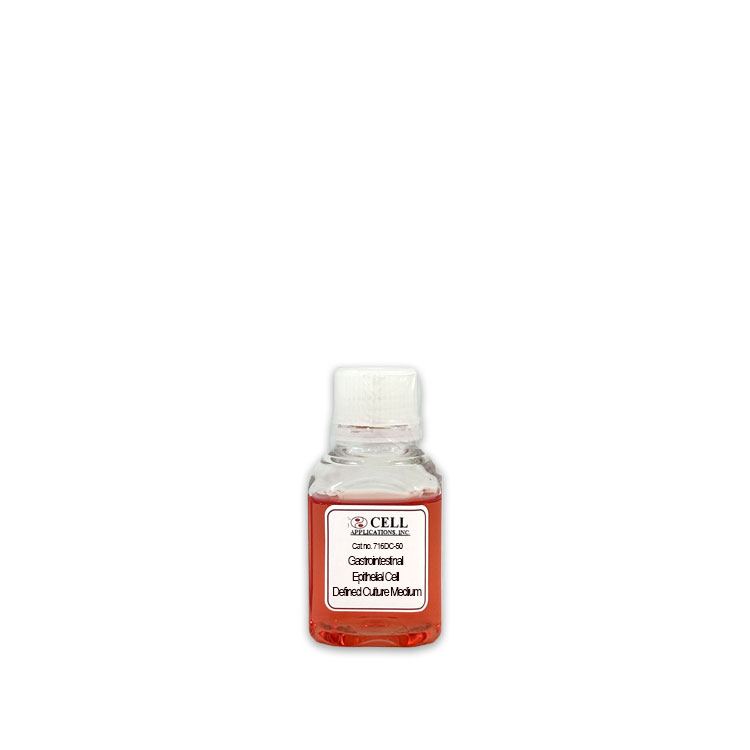
Human GI Epithelial Cell Medium
Human GI Epithelial Cell Media
GI Epithelial Cell Defined Culture Medium: All-in-one medium, includes antibiotics. Store at -20C. Once thawed, store at 4C and use within 4 weeks.
Description
Human GI Epithelial Cell Media is a specialized culture medium optimized to support primary human intestinal epithelial cells in vitro studies of intestinal epithelial biology. Intestinal epithelial cells are found lining the mucosal surfaces of the gastrointestinal tract, including the small intestine (for example, the villi and intestinal crypts) and the colon. In vivo, the intestinal epithelium coordinates nutrient absorption and regulated secretion, while maintaining an intestinal barrier that helps limit exposure to luminal antigens and shapes immune responses between epithelial cells and underlying immune cells.
In culture, Human GI Epithelial Cell Media supports primary cell culture of human intestinal epithelial cell models, including small intestine– and colon-derived epithelial systems. It helps maintain epithelial marker–associated properties, supporting epithelial marker expression and epithelial differentiation-related behavior in 2D primary cell culture formats. The medium is commonly used for research and studies of disease processes and epithelial dysfunction, including inflammatory bowel disease (IBD), where investigators may monitor epithelial injury, epithelial cell death, epithelial barrier changes, and immune-associated responses in epithelial-immune co-culture or challenge settings.
The media is also used in Transwell-style barrier models and other epithelial tissue culture systems designed to preserve barrier-like organization and epithelial responses under controlled culture conditions. While GI epithelial research increasingly uses intestinal organoid culture and stem cell–driven regenerative medicine approaches to model crypt architecture and lineage outcomes, Human GI Epithelial Cell Media is best understood as a supportive culture media component within broader organoid/3D workflows. In these systems, maintaining intestinal stem cells and specialized lineage programs typically relies on specialized, heavily supplemented stem cell niche factors; the medium helps provide a consistent baseline environment that supports epithelial growth alongside these niche supplements and 3D culture conditions.
Importantly, cell-type organization is anatomically distinct: Paneth cells are associated with small intestinal crypts (at the base of duodenal, jejunal, and ileal crypts) rather than healthy adult colon. Accordingly, Paneth cell–related findings in GI epithelial studies are typically interpreted in the context of small intestinal crypt-derived organoid or crypt culture models, including crypt-based research on epithelial turnover, regeneration, and disease-associated epithelial remodeling.
Overall, Human GI Epithelial Cell Media contributes to GI epithelial research by supporting reliable culture of primary human intestinal epithelium and enabling assay-driven studies of absorption, secretion, immune responses, and epithelial barrier health in both normal and diseased contexts.
Specialized media, optimized for the unique requirements of human GI Epithelial Cells. Carefully crafted, quality tested. CAI media are tested for sterility to confirm no bacteria, yeast or fungi contamination, and QC tests for correct pH, osmolality and lack of endotoxins. Bioassays affirm proper culture, growth, plating, karyotype, physiology, morphology, viability, population doublings, surface markers, cryopreservation, differentiation and/or induction.
Details
CAI media are tested for sterility in order to confirm no bacteria, yeast or fungi contaminate the solutions. The products undergo further quality control for correct pH, osmolality and lack of endotoxins. A panel of different bioassays affirm the media sustain a proper environment for expected cell-type-specific culture, growth, plating, karyotype, physiology, morphology, viability, population doublings, surface markers, cryopreservation, differentiation and/or induction.
Laboratory research use only (RUO). Not for human, clinical, diagnostic or veterinary use.
 Powered by Bioz