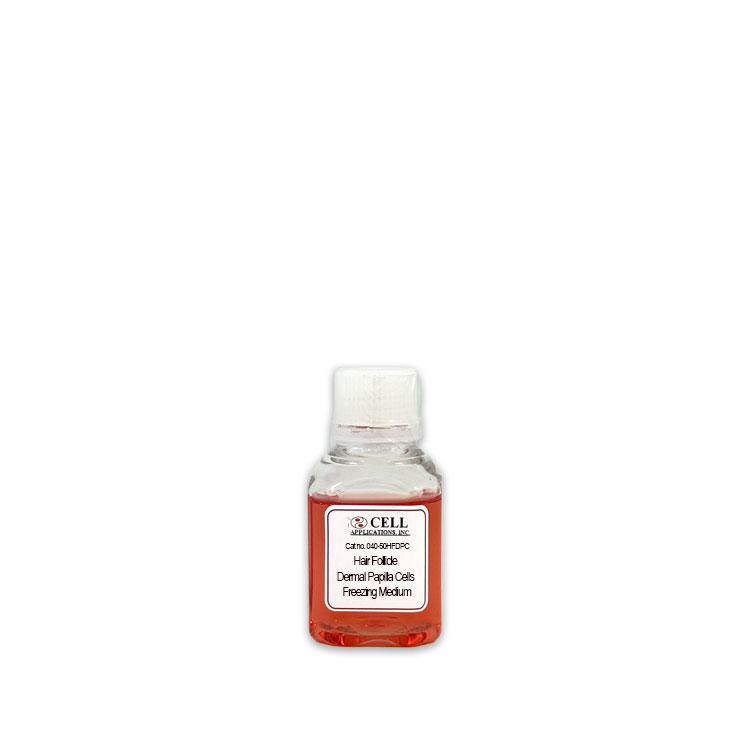
Human Hair Follicle Dermal Papilla Cell Freezing Media
Freezing Medium for HFDPC: Freezing Medium formulated specifically for Hair Follicle Dermal Papilla Cells (HFDPC)
Size: 50 ml
Price: $72.00
Description
Human Hair Follicle Dermal Papilla Cell Freezing Media are specialized cryopreservation formulations designed to support the freezing, long-term storage in liquid nitrogen, and post-thaw recovery of primary human hair-follicle dermal papilla cells (HFDPC).
Human hair-follicle dermal papilla cells are specialized mesenchymal cells located at the base of the hair bulb within the dermal hair papilla of the skin. They function as a pivotal signaling center regulating the hair growth cycle by producing growth factors, cytokines, and other signaling molecules, depositing extracellular matrix components, and driving essential epithelial-mesenchymal interactions with surrounding follicular stem cell and epithelial populations to orchestrate hair growth and morphogenesis. The phenotype and functional properties of these primary human dermal papilla cells may vary depending on donor source, hair cycle stage, cell culture isolation methods, passage number, and overall laboratory culture media conditions.
Because primary hair follicle cells can be sensitive to dissociation, temperature shifts, and cryoprotectant exposure, an appropriate cryopreservation medium and validated freezing and thawing protocols are important for supporting cell growth, cell proliferation, attachment, and post-thaw recovery. After enzymatic detachment using trypsin solution, neutralization of the dissociation reagent, and centrifugation to obtain a cell pellet, cells are resuspended in dedicated freezing media and dispensed into cryovials. Cryoprotective components, in conjunction with proper cell density and controlled-rate cooling, help reduce cellular injury associated with intracellular ice crystal formation and osmotic stress during freezing.
Cryovials should be frozen using a validated controlled-rate cooling procedure before being transferred to liquid nitrogen storage for long-term storage. Dry ice may be used for temporary transport or short-term holding of already frozen vials, but it should not be presented as a substitute for controlled-rate freezing or liquid nitrogen storage conditions.
Because the formulation contains DMSO as a cryoprotectant, exposure time, handling temperature, and cooling rate should be controlled according to the product instructions, because cryoprotectants can be cytotoxic at excessive concentrations or after prolonged exposure at temperatures above the recommended handling temperature. Human Hair Follicle Dermal Papilla Cell Freezing Media supports the cryopreservation of consistent primary cells for research use, enabling downstream studies in hair follicle biology, alopecia mechanisms, dermatological toxicity, and the evaluation of potential hair growth products. Following post-thaw recovery, well-characterized human dermal papilla cells can be used to investigate cell signaling pathways, gene expression, and protein localization using assays such as immunofluorescence using primary and secondary antibodies, ELISA, and molecular biology workflows.
These formulations are intended for research use only and do not guarantee the preservation of all native dermal papilla functions or hair-inductive properties after freezing, thawing, and extended cell culture expansion. Before cryopreservation, primary cell culture stocks should be assessed for identity, morphology, cell viability, and microbial contamination. Routine mycoplasma detection and contamination monitoring are critical precautions for maintaining the quality of cryopreserved cell stocks and preventing cross-contamination of stored cell lines or primary cell inventories. Post-thaw cell growth, viability, attachment, morphology, and any application-specific functional markers should always be evaluated after recovery.
CAI offers freezing media that provides optimal cell survival and recovery after storage. Note that some cells require their own specialized freezing medium, while most other cells respond well to our regular freezing medium.