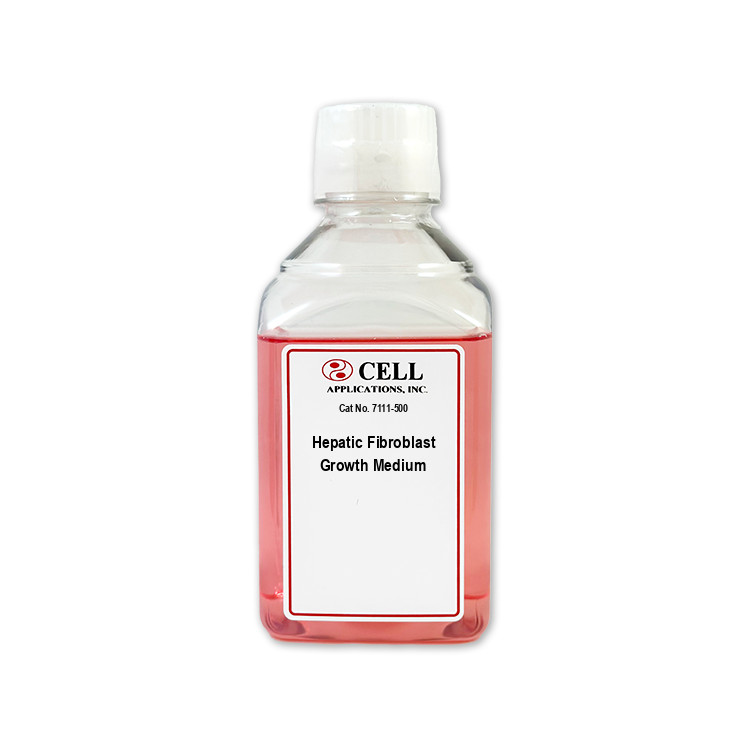
Human Hepatic Duct Fibroblast Media
Human Hepatic Duct Fibroblast Media
Human Hepatic Duct Fibroblast Growth Medium: All-in-one ready-to-use
Type: Growth Medium
Size: 500 ml
Price: $150.00
Description

Human Hepatic Duct Fibroblast Media is a specialized formulation designed to support the attachment, viability, growth, and expansion of primary human hepatic duct fibroblasts in vitro.
Hepatic duct fibroblasts, also referred to in the literature as portal or peribiliary fibroblasts, are resident mesenchymal cells found within portal tracts and the connective-tissue regions surrounding intrahepatic bile ducts. They reside in close structural and paracrine association with cholangiocytes, the epithelial cells that line the biliary tree.
Under homeostatic conditions, these fibroblasts contribute to portal-tract and biliary-tree architecture by producing and remodeling extracellular-matrix components. They also participate in signaling interactions with cholangiocytes, endothelial cells, immune cells, and other stromal populations. Although hepatic duct fibroblasts and hepatic stellate cells share some mesenchymal and matrix-related functions, they are distinct and heterogeneous populations with different anatomical locations, phenotypic markers, and responses to injury.
In response to cholestatic injury, bile-duct obstruction, inflammatory signaling, or other forms of biliary stress, portal fibroblasts can proliferate and acquire activated myofibroblast-like properties, including increased extracellular-matrix production. They are particularly relevant to biliary fibrosis and diseases involving chronic cholangiocyte injury. Hepatic stellate cells also contribute substantially to liver fibrogenesis, and the relative contribution of each fibroblast population depends on the type, stage, and location of liver injury.
Human Hepatic Duct Fibroblast Media provides growth-supporting conditions for primary human hepatic duct fibroblasts and may facilitate their maintenance and expansion for in vitro research. These cultures may be useful for investigating biliary-tract biology, cholangiocyte–stromal interactions, extracellular-matrix remodeling, liver and biliary toxicity, fibrosis mechanisms, and candidate antifibrotic therapies. Culture performance, phenotype stability, and application-specific responses should be validated for the donor, passage number, and experimental conditions.
Medium carefully optimized for the characteristics and requirements unique to Human Hepatic Duct Fibroblasts. Attention to detail ensures ideal cell health, viability, performance, physiology, morphology, consistency and data.
Use with:
Details
CAI media are tested for sterility in order to confirm no bacteria, yeast or fungi contaminate the solutions. The products undergo further quality control for correct pH, osmolality and lack of endotoxins. A panel of different bioassays affirm the media sustain a proper environment for expected cell-type-specific culture, growth, plating, karyotype, physiology, morphology, viability, population doublings, surface markers, cryopreservation, differentiation and/or induction.
Laboratory research use only (RUO). Not for human, clinical, diagnostic or veterinary use.