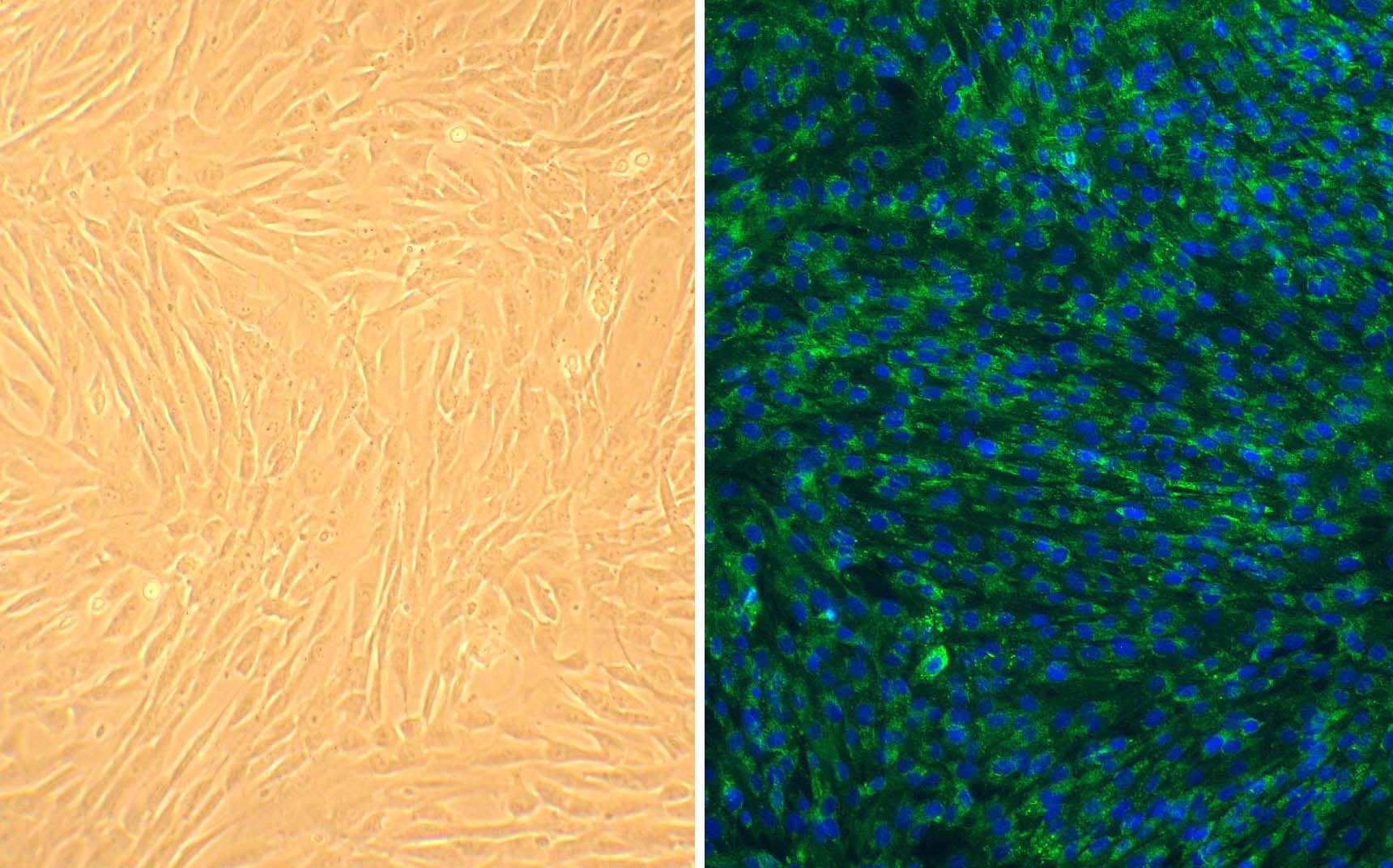
Human Hepatic Duct Fibroblasts: HHDF, Left: phase contrast, Right: HHDF immunostained for fibroblast surface protein (green) and nuclei are stained with DAPI.
Human Hepatic Duct Fibroblasts: HHDF
Human Hepatic Duct Fibroblasts (HHDF) represent a specialized subset of portal fibroblasts, which are subepithelial stromal cells situated within the portal tracts of the liver.
Description
Human Hepatic Duct Fibroblasts (HHDF) represent a specialized subset of portal fibroblasts, which are subepithelial stromal cells situated within the portal tracts of the liver. These cells are critical regulators of biliary homeostasis, providing essential structural and paracrine support to the bile duct architecture. While frequently discussed alongside hepatic stellate cells — which primarily reside in the space of Disse — HHDF exhibit distinct phenotypic and functional profiles that are uniquely relevant to human pathophysiology, particularly when compared to findings in rodent models.
In the normal liver, these mesenchymal cells contribute to the structural integrity of the portal vein and bile ductules by secreting and organizing the local extracellular matrix. Their role in maintaining tissue architecture makes them a vital subject for studying liver physiology and the underlying mechanisms of chronic liver disease.
HHDF are central participants in the progression of liver disease, particularly in conditions characterized by billiary fibrosis and other forms of hepatic fibrosis. Upon chronic stimulation or sustained liver injury, these cells undergo an activation process, transdifferentiating into portal myofibroblasts. This transition is marked by the increased expression of alpha smooth muscle actin and a massive, dysregulated deposition of collagenous matrix.
In the context of a cirrhotic liver, the interaction between these activated fibroblasts and surrounding epithelial cells (specifically the bile duct epithelia) dictates the severity of scarring. By studying these cells in culture, researchers can map the complex signaling pathways that govern the transition from liver repair to pathological fibrosis, offering insights that are often obscured in broader studies of hepatocytes or systemic mesenchymal models.
Primary cultures of HHDF are an indispensable tool for cell based assays, including drug screening, toxicity testing, and metabolic profiling. To better mimic in vivo conditions, researchers increasingly employ HHDF-cholangiocyte co-culture systems, which recapitulate the paracrine signaling driving biliary fibrosis. While HHDF provide critical insights into portal-based fibrosis, their role in systemic metabolic diseases (e.g., NASH) is complemented by studies of hepatic stellate cells and Kupffer cells.
1. Translational Significance
HHDF are essential for understanding the molecular “crosstalk” that triggers fibrotic liver development. While studies using mice provide necessary in vivo context, human-derived HHDF are essential for ensuring translational accuracy when investigating the transition from a healthy to a cirrhotic state in patients.
2. Specialized Functional Modeling
By differentiating the roles of stellate cells from portal fibroblasts, scientists can better characterize the cellular origins of scar tissue. This distinction is critical for identifying novel therapeutic targets capable of reversing or halting the progression of chronic liver failure. As researchers continue to refine mesh terms and standardized protocols for these cells, HHDF remain a primary choice for investigating the nuanced dynamics of the hepatic microenvironment.
Human Hepatic Duct Fibroblasts (HHDF) are unique cell type that play an important role in liver homeostasis and maintenance. Primary culture of Hepatic Duct Fibroblasts is suitable for many cell-based assays including toxicity, drug screening and metabolism and is a valuable tool to study liver function, physiology and related liver diseases.
Details
| Tissue | Normal healthy human liver tissue | |
|---|---|---|
| QC | No bacteria, yeast, fungi, mycoplasma, virus | |
| Bioassay | Attach, spread, proliferate in Growth Med | |
| Cryovial | 500,000 HHDF (2nd passage) frozen in Basal Medium w/ 10% FBS, 10% DMSO | |
| Kit | Cryovial frozen HHDF (702-05f), Growth Medium (7111-500), Subcltr Rgnt Kit (090K) | |
| Proliferating | Shipped in Gr Med, 2nd psg (flasks or plates) | |
| Doublings | At least 15 | |
| Applications | Laboratory research use only (RUO). Not for human, clinical, diagnostic or veterinary use. |
Resources
FAQs
Need More Help?
Visit our comprehensive FAQ page for detailed answers to common questions.
Need More Help?
Visit our comprehensive FAQ page for detailed answers to common questions.
Primary Cell FAQs