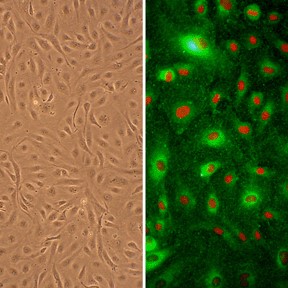
Human Umbilical Artery Endothelial Cells: HUAEC
Human Umbilical Artery Endothelial Cells (HUAEC) are specialized primary cell populations isolated from the arterial component of the umbilical cord.
Description
- Arterial Identity: Research indicates that HUAEC exhibit gene expression and metabolic profiles that can differentiate them from the human umbilical vein. However, the maintenance of this “arterial” identity in vitro is complex and dependent upon variables such as donor gestational factors, the specific isolation method, the passage number, and the culture environment.
- Functional Responsiveness: These vascular endothelial cells are sensitive to chemical and mechanical stimuli, such as oxidative stress or inflammatory cues. They are utilized to examine endothelial dysfunction — a precursor to many vascular diseases — and to characterize the expression of adhesion molecules (such as selectins and ICAMs) that govern leukocyte recruitment during inflammation. Importantly, investigating mechanisms like barrier function in response to mechanical stimulation often requires the application of controlled stimuli, such as shear stress, via specialized flow systems.
. HUAEC are applied in diverse studies seeking an endothelium that aligns with arterial-like characteristics:
- Angiogenesis and Tumor Biology: HUAEC are used to investigate how soluble factors, including those derived from tumor cells, influence the endothelial cell surface and signaling landscape, contributing to the recruitment and interactions required during pathological angiogenesis.
- Atherosclerosis and Cell Signaling: By modeling the interaction between the endothelium and systemic factors (like oxidized lipids), HUAEC provide insights into early cellular responses to injury and the impact of disturbed flow on endothelial function.
- Integrative Research: Researchers leverage these cells to study the crosstalk between the endothelium and other tissue types, including skeletal muscle progenitors and their interactions with stem cell differentiation kits, highlighting their utility in broader regenerative medicine.
To support robust cell proliferation and the preservation of specific cellular phenotypes, HUAEC require careful selection of an endothelial cell growth medium and an appropriate human EC growth supplement. It is well-documented that endothelial phenotype is highly responsive to culture conditions; therefore, rigorous control of the endothelial cell growth medium composition and passage number is necessary to mitigate the phenotypic drift that can occur over time. While various media formulations exist, researchers must validate that their chosen conditions are sufficient for their specific experimental endpoints — whether analyzing HUVEC RNA expression profiles or assessing cell growth — to ensure that observations regarding vascular endothelial cells remain consistent and reproducible. HUAEC represent a vital, arterial-derived tool that complements the more commonly used umbilical vein models. By reflecting the responses of the arterial endothelium to various stressors, HUAEC enable investigators to explore mechanisms relevant to human cardiovascular health, providing essential data for fundamental research aimed at understanding vascular disorders.
Details
| Tissue | Normal healthy human umbilical arteries |
|---|---|
| QC | No bacteria, yeast, fungi, mycoplasma, virus |
| Character | Factor VIII-related Ag, DiI-Ac-LDL |
| Bioassay | Attach, spread, proliferate in Growth Med |
| Cryovial | 500,000 HUAEC (2nd passage) frozen in Basal Medium w/ 10% FBS, 10% DMSO |
| Kit | Cryovial frozen HUAEC, Growth Medium (212-500), Subculture Rgnt Kit (090K) |
| Proliferating | Shipped in Gr Med, 3rd psg (flasks or plates) |
| Doublings | At least 15 |
| Applications | Laboratory research use only (RUO). Not for human, clinical, diagnostic or veterinary use. |
Resources
FAQs
Need More Help?
Visit our comprehensive FAQ page for detailed answers to common questions.
Need More Help?
Visit our comprehensive FAQ page for detailed answers to common questions.
Primary Cell FAQs Powered by Bioz