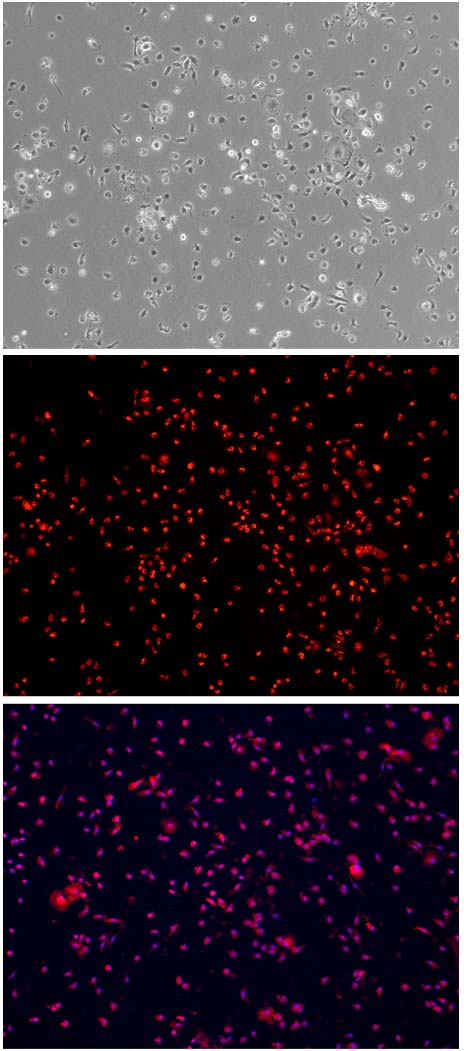
Rat Kupffer Cells: RKC Top: RKC culture on day 6, Middle: DiI-Ac-LDL uptake in RKC on day 6, Bottom: Immunostaining in RKC culture on day 6 for F4/80 (red) and DAPI (blue).
Rat Kupffer Cells: RKC
Rat Kupffer cells (RKC) are the specialized, resident macrophage population of the hepatic tissue lining the walls of the sinusoids in the liver.
Description
Rat Kupffer cells (RKC) are the specialized, resident macrophage population of the hepatic tissue. As a distinct kupffer cell type isolated from rats, these cells represent a critical component of the mononuclear phagocytic system. Similar to their counterparts in the mouse, they are immunologically characterized by positive F4/80 immunocytochemistry (ICC) staining, serving as the primary innate immune guardians of the hepatic environment.
In the living organism, these cells reside within the rat liver, specifically lining the walls of the hepatic sinusoids. Adhered to the sinusoidal endothelial cell layer, they are exposed directly to blood entering from the gastrointestinal tract and sit in close anatomical proximity to parenchymal hepatocytes, positioning them perfectly to sample circulating antigens.
The primary physiological role of these cells is maintaining liver homeostasis through rapid, highly efficient phagocytosis. They continuously clear bloodborne pathogens, fungi, cellular debris, and apoptotic cells. Upon encountering metabolic stressors or a bacterial endotoxin, kupffer cell activation occurs. This shift prompts the cells to generate reactive oxygen species and release potent mediators, including pro inflammatory cytokines. While this localized inflammatory response is vital for host defense, persistent or unchecked inflammation leads to chronic liver inflammation, which can disrupt adjacent hepatocyte function and drive tissue damage.
For experimental use, RKC serve as an excellent in vitro model system to investigate the development and progression of liver disease, including drug-induced liver injury, nonalcoholic steatohepatitis (NASH), and hepatic fibrosis. Primary cultures are widely utilized in cell-based toxicity assays and drug screening. Furthermore, integrating these macrophages into a hepatocyte cell culture system allows researchers to study complex cellular cross-talk, yielding data that is highly translatable to human liver tissue. This research provides valuable insights into clinical procedures like liver transplantation, where understanding the immune profile of the hepatic donor source is critical to preventing graft rejection.
Rat Kupffer cells (RKC) are specialized macrophages lining the walls of the sinusoids in the liver. These macrophages are critical component of the mononuclear phagocytic system and associated with a variety of disease states including drug-induced liver injury, nonalcoholic fatty liver diseases (NASH) and hepatic fibrosis.
Rat Kupffer cells from Cell Applications, Inc. provide an excellent model system to study many aspects of human liver function, metabolism and pathophysiology. Primary culture of Rat Kupffer cells is suitable for cell-based assays including toxicity, drug screening and disease modeling, and is a valuable tool to study liver physiology and associated diseases.
Characterization: Positive for F4/80 by ICC staining.
Details
| Tissue | Normal healthy rat liver tissue | |
|---|---|---|
| QC | No bacteria, yeast, fungi, mycoplasma, virus | |
| Bioassay | Attach, spread in culture Medium | |
| Cryovial | 1,000,000 RKC frozen in Macrophage Freezing Medium | |
| Kit | Cryovial frozen RKC (R784-10n), Culture Medium (R7119-500) | |
| Proliferating | Shipped in flasks or plates in medium | |
| Doublings | Cells do not divide, and cannot be passaged | |
| Applications | Laboratory research use only (RUO). Not for human, clinical, diagnostic or veterinary use. |
Resources
FAQs
Need More Help?
Visit our comprehensive FAQ page for detailed answers to common questions.
Need More Help?
Visit our comprehensive FAQ page for detailed answers to common questions.
Primary Cell FAQs