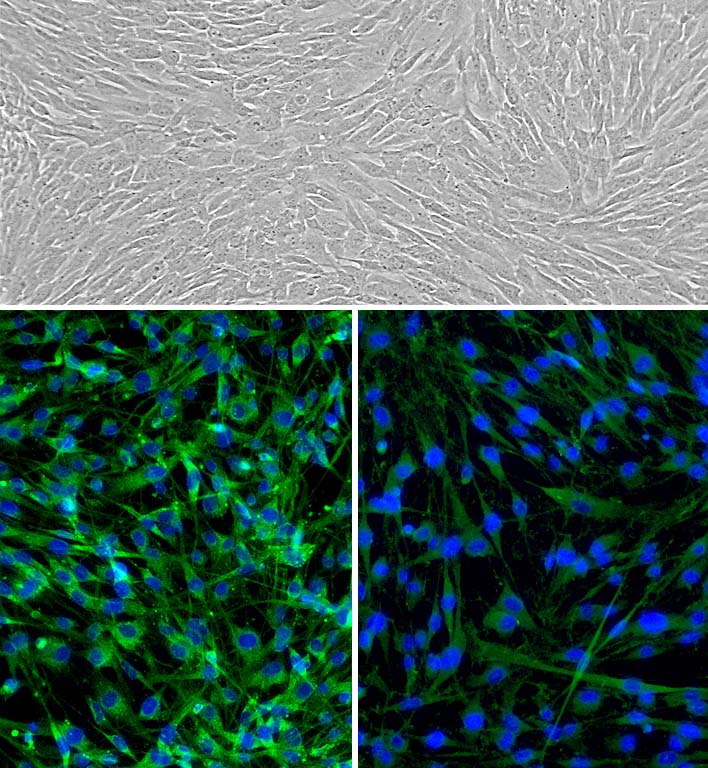
Human Gall Bladder Fibroblasts: HGBF Top: phase contrast, Bottom left: HGBF immunolabeled for fibroblast surface protein(green), Bottom right: fibronectin (green), nuclei are stained with DAPI.
Human Gall Bladder Fibroblasts: HGBF
Human Gall Bladder Fibroblasts (HGBF) are primary fibroblast cell populations derived from healthy human gallbladder tissue.
Description
Human Gall Bladder Fibroblasts (HGBF) are primary cell populations derived from healthy human gallbladder tissue. The gallbladder is located beneath the liver and serves an important physiological function in storing, concentrating, and releasing bile into the digestive system.
In vivo, these connective tissue cells reside within the gallbladder wall, where they contribute to structural support, extracellular matrix organization, and tissue homeostasis alongside neighboring cell populations such as smooth muscle cells and human gallbladder epithelial cells. In biomedical research, Human Gall Bladder Fibroblasts (HGBF) provide an excellent model system to study gallbladder function, physiology, and related diseases. Cultured in specialized gall bladder fibroblast medium, HGBF can typically propagate for up to 10 population doublings under recommended conditions.
Researchers can use these cell models for various cell-based assays — including toxicity testing, drug screening, and metabolism studies — as well as to investigate pathological processes relevant to acute cholecystitis, chronic stimulation, and tissue wound healing. Furthermore, researchers frequently utilize HGBF in cancer research and cell proliferation studies, comparing fibroblast behavior with cancer cells and stable cell lines derived from human gallbladder cancer or gallbladder carcinoma to explore gene expression, extracellular matrix remodeling (such as type III collagen dynamics), and tumor microenvironment interactions.
Investigators typically characterize these cultures by confirming positive expression for fibroblast surface protein and fibronectin using immunocytochemistry (ICC) staining.
HGBF from Cell Applications, Inc. provide an excellent model system to study gall bladder function and pathophysiology. Human Gall Bladder Fibroblasts are suitable for many cell-based assays including toxicity, drug screening and metabolism to study gall bladder function, physiology and related diseases.
HGBF are cultured in Gall Bladder Fibroblast Growth Medium and can propagate to 10 population doublings when cultured under the recommended conditions.
Characterization: Positive for fibroblast surface protein and fibronectin expression by ICC staining.
Details
| Tissue | Normal healthy human gall bladder | |
|---|---|---|
| QC | No bacteria, yeast, fungi, mycoplasma, virus | |
| Bioassay | Attach, spread, proliferate in Growth Med | |
| Cryovial | 500,000 HGBF frozen in Basal Medium w/ 10% FBS, 10% DMSO | |
| Kit | Cryovial frozen HGBF (704-05f), Growth Medium (7113-500), Subcltr Rgnt Kit (090K) | |
| Proliferating | Shipped in Gr Med, flasks or plates | |
| Doublings | At least 10 | |
| Applications | Laboratory research use only (RUO). Not for human, clinical, diagnostic or veterinary use. |
Resources
FAQs
Need More Help?
Visit our comprehensive FAQ page for detailed answers to common questions.
Need More Help?
Visit our comprehensive FAQ page for detailed answers to common questions.
Primary Cell FAQs