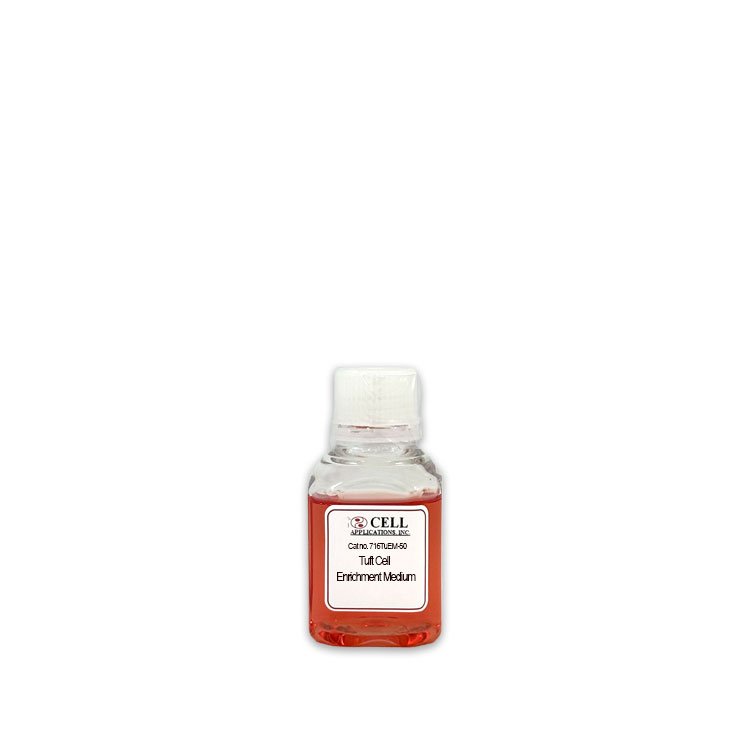
Human Tuft Cell Media
Human Tuft Cell Media
Tuft Cell Enrichment Medium: Enrichment Medium
Type: Enrichment Medium
Size: Yields 50 ml
Price: $91.00
Description
Human Tuft Cell Media is a specialized enrichment formulation developed to support the culture, viability, and maintenance of tuft-cell-containing human epithelial preparations in vitro. The medium provides defined biochemical signaling components intended to support primary cells, preserve cellular morphology, and enable experimental assessment of tuft-cell-associated chemosensory and mucosal functions. Because tuft cells are rare, heterogeneous, and sensitive to tissue source and culture conditions, researchers should confirm tuft-cell identity and functional state using complementary phenotypic and molecular assays.
Tuft cells are rare, solitary specialized epithelial cells distributed throughout the gastrointestinal (GI) tract, as well as in related chemosensory epithelial populations within the respiratory and pancreaticobiliary systems. Morphologically, they are distinguished by a prominent, tufted apical display of long, actin-rich microvilli that extend into the lumen. In the human intestine, tuft cells arise from intestinal epithelial progenitor populations and exhibit regionally distinct states along the crypt-villus axis. Recent human studies indicate that many intestinal tuft cells are concentrated in mucosal crypts, while other tuft-cell populations populate the villi and show distinct patterns of maturation and functional specialization across the GI tract.
Tuft cells function as chemoreceptive sentinels, expressing key components of taste-receptor-associated signaling pathways, G-protein signaling machinery, TRPM5, and — in specific intestinal regions and cell states — the succinate receptor SUCNR1 to monitor luminal danger signals and microbial metabolites. Upon stimulation, tuft cells synthesize and release diverse paracrine and immune mediators, including IL-25, acetylcholine, prostaglandins, and cysteinyl leukotrienes. These secreted factors coordinate responses across neighboring epithelial cells, mucosal immune cells, and underlying enteric neural or stromal networks. While the best-characterized tuft-cell–ILC2 circuit involves IL-25-driven type 2 immune defenses during helminth infection in animal models, human tuft-cell functional responses remain a dynamic area of translational research.
Human Tuft Cell Media provides a primary human-cell and epithelial-culture platform for investigating tuft-cell biology, mucosal physiology, and epithelial–immune interactions across the gastrointestinal tract, including:
- Host–Microbe and Parasite Interactions: Studying tuft-cell responses to microbial metabolites, helminth-derived signals, and luminal danger cues in 2D and 3D intestinal epithelial models.
- Mucosal Immune Signaling: Quantifying IL-25, eicosanoid, and acetylcholine-associated pathways, and examining their paracrine effects on adjacent epithelial cells and mucosal immune populations.
- Chemosensory Signaling: Dissecting chemoreceptive mechanisms, taste-receptor-associated pathways, SUCNR1 or TRPM5 signaling cascades, and intracellular calcium responses to defined chemical stimuli.
- Organoid and Lineage Studies: Enriching and characterizing tuft-cell populations across crypts and villi in two-dimensional epithelial monolayers and three-dimensional intestinal organoids under controlled, xeno-free or defined culture conditions.
Tuft cells are a key intestinal epithelial cell type found in gastrointestinal (GI) tract, responsible for promoting intestinal epithelial cells proliferation, activation of immune responses and protective roles in GI diseases such as colitis and colorectal cancer.
Cell Applications, Inc. offers specialized medium optimized for enrichment of Tuft Cells. Attention to detail ensures ideal cell health, viability, performance, physiology, morphology, consistency and data.
Details
CAI media are tested for sterility in order to confirm no bacteria, yeast or fungi contaminate the solutions. The products undergo further quality control for correct pH, osmolality and lack of endotoxins. A panel of different bioassays affirm the media sustain a proper environment for expected cell-type-specific culture, growth, plating, karyotype, physiology, morphology, viability, population doublings, surface markers, cryopreservation, differentiation and/or induction.
Laboratory research use only (RUO). Not for human, clinical, diagnostic or veterinary use.