Coating Solution
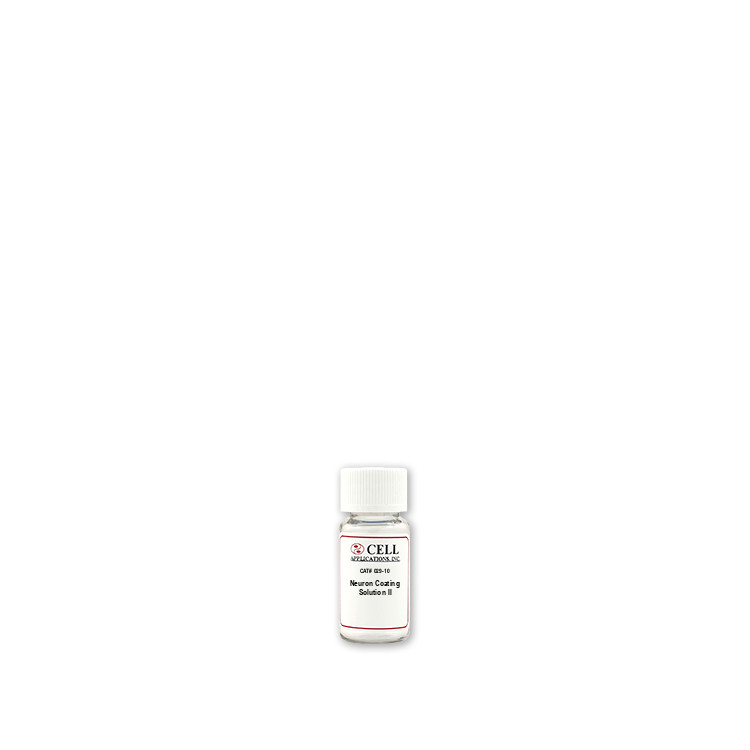
Neuron Coating Solution II
Neuron Coating Solution II: Poly-D-Lysine and Laminin coating solution for neurons, especially RDGRN and HBN.
Description
Neuron Coating Solution II is an advanced, specialized biocompatible reagent designed to optimize culture vessel surfaces for primary and continuous cells, helping promote strong attachment, healthy morphology, and long-term viability in vitro. By creating a uniform, cell-friendly substrate, it supports the culture of complex neural populations and related cell models with consistency and confidence.
In the nervous system, a typical neuron is a highly polarized cell specialized for integrating and transmitting electrochemical signals. It contains a central soma, branching dendrites that receive synaptic inputs, and a long axon that conducts action potentials. During development and in culture, neurons extend neurites that mature into axons and dendrites, supporting synapse formation across the brain.
These cells are found throughout the central and peripheral nervous systems, including the cerebral cortex, striatum, spinal cord, and peripheral ganglia. The cerebral cortex contains cortical networks involved in higher cognitive processing, while the striatum includes medium spiny neurons influenced by dopamine signaling and receptor pathways. Dorsal root ganglia contain sensory neurons that detect environmental stimuli and transmit signals to the spinal cord. Beyond primary tissues, neuroblastoma and hybridoma cell lines are also widely used to investigate fundamental neurobiology.
For studies of neurogenesis, neurotransmission, and neurodegenerative disease models in vitro, stable and well-adhered cultures are essential. Neuron Coating Solution II helps prepare culture surfaces to support these intricate cellular architectures and enable reproducible, high-quality neurological research.
Cells adhere to one another and to the extracellular matrix during normal physiology and development, but also in pathological conditions such as chronic inflammation and tumor metastasis.
For example, during extravasation from blood vessels into the tissue space, leukocytes first weakly adhere to and roll upon vascular endothelial cells via cell surface receptors known as selectins. Subsequent, stronger adhesion ensues using other receptors and ligands, such as LFA-1 and ICAM-1. Transendothelial migration follows, where the leukocytes squeeze between the tight endothelial cell junctions. As a final impediment to entering the tissue space, the leukocytes encounter the basement membrane, a mixture of extracellular components that ensheathes the vessel. The leukocytes utilize still other receptors to bind ECM, and also secrete matrix-degrading enzymes to facilitate their passage. Unfortunately, tumor cells utilze a similar mechanism as they spread to distant parts of the body during metastasis.
Organs and tissues of the body also contain extensive networks of extracellular matrix, acting as structural scaffolding and regulating cell adhesion, migration and behavior. Finally certain cells, when cultured in vitro, behave more robustly when adhering to a cell culture vessel coated with an ECM analog, component or other attachment factor. Thus, the study of cell adhesion remains an area of particular interest to cell biologists.
Details
| Attachment Factor Solution | |
| Components: | Bovine Gelatin |
| Cell Types: | Various, especially Endothelial Cells (Required for microvascular ECs) |
| Applications: | Promotes attachment and spreading of endothelial cells |
| Collagen Coated T-75 Flask | |
| Components: | Bovine Collagen |
| Cell Types: | Various, including HFDPC |
| Applications: | For attachment and spreading of cells |
| Collagen Coating Solution | |
| Components: | Bovine Collagen |
| Cell Types: | Various |
| Applications: | For coating plates, flasks and dishes to promote cell attachment |
| EHS Matrix Extract (with and w/out Phenol Red) | |
| Componenets | Heterogeneous mix of extracellular matrix / basement membrane components: Laminin, entactin, collagen, HSPG, growth factors extracted from mouse Engelbreth-Holm-Swarm tumor |
| Cell Types: | Various |
| Applications: | For culturing cells where adhesion is dependent upon ECM-coated surface |
| Extracellular Matrix Attachment Factor Solution | |
| Components: | Bovine Fibronectin & Gelatin |
| Cell Types: | Various, especially Endothelial Cells |
| Applications: | Promotes cell attachment & spreading. Prevents endothelial cell monolayer from peeling under shear stress. |
| Extracellular Matrix Protein Coated T-25 flasks | |
| Components: | Bovine Fibronectin & Gelatin |
| Cell Types: | Various, especially Endothelial Cells |
| Applications: | For culturing cells where adhesion is dependent upon ECM-coated surface |
| Neuron Coating Solution I | |
| Components: | Poly-D-Lysine |
| Cell Types: | Neurons |
| Applications: | For the coating of cell cultureware to enhance adhesion |
| Neuron Coating Solution II | |
| Components: | Poly-D-Lysine |
| Cell Types: | Neurons, especially RDRGN & HBN |
| Applications: | For the coating of cell cultureware to enhance adhesion |
| Poly-D-Lysine & Laminin | |
| Components: | Poly-D-Lysine, Mouse Laminin |
| Cell Types: | Various |
| Applications: | For culturing cells where adhesion is dependent upon ECM-coated surface |
| Rat Tail Collagen Coating Solution | |
| Components: | Rat Tail Collagen |
| Cell Types: | Various, especially Endothelial Cells, Hepatocytes, Muscle Cells |
| Applications: | For coating plates, flasks and dishes to promote cell attachment |
| Rat Tail Collagen Solution | |
| Components: | Rat Tail Collagen |
| Cell Types: | Various, especially Endothelial Cells, Hepatocytes, Muscle Cells |
| Applications: | Enhances cell attachment and proliferation, or promotion of cell-specific morphology and function |
Need help choosing? See our Media Selection Guide
 Powered by Bioz