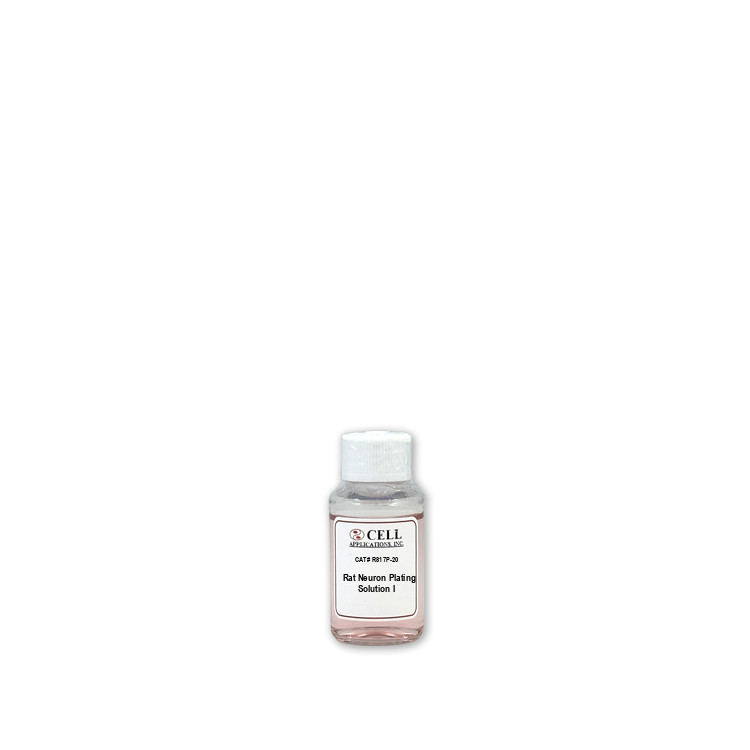
Plating Solution
Plating Solutions
Plating Solution: For initial plating of neurons
Description
Plating Solutions are specialized formulations designed to support the delicate initial seeding of primary neural cells in vitro. By helping reduce stress associated with tissue dissociation, these solutions provide a supportive environment for freshly isolated cells, including hippocampal and cortical neurons from mouse and rat models.
In the nervous system, these highly specialized cells form interconnected networks that receive, integrate, and transmit electrochemical signals involved in sensory processing, motor control, learning, and memory. After isolation or thawing, primary neural cultures are especially sensitive to the plating environment, making the initial attachment step critical for culture success.
Plating Solutions help promote cell attachment and support efficient adhesion of dissociated cells to pre-coated culture vessels. This can help improve early cell survival and support more consistent, reproducible cultures for downstream applications such as electrophysiology, synaptogenesis assays, neurotoxicity screening, and neurological disease modeling.
Cells adhere to one another and to the extracellular matrix during normal physiology and development, but also in pathological conditions such as chronic inflammation and tumor metastasis.
For example, during extravasation from blood vessels into the tissue space, leukocytes first weakly adhere to and roll upon vascular endothelial cells via cell surface receptors known as selectins. Subsequent, stronger adhesion ensues using other receptors and ligands, such as LFA-1 and ICAM-1. Transendothelial migration follows, where the leukocytes squeeze between the tight endothelial cell junctions. As a final impediment to entering the tissue space, the leukocytes encounter the basement membrane, a mixture of extracellular components that ensheathes the vessel. The leukocytes utilize still other receptors to bind ECM, and also secrete matrix-degrading enzymes to facilitate their passage. Unfortunately, tumor cells utilze a similar mechanism as they spread to distant parts of the body during metastasis.
Organs and tissues of the body also contain extensive networks of extracellular matrix, acting as structural scaffolding and regulating cell adhesion, migration and behavior. Finally certain cells, when cultured in vitro, behave more robustly when adhering to a cell culture vessel coated with an ECM analog, component or other attachment factor. Thus, the study of cell adhesion remains an area of particular interest to cell biologists.
Details
| Attachment Factor Solution | |
| Components: | Bovine Gelatin |
| Cell Types: | Various, especially Endothelial Cells (Required for microvascular ECs) |
| Applications: | Promotes attachment and spreading of endothelial cells |
| Collagen Coated T-75 Flask | |
| Components: | Bovine Collagen |
| Cell Types: | Various, including HFDPC |
| Applications: | For attachment and spreading of cells |
| Collagen Coating Solution | |
| Components: | Bovine Collagen |
| Cell Types: | Various |
| Applications: | For coating plates, flasks and dishes to promote cell attachment |
| EHS Matrix Extract (with and w/out Phenol Red) | |
| Componenets | Heterogeneous mix of extracellular matrix / basement membrane components: Laminin, entactin, collagen, HSPG, growth factors extracted from mouse Engelbreth-Holm-Swarm tumor |
| Cell Types: | Various |
| Applications: | For culturing cells where adhesion is dependent upon ECM-coated surface |
| Extracellular Matrix Attachment Factor Solution | |
| Components: | Bovine Fibronectin & Gelatin |
| Cell Types: | Various, especially Endothelial Cells |
| Applications: | Promotes cell attachment & spreading. Prevents endothelial cell monolayer from peeling under shear stress. |
| Extracellular Matrix Protein Coated T-25 flasks | |
| Components: | Bovine Fibronectin & Gelatin |
| Cell Types: | Various, especially Endothelial Cells |
| Applications: | For culturing cells where adhesion is dependent upon ECM-coated surface |
| Neuron Coating Solution I | |
| Components: | Poly-D-Lysine |
| Cell Types: | Neurons |
| Applications: | For the coating of cell cultureware to enhance adhesion |
| Neuron Coating Solution II | |
| Components: | Poly-D-Lysine |
| Cell Types: | Neurons, especially RDRGN & HBN |
| Applications: | For the coating of cell cultureware to enhance adhesion |
| Poly-D-Lysine & Laminin | |
| Components: | Poly-D-Lysine, Mouse Laminin |
| Cell Types: | Various |
| Applications: | For culturing cells where adhesion is dependent upon ECM-coated surface |
| Rat Tail Collagen Coating Solution | |
| Components: | Rat Tail Collagen |
| Cell Types: | Various, especially Endothelial Cells, Hepatocytes, Muscle Cells |
| Applications: | For coating plates, flasks and dishes to promote cell attachment |
| Rat Tail Collagen Solution | |
| Components: | Rat Tail Collagen |
| Cell Types: | Various, especially Endothelial Cells, Hepatocytes, Muscle Cells |
| Applications: | Enhances cell attachment and proliferation, or promotion of cell-specific morphology and function |
Need help choosing? See our Media Selection Guide