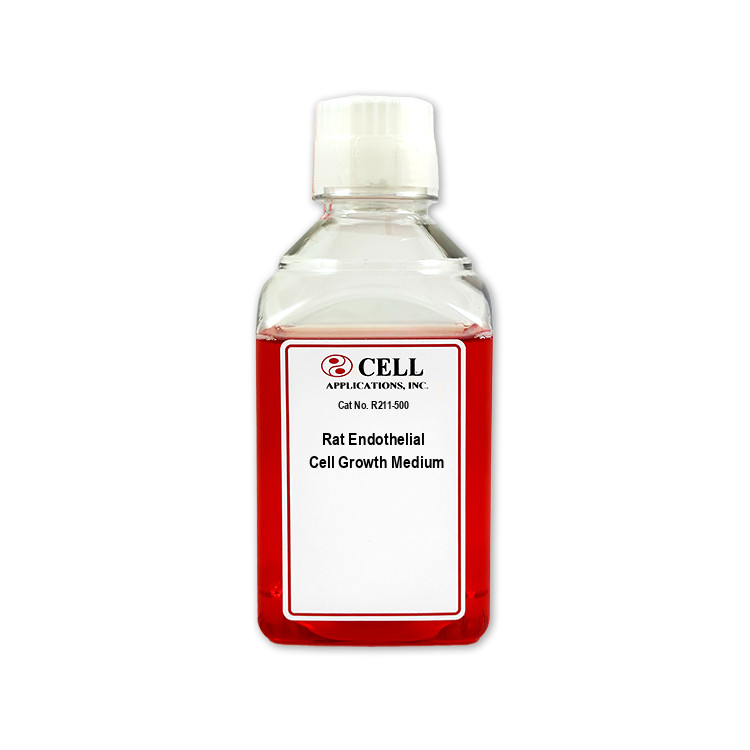
Rat Endothelial Cell Media, with components and supplements optimized for these rodent vascular cells.
Rat Endothelial Cell Media
Rat EC Growth Medium: All-in-one ready-to-use
Type: Growth Medium
Size: 500 ml
Price: $160.00
Description

In research settings, Rat Endothelial Cell Media provide an optimized nutrient and growth factor environment for primary endothelial cells as well as established rat endothelial lines. These cell systems are used in cell biology and molecular biology to study key vascular processes, including angiogenesis, endothelial activation, barrier integrity, nitric oxide–related endothelial functions, and receptor-mediated signaling. Because the endothelium is a critical interface with the immune system, endothelial cultures grown in these media are also commonly applied to investigate vascular inflammation, immune cell adhesion and transendothelial migration, and related mechanisms that influence systemic immune responses.
Rat Endothelial Cell Media help preserve endothelial phenotype and morphology across serial passages, supporting consistent experimental outcomes. Endothelial identity and functional state are typically confirmed using canonical endothelial markers such as CD31 (PECAM-1) and von Willebrand Factor (vWF), alongside uptake- and function-based assays. Common readouts include Matrigel tube formation assays for angiogenesis, acetylated LDL uptake for endothelial function, and transendothelial electrical resistance (TEER) measurements to quantify barrier integrity. These media can also be used with genetic or viral delivery approaches, including endothelial-specific transgene expression (for example, endothelial-specific adenoviral overexpression) and reporter cell lines, to link molecular perturbations to vascular behavior (molecular biology and cell biology applications).
Across translational research pipelines, Rat Endothelial Cell Media support complex in vitro models, such as tumor-vascular co-cultures, 3D cell culture systems, and permeability-focused studies. They are also relevant to evaluating vascular delivery and interactions of therapeutic biologics and nanocarrier platforms, including LNP transport across the endothelial barrier — useful for contexts where endothelial activation or permeability changes affect drug distribution and safety. By providing a standardized culture platform for rat endothelial cells, these media facilitate reproducible data generation for cardiovascular and oncological research, as well as immunology-linked studies involving endothelial–immune crosstalk.
Medium carefully optimized for the characteristics and requirements unique to Rat Endothelial Cells. Attention to detail ensures ideal cell health, viability, performance, physiology, morphology, consistency and data.
Use with:
Details
CAI media are tested for sterility in order to confirm no bacteria, yeast or fungi contaminate the solutions. The products undergo further quality control for correct pH, osmolality and lack of endotoxins. A panel of different bioassays affirm the media sustain a proper environment for expected cell-type-specific culture, growth, plating, karyotype, physiology, morphology, viability, population doublings, surface markers, cryopreservation, differentiation and/or induction.
Laboratory research use only (RUO). Not for human, clinical, diagnostic or veterinary use.
 Powered by Bioz