
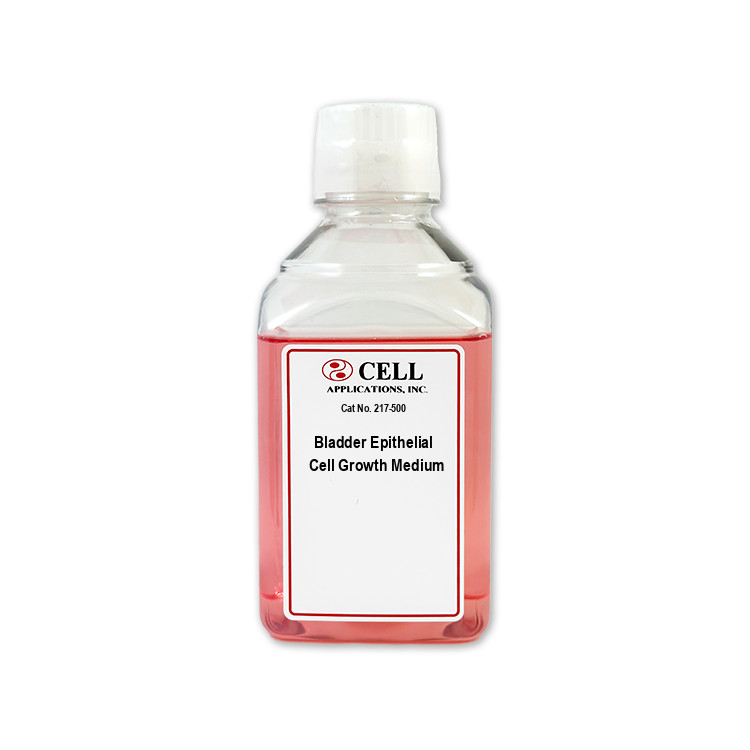
Human Bladder Epithelial Cell Media are specialized culture formulations designed for the growth, maintenance, and expansion of primary human bladder epithelial cells, a tissue-specific type of urothelial cell. Urothelial cells more broadly line the mucosal surface of the urinary tract, including the renal pelvis, ureters, urinary bladder, and parts of the urethra. In these regions, they form a specialized barrier (the urothelium) that protects underlying tissues from potentially toxic, hyperosmolar, and acidic urine. Beyond serving as a protective permeability barrier, primary epithelial cells contribute to innate immune signaling, cytokine and chemokine production, and sensory responses mediated in coordination with sensory nerves and neighboring bladder-wall cells.
To support these cells in vitro, Human Bladder Epithelial Cell Media are formulated to provide essential nutrients, trace elements, growth factors, and hormones. Using an epithelial basal medium formulated without serum — or with defined low-serum additions — may help support epithelial-cell growth and reduce fibroblast or other stromal-cell overgrowth. The effects on differentiation, senescence, and phenotype depend on the formulation and culture conditions. In research, these primary cell solutions provide a highly relevant cell model for investigating urothelial biology, bladder cancer mechanisms, interstitial cystitis, urinary tract infections (such as uropathogenic
E. coli adherence), toxicological responses, and tissue engineering strategies.
Providing a cell-type-specific nutrient environment enables primary cell culture workflows that may help maintain characteristic epithelial morphology, urothelial marker expression, and barrier properties. These human cell models support diverse applications, including gene-expression analysis, drug permeability and transport studies, barrier-function testing such as transepithelial electrical resistance (TEER) and permeability assays, and infection modeling. Human Bladder Epithelial Cell Media can also be used in co-culture systems alongside bladder smooth muscle, human bladder fibroblasts, or endothelial cells on an appropriate extracellular-matrix coating or scaffold, and may be incorporated into selected co-culture or organoid workflows, subject to application-specific validation.
While optimized for primary epithelial cells, this specialized medium should not be assumed to support all cell types, such as neural stem cells, mesenchymal stem cells, skeletal muscle, male reproductive system models, or immortalized continuous cell lines. Proper culture vessel preparation and aseptic techniques remain essential for optimal proliferation. For long-term storage, cells expanded in this medium can be cryopreserved using a validated freezing medium and stored in liquid nitrogen, with post-thaw viability and recovery assessed for the intended application.
Medium carefully optimized for the characteristics and requirements unique to Human Bladder Epithelial Cells. Attention to detail ensures ideal cell health, viability, performance, physiology, morphology, consistency and data. As with the majority of our epithelial cell media, this product contains no serum.
Use with:
EpiVita Basal Medium, used in conjunction with Human Bladder Epithelial Growth Supplement growth supplement, provides excellent culture conditions for HBlEpC. This robust and versatile basal medium is animal origin-free, and contains essential & non-essential amino acids, vitamins, other organic compounds, trace minerals and inorganic salts. Available only from Cell Applications, top-performing EpiVita Basal Medium (plus supplement), outperforms competitor formulations by a wide margin. Manufactured in a GMP certified facility, EpiVita is an ideal choice for fundamental life science studies, pharmaceutical drug discovery & toxicity assay, and translational research aimed at taking discoveries from the bench to the clinic.
 Powered by Bioz