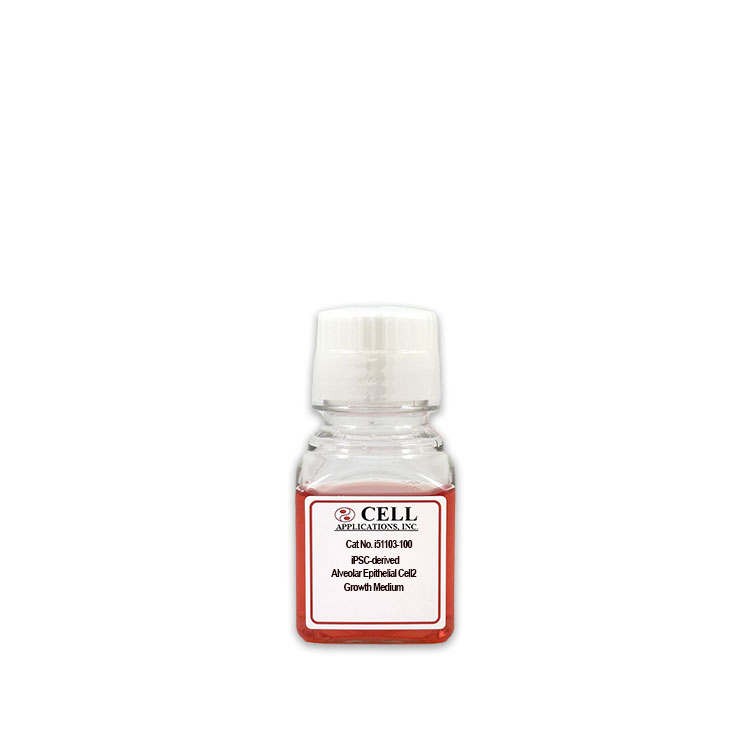
AEC2/iHAEpC2 Medium
AEC2/iHAEpC2 Growth Medium : All-in-one ready-to-use
Type: Growth Medium
Size: 100 ml
Price: $168.00
Description
AEC2/i-HAEpC2 Medium is a specialized culture formulation designed to support the attachment, maintenance, and expansion of human alveolar type II epithelial cells in vitro, including primary human AEC2s and human induced pluripotent stem cell-derived alveolar epithelial cells such as i-HAEpC2 or iPSC-derived AEC2-like cells. These cultures provide a human-relevant in vitro system for studying distal-lung epithelial biology.
Native alveolar type II cells are cuboidal epithelial cells located in the distal lung alveoli. They contribute to pulmonary surfactant synthesis and homeostasis, alveolar fluid regulation, epithelial barrier maintenance, host defense, and repair of the distal lung. Unlike the thin, squamous type I alveolar cells that cover most of the gas-exchange surface, AEC2s are secretory and metabolically active cells that support the function and regeneration of the alveolar epithelium.
AEC2s synthesize, store, and secrete pulmonary surfactant, a lipid- and protein-rich material containing phospholipids such as dipalmitoylphosphatidylcholine and surfactant proteins including SP-A, SP-B, SP-C, and SP-D. Surfactant reduces alveolar surface tension and helps maintain alveolar stability during respiration. AEC2s also contribute to alveolar fluid balance and innate immune defense by releasing collectins, antimicrobial factors, cytokines, and chemokines in response to infection or tissue injury.
AEC2s function as facultative progenitor cells of the alveolar epithelium. Following injury, selected AEC2 populations can proliferate and differentiate into type I alveolar epithelial cells, helping restore epithelial integrity and gas-exchange function. AEC2 dysfunction, senescence, impaired regeneration, and abnormal inflammatory signaling are associated with pulmonary injury and can contribute to fibrotic remodeling in diseases such as idiopathic pulmonary fibrosis. These processes involve coordinated interactions among epithelial, mesenchymal, endothelial, and immune-cell populations.
AEC2/i-HAEpC2 Medium supports the culture and expansion of human AEC2 and i-HAEpC2 populations for phenotypic and functional studies. Depending on the experimental system and additional culture conditions, these cells can be incorporated into two-dimensional epithelial cultures, air–liquid interface models, three-dimensional alveolar organoid or alveolosphere systems, and multicellular co-cultures.
Potential applications include investigation of surfactant biology, alveolar epithelial repair, barrier and transport properties, host–pathogen interactions, inflammatory signaling, hypoxia responses, and mechanisms associated with pulmonary fibrosis. ACE2-mediated viral-entry studies should be interpreted in conjunction with direct confirmation of ACE2 expression in the specific donor, iPSC line, passage, and culture condition being used.