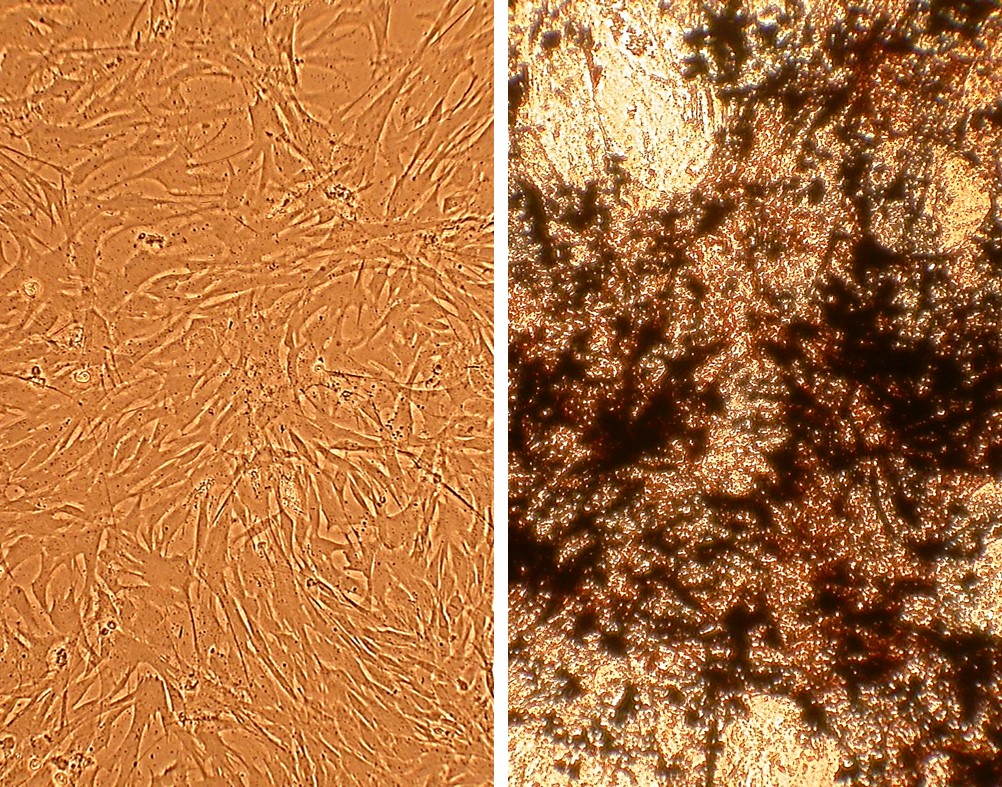
Canine Osteoblasts, CnOb (L) von Kossa stained (R).
Canine Osteoblasts: CnOb
Canine Osteoblasts (CnOb) are primary osteoblast cells isolated from canine skeletal tissue.
Description
- Defining Malignant Biomarker Profiles: Investigators leverage primary CnOb to establish a healthy molecular baseline when mapping the biomarker profiles of canine osteosarcoma. By contrasting normal osteoblasts against malignant osteosarcoma lines, research has helped delineate the transcriptional and proteomic shifts that characterize bone oncogenesis. These comparative screens are critical for identifying early diagnostic markers and tracking how tumor cells subvert normal bone deposition to drive osteolytic or osteoblastic lesions.
- Elucidating Dysregulated Signaling Pathways: CnOb serve as an essential control for dissecting the intracellular cascades that become hijacked during carcinogenesis. Studies have utilized these primary cells to explore the roles of the canonical Wnt signaling pathway and the STAT3 pathway in maintaining bone homeostasis versus driving tumor proliferation. For example, experimental models highlight how the constitutive activation of oncogenic STAT3 or alterations in β-catenin stabilization — which are reported in specific osteosarcoma subsets — disrupt the normal differentiation program maintained by healthy primary CnOb, shifting cells toward hyper-proliferative, poorly differentiated phenotypes with altered alkaline phosphatase marker expression.
- Personalized Therapeutics and Targeted Screening: To advance veterinary and human clinical treatment interventions, primary CnOb are frequently deployed in paired cytotoxicity and efficacy screens alongside osteosarcoma cells to evaluate novel targeted compounds. This testing grid ensures that candidate drugs selectively target malignant pathways while sparing healthy bone-forming cells, ultimately aiming to mitigate severe tumor-associated pain and eliminate the need for radical limb-amputation surgery. Key compounds evaluated in these comparative setups include:
- Dasatinib: A small-molecule Src family kinase inhibitor tested to disrupt the migratory and invasive capacity of bone tumor cells.
- PAC-1: A procaspase-3 activating compound screened to selectively trigger apoptosis in malignant lines.
- STA-1474: An injectable prodrug of the heat shock protein 90 (HSP90) inhibitor ganetespib, used to destabilize client oncoproteins.
- LLL12: A small-molecule STAT3 inhibitor designed to blunt downstream transcription in hyper-activated tumor environments.
Comparative Insight: While spontaneous bone malignancies are well-documented in canines, they present distinctly from patterns observed in other companion animals like cats, where primary bone tumors are less frequent and show differing clinical behavior, making the canine model uniquely valuable for human translational oncology. Furthermore, healthy CnOb co-cultures allow researchers to observe the bidirectional signaling crosstalk between matrix-building osteoblasts and matrix-resorbing osteoclasts that is frequently hijacked by tumor microenvironments.
- Define a biomarker profile of canine osteosarcoma, elucidate the roles of oncogenic STAT3 and canonical Wnt signaling pathways
- Develop personalized osteosarcoma treatments by testing Src inhibitor dasatinib, procaspase-3 activating compound PAC-1, HSP90 inhibitor STA‐1474 and STAT3 inhibitor LLL12.
Details
| Tissue | Normal healthy canine bone. | |
|---|---|---|
| QC | No bacteria, yeast, fungi, mycoplasma | |
| Character | Bone mineralization (von Kossa stain) | |
| Bioassay | Attach, spread, proliferate in Growth Med | |
| Cryovial | 500,000 CnOb (1st passage) frozen in Basal Medium w/ 10% FBS, 10% DMSO | |
| Kit | Cryovial frozen CnOb (Cn406-05), Growth Med (Cn417-500), Subcltr Rgnt Kit (090K) | |
| Proliferating | Shipped in Gr Med, 2nd psg (flasks or plates) | |
| Doublings | At least 10 | |
| Applications | Laboratory research use only (RUO). Not for human, clinical, diagnostic or veterinary use. |
Resources
FAQs
Need More Help?
Visit our comprehensive FAQ page for detailed answers to common questions.
Need More Help?
Visit our comprehensive FAQ page for detailed answers to common questions.
Primary Cell FAQs Powered by Bioz