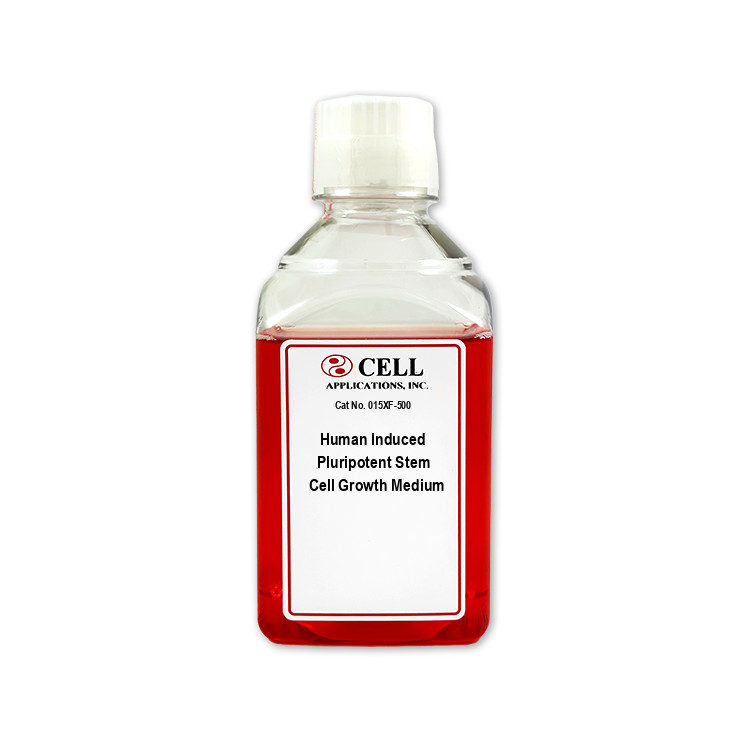
Human Induced Pluripotent Stem Cell Medium. Carefully optimized with select growth factors, supplements and components tailored to HiPSC growth, or the differentiation of these cells into specific lineages.
Human Induced Pluripotent Stem Cell (HiPSC) Medium
HiPSC Growth Medium: All-in-one ready-to-use, growth supplements pre-added, no mixing necessary. Recommend use within 2 weeks (Or use Kit for longer storage).
Type: Growth Medium
Size: 500 ml
Price: $275.00
Description
Human Induced Pluripotent Stem Cell (HiPSC) Medium is a chemically defined, xeno-free growth medium formulated to support the maintenance, expansion, and propagation of human induced pluripotent stem cells. The medium is suitable for culturing an undifferentiated reprogrammed pluripotent cell population in a monolayer format and can be used with appropriately validated human iPSC culture systems. It is designed to support consistent cell attachment, morphology, viability, and self-renewal during routine culture and passaging.
Human induced pluripotent stem cells, or HiPSC, are generated by artificially reprogramming mature somatic or other adult cells into an embryonic-like state. Common starting materials include dermal fibroblasts, peripheral blood mononuclear cells, and T cells obtained from a donor. These source cells originate in somatic tissue and normally have specialized functions, whereas HiPSCs acquire the defining characteristics of pluripotent stem cells: the capacity for long-term self-renewal and the potential to differentiate into cell types representing all three embryonic germ layers.
HiPSCs resemble embryonic stem cells in their developmental potential but can be generated from adult cells without requiring the derivation of cells from an embryo. This feature provides an important ethical and practical alternative for many research applications. Because HiPSCs retain donor-associated genetic and epigenetic information, they can be used to study donor-specific traits, hereditary predispositions, and disease-associated phenotypes in a human cellular context.
During reprogramming, defined transcription factors alter the epigenetic landscape and reorganize somatic gene networks. Reprogramming methods may be RNA-based, Sendai-virus-based, or DNA-based, depending on the system and experimental requirements. Some approaches are designed to minimize or eliminate the persistence of viral sequences or transgenes. The resulting cells must be evaluated for true pluripotency, stable morphology, appropriate nucleus-to-cytoplasm ratio, expression of pluripotency markers, normal karyotype, and the absence of clinically or experimentally relevant genomic abnormalities.
The medium contributes to HiPSC research by providing growth factors, nutrients, and other culture components that help maintain cells in an undifferentiated, pluripotent state. Supporting endogenous pluripotency loops and stable self-renewal enables researchers to expand HiPSCs before directed differentiation, genetic analysis, disease modeling, or cell-based assay development. Consistent culture conditions can also improve plating efficiency, help preserve colony morphology, and reduce variability associated with changes in cell density, passage conditions, or medium preparation.
Expanded HiPSCs can be directed toward specialized differentiated cell types, including cortical neurons, astrocytes, cardiomyocytes, hepatocytes, endothelial cells, and other derivatives of the embryonic germ layers. These iPSC-derived cells are used to investigate neurodegenerative disease, cardiotoxicity, liver biology, developmental disorders, macular degeneration, and other human-specific disease processes. HiPSC models also support research in regenerative medicine and tissue engineering, where differentiated cells may be incorporated into biomimetic hydrogels, microfluidic platforms, organs-on-a-chip, or bioreactor systems developed by bioengineers.
The HiPSC culture workflow may include a compatible coating solution, gentle dissociation reagent, and serum-free cryopreservation formulation. The associated dissociation system is intended for routine subculture of HiPSCs, while cryopreservation reagents can support recovery and banking of validated cell stocks. For studies requiring scalability or comparison across experiments, researchers may use characterized single-donor lots and standardized culture procedures. These practices help maintain coherent experimental populations and facilitate reproducible downstream differentiation.
Human Induced Pluripotent Stem Cell (HiPSC) Medium is intended for research use only and is not intended for human or clinical applications. It does not by itself establish true pluripotency, prevent genomic instability, or guarantee successful differentiation into a specific lineage. Each HiPSC line should be independently characterized for identity, viability, morphology, karyotype, contamination, pluripotency, and donor-specific characteristics before use in downstream research.
HiPSC Media & Reagents:
- Growth Medium: Xeno-free, chemically-defined medium used to thaw, culture, grow and propagate HiPSC monolayer
- Freezing Medium: Serum-free cryopreservation formula, containing sucrose & dextran
- Dissociation Kit: Ca2+ & Mg2+ – free formulation containing metal ion chelator EDTA in buffered saline
- Coating Solution: Pre-diluted, ready-for-use preparation of basement membrane components
- Xeno-Free Coating Solution: Truncated Vitronectin, also ready-for-use
Use with: Human Induced Pluripotent Stem Cells: HiPSC
For Research Use Only – Not for Human or Clinical Applications
Details
| HiPSC Growth Medium Kit (Cat. No. 015XFK-500) | |||
| Kit Component | Vol | Item No. | Store |
| Basal Medium | 500 ml | 014-500 | 4C |
| GS: Growth Suppl | 10 ml | 015XF-GS | -20C |
| HiPSC Dissociation Kit (Cat. No. 091K) Use at Room Temperature | |||
| Kit Component | Vol | Item No. | Store |
| Dissoc Soln: EDTA (0.5mM in PBS) | 50 ml | 075-25 | 4C |
| PBS | 100 ml | 060-50 | 4C |
 Powered by Bioz