Human Induced Pluripotent Stem Cells: HiPSC
Human Induced Pluripotent Stem Cells (HiPSC) are patient-specific stem cells generated by artificially reprogramming mature somatic adult cells back into an embryonic-like state.
Description
Human Induced Pluripotent Stem Cells (HiPSC), alternatively written as hiPSCs, iPS cells, or referred to as a reprogrammed pluripotent cell population — are patient-specific stem cells generated by artificially reprogramming mature somatic adult cells back into an embryonic-like state. First introduced to the scientific community in pioneering papers that reshaped modern stem cell research, these human pluripotent stem cells bypass the ethical concerns and immunological hurdles historically associated with embryonic stem cells. Structurally, these undifferentiated cells display the classic morphology of a pluripotent stem cell, characterized by a high nucleus-to-cytoplasm ratio, distinct prominent nucleoli, and compact, tightly packed colony formation when grown in appropriate feeder-free environments. Functionally, a verified induced pluripotent stem cell line possesses the dual properties of indefinite self-renewal and true pluripotency, meaning they can proliferate indefinitely while maintaining a stable human genetic background.
Unlike tissue-resident stem cells, HiPSC do not exist natively within the human body. Instead, they are engineered in vitro from fully differentiated human cells harvested from a donor. The iPSC generation process involves taking easily accessible somatic tissue — most commonly skin cells (such as dermal fibroblasts) or blood cells (such as peripheral blood mononuclear cells or specific T cells) — and resetting their epigenetic landscape. By introducing a canonical cocktail of transcription factors, researchers force these specialized cells to undergo a mesenchymal-to-epithelial transition (MET), silencing somatic gene networks and reactivating endogenous pluripotency loops. Because these lines are derived from individual donors, every iPSC line carries the exact genetic material, donor-specific traits, and hereditary pre-dispositions of the patient from whom the original adult cells were collected.
In laboratory settings, HiPSC and iPSC-derived cells are a cornerstone of modern regenerative medicine, tissue engineering, and molecular biology. Specialized publications, including journals like Nature Biotechnology, frequently highlight how these systems are used to decipher complex human disease mechanisms that cannot be accurately captured in animal models. Researchers actively differentiate patient-specific lines to investigate the cellular onset of severe neurodegenerative diseases — such as Alzheimer’s disease — and structural disorders like macular degeneration.
Furthermore, these cells are heavily utilized in high-throughput drug screening and toxicity testing to discover safe therapeutic compounds before moving to clinical trials. By cultivating them in 3D biomimetic hydrogels, microfluidic organs-on-a-chip, or scalable bioreactor suspension systems, bioengineers are optimizing advanced tissue engineering parameters. While investigators must carefully monitor cultures for long-term culture hazards like genomic instability, the ability to generate scalable, non-engineered human tissues from single-donor lots makes HiPSC a foundational platform for developing next-generation cell therapy, autologous stem cell therapy, and targeted personalized medicine.
Integration-free HiPSC. Our HiPSC are generated with the RNA-based Sendai virus to deliver reprogramming factors to donor skin fibroblasts. Since the virus does not go through a DNA phase, its genetic material and transgenes do not integrate into the host cell genome. HiPSC are validated for viability, karyotype, pluripotency, plating efficiency, morphology, passage number and lack of contamination.
HiPSC-derived Neural Stem Cells (L) and Neurons (R). i-HNSC stained w/ Nestin (neural stem cell marker, green), SOX 2 (stem cell marker, red) & DAPI (nuclear stain, blue). SOX2 & DAPI nuclear co-localization yields purple (Left). Video: Human iPSC-Derived Neurons establish mature, synchronized neuronal network. In real time, Multi-electrode array (MEA) shows optimal electrophysiological activity, which can be modulated by neurotransmitters or small compounds (Right).
HiPSC-derived Cardiomyocytes (i-HCM) plated onto a flat culture surface pulsate in vitro (L), while iHCM printed into 3D heart tissue using a Cyfuse Regenova also beat (R)
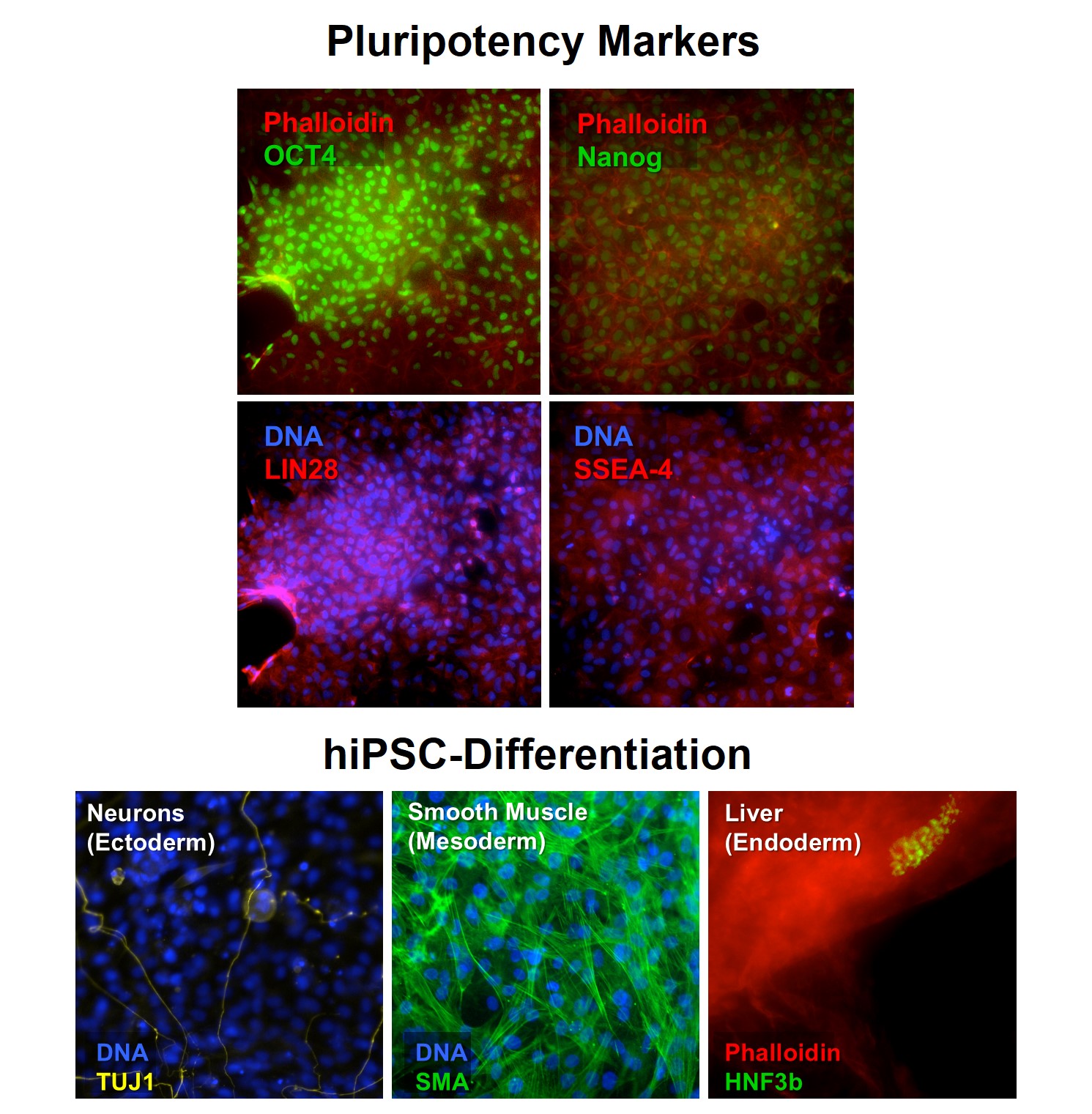
Reprogramming triggers a cascade of evident changes in the host cells that are recognizable morphologically and through a combination of markers and pluripotency assays. Our HiPSCs display classic pluripotent stem cell morphology, with a high nucleus to cytoplasm size ratio, as well as they are amenable to be cultivated in serum-free media, independent of feeder cells and of feeder-conditioned media as colonies or high density monolayers. hiPSCs are also evaluated for the presence of karyotypic abnormalities. Confirmation of pluripotency is performed through the analysis of expression of several established independent pluripotency markers. Unguided differentiation confirms HiPSC ability to generate cell derivatives of tissues arising from the three embryonic layers.
Cell Characterization. Post-thawing viability of HiPSCs is typically higher than 70%, and HiPSC have demonstrated coherent pluripotent behavior over more than 60 passages. Although it is in theory possible to propagate HiPSCs indefinitely, HiPSC subculturing over passages higher than is usually not recommended, as the chances of karyotypic abnormalities increase. HiPSCs are also tested to ensure absence of microorganism contaminants.
For Research Use Only – Not for Human or Clinical Applications
Details
| Source | Neonatal Male (iPS11-10) or Adult Female (iPS12-10) human dermal fibroblasts (single donor), reprogrammed w/ replication-deficient Sendai virus | |
|---|---|---|
| QC | No bacteria, yeast, fungi, mycoplasma, virus (Trace Sendai virus possible) | |
| CofA | Donor, gender, tissue source, disease status, cell viability (post-thaw), plating efficiency, passage #, karyotype, pluripotency | |
| Cryovial | 1,000,000 HiPSC (low passage) frozen in serum-free HiPSC Freezing Medium | |
| Medium | Cells manufactured, maintained in serum-free, feeder-free culture conditions | |
| Doublings | At least 60 w/out lost morphology, phenotype | |
| Storage | Liquid Nitrogen | |
| Bioassay | iPSC morphology, growth behavior when grown in pluripotency conditions | |
| Applications | Non-commercial research use only (RUO), not for human or clinical use |
| Component | Cat. No. | Vol | Store |
|---|---|---|---|
| Cryopreserved Cell Ampoule | iPS11-10 or iPS12-10 | 1ml | LN2 |
| Growth Medium Kit (015XFK-500) | Basal Med (014-500) Gr Supp (015XF-GS) | 500ml 10ml | 4°C -20°C |
| Coating Solution, Xeno-Free 100x Stock | 126XF-005 | 50ul | -20°C |
| Dissociation Solution (076-5) | 076-5 | 5ml | -20°C |
Resources
FAQs
Need More Help?
Visit our comprehensive FAQ page for detailed answers to common questions.
Need More Help?
Visit our comprehensive FAQ page for detailed answers to common questions.
Primary Cell FAQs Powered by Bioz