
Rat Neural Stem Cell Differentiation Medium, for sterile, in vitro change of multipotent cells toward specialized lineages including astrocyte, neural and oligodendrocyte.
Rat Neural Stem Cell Differentiation Media
RNSC Differentiation Medium carefully optimized to derive Astrocytes (R813D-100A), Neurons (R813D-100N) or Oligodendrocyte (R813D-100O).
Description
Rat Neural Stem Cell Differentiation Media is a culture formulation designed to support differentiation of primary rat neural stem cells (RNSC). By supplying differentiation-supporting factors and reducing mitogenic signals such as FGF-2 and EGF, this medium promotes the transition of multipotent neural progenitors away from self-renewal and toward lineage-specific differentiation.
Neural stem cells are multipotent progenitor cells found in neurogenic niches within the central nervous system (CNS), including the subventricular zone (SVZ) of the lateral ventricles in the brain, the subgranular zone (SGZ) of the hippocampal dentate gyrus, and the central canal region of the spinal cord.
These cells contribute to neurogenesis and gliogenesis by giving rise to neuron, astrocyte, and oligodendrocyte lineages. They may also support structural plasticity and tissue repair in response to injury or stress within the neural environment.
In culture, primary RNSC may remain as neurosphere-like clusters in the presence of mitogens or differentiate when exposed to lineage-directing signals. Rat Neural Stem Cell Differentiation Media is intended to support reproducible differentiation in 2D monolayer and three-dimensional culture models.
This formulation is useful for neurobiology, pharmacology, and regenerative medicine studies, including differentiation into neurons, astrocytes, and oligodendrocytes, neurogenesis, axonal outgrowth, synaptogenesis, glial interactions, and models of neurodegenerative disease and CNS injury.
RNSC Differentiation Medium
Carefully optimized to derive Astrocytes (R813D-100A), Neurons (R813D-100N) or Oligodendrocyte (R813D-100O).
Use with:
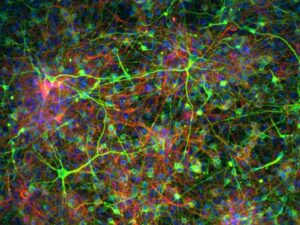
Image: Differentiation Medium R813D-100N effectively derives neuron lineage cells from RNSC. Fluorescent image of differentiated RNSC stained with neuron marker Class III and β-Tubulin in green.
Details
CAI media are tested for sterility in order to confirm no bacteria, yeast or fungi contaminate the solutions. The products undergo further quality control for correct pH, osmolality and lack of endotoxins. A panel of different bioassays affirm the media sustain a proper environment for expected cell-type-specific culture, growth, plating, karyotype, physiology, morphology, viability, population doublings, surface markers, cryopreservation, differentiation and/or induction.
Laboratory research use only (RUO). Not for human, clinical, diagnostic or veterinary use.
 Powered by Bioz