
Rat Neural Stem Cells: RNSC
Rat Neural Stem Cells (RNSC) are multipotent stem cells isolated from fetal or adult rat brains that serve as foundational CNS stem cells.
Description
Rat Neural Stem Cells (RNSC) are multipotent stem cells isolated from fetal or adult rat brains that serve as foundational CNS stem cells. In their undifferentiated state, these neural progenitors function as highly proliferative cells capable of extensive self-renewal in vitro. They retain the unique multi-lineage potential to undergo directed neurogenesis and differentiation into the distinct neural cell types that compose the central nervous system:
- functional neurons
- astrocytes
- oligodendrocytes
Because they maintain this plastic progenitor cell profile, RNSC provide a biologically authentic model for exploring development, mapping disease pathways, and testing regenerative therapies within diverse research areas like neurodegenerative disease and spinal cord injury. To preserve their multipotent status and prevent premature differentiation during culture, primary RNSC require specialized handling and defined microenvironments:
- Neurosphere Maintenance: When cultured in Rat Neural Stem Cell Growth Medium, RNSC naturally proliferate as free-floating, three-dimensional cellular aggregates known as neurospheres. This floating architecture mimics the native neural stem cell niche, sustaining high cell viability and expansion capacity across early passages.
- Lineage Specificity: Upon the withdrawal of mitogens and transition to a defined Rat Neural Differentiation Medium, the cells exit the cell cycle and undergo synchronized differentiation. Successful lineage commitment is confirmed by monitoring specific phenotypic markers: β-tubulin III for mature neurons, glial fibrillary acidic protein (GFAP) for astrocytes, and the O4 marker for oligodendrocytes, establishing a balanced population of neuronal and glial cells.
Validating the physiological potency of primary RNSC lots requires strict quality control metrics to ensure translationally rigorous performance in downstream analytical assays:
- Purity and Verification: Prior to cryopreservation at early passage, lots undergo screening to verify species reactivity, a guaranteed sterile status, and freedom from contaminants. Analytical workflows utilize specialized immunofluorescence imaging and detection instrument configurations to quantify marker expression profiles. These evaluation platforms operate under precise parameters—accounting for test principle dynamics, detection type, result type, and a calibrated detection range—to minimize random error and ensure reproducible baseline data.
- In Vivo Potency: The ultimate benchmark of RNSC functionality is their capacity to integrate into a living system. When transplanted cells are engrafted into an intact or injured host adult brain, these transplanted neural stem cells survive, expand, and execute region-specific differentiation into mature neurons and glia within three weeks. This successful transplantation and structural integration make them a critical baseline model, frequently benchmarked against mouse neural lines, for developing advanced cell-replacement therapies.
Rat Neural Stem Cells (RNSC) are multipotent, and can be induced to differentiate into neurons, astrocytes and oligodendrocytes that make up the central nervous system (CNS). The ability of neural stem cells to retain multi-lineage potential and proliferate extensively in vitro provides new avenues for the treatment of neural degenerative diseases and injuries. Isolated from fetal or adult rat brains, RNSC are maintained in an undifferentiated, proliferative state by culturing them as free floating neurospheres in serum-free medium optimized with growth factors.
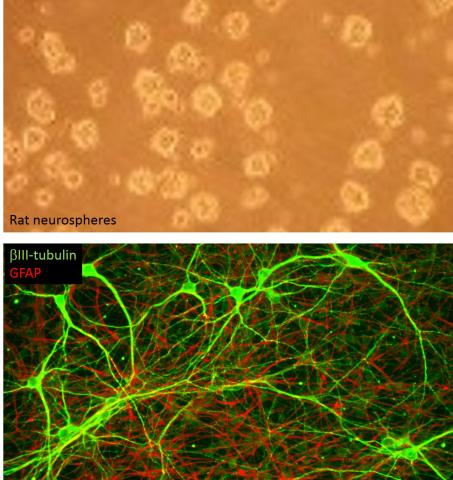 Image: The RNSC depicted here have formed neurospheres (top), and are stained for β-tubulin III (green) and GFAP (red) (bottom)
Details
| Tissue | Normal healthy rat brain cerebral cortex | |
|---|---|---|
| QC | No bacteria, yeast, fungi, mycoplasma | |
| Character | β-tubulin III, GFAP & O4 in Differentiation Med | |
| Bioassay | Form neurosphere in RNSC Growth Med | |
| Cryovial | 2,000,000 RNSC (1st passage) cryopreserved in Freezing Med (040-50) | |
| Kit | Cryovial frozen RNSC (RS820-20f), Growth Medium (R813-250), Neural Stem Cell Dissociation Solution (076-20), 10cm non-TC dish x2 | |
| Cultured | Shipped in Gr Med, 2nd psg (flasks or plates) | |
| Doublings | At least 2 | |
| Applications | Laboratory research use only (RUO). Not for human, clinical, diagnostic or veterinary use. |
Resources
FAQs
Need More Help?
Visit our comprehensive FAQ page for detailed answers to common questions.
Need More Help?
Visit our comprehensive FAQ page for detailed answers to common questions.
Primary Cell FAQs