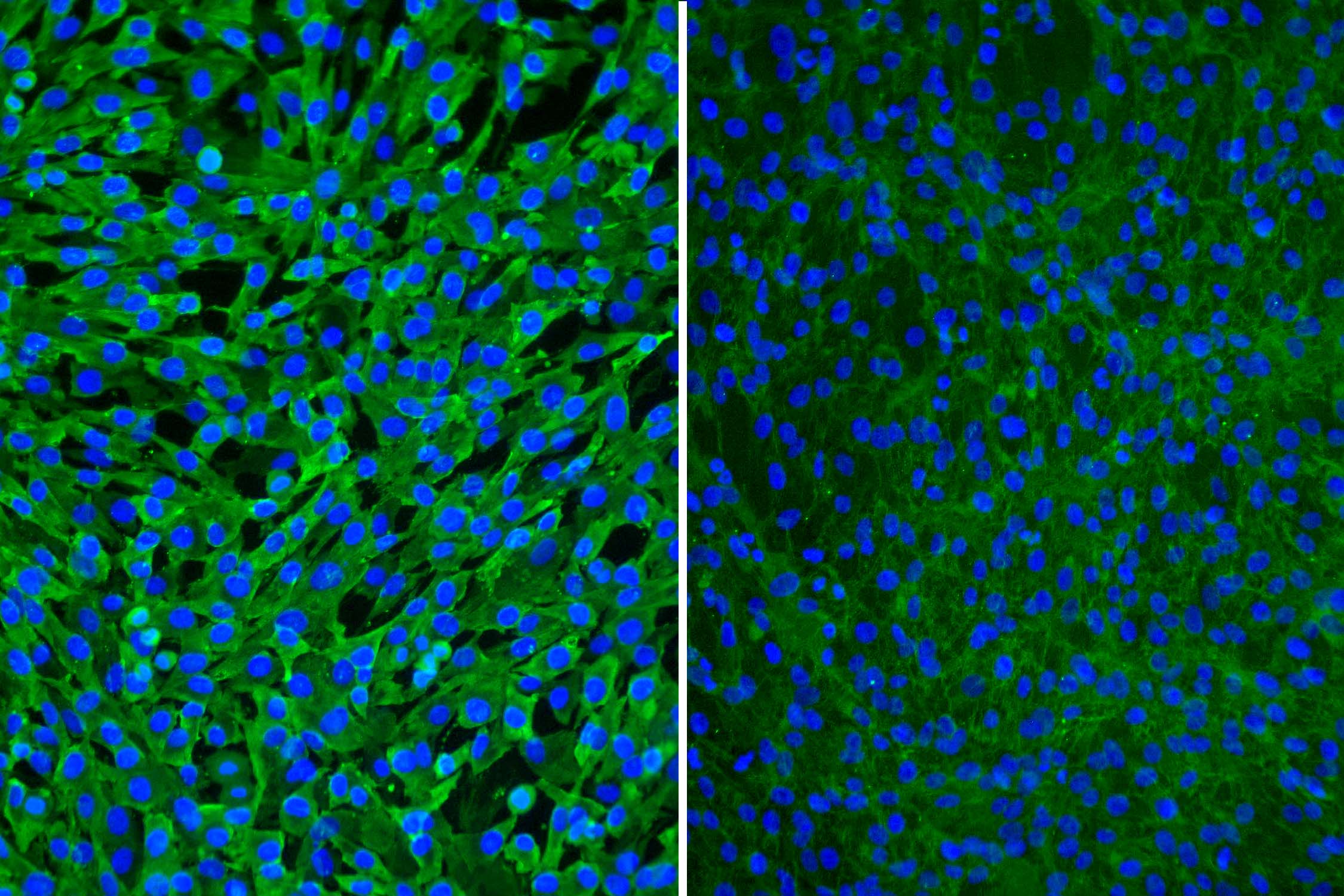
Human Hepatic Stellate Cells: HHSC Left: HHSC immunolabeled for α-smooth muscle actin (green) Right: HHSC immunostained for fibronectin (green) nuclei are stained with DAPI.
Human Hepatic Stellate Cells: HHSC
Human Hepatic Stellate Cells (HHSC) are primary liver-specific mesenchymal cells isolated from adult human liver tissue.
Description
Human Hepatic Stellate Cells (HHSC) — alternatively referred to as perisinusoidal cells or Ito cells — are primary liver-specific mesenchymal cells isolated from adult human liver tissue. In a healthy liver, these cells maintain a quiescent, non-proliferative phenotype and serve as the body’s principal reservoir for retinoids, storing vitamin A as retinyl esters within characteristic intracellular lipid droplets. Unlike continuous cell lines that lack authentic physiological donor traits, primary HHSC better preserve their native metabolic pathways, receptor profiles, and pathological responsiveness ex vivo. However, researchers must handle them carefully; when cultured on standard, rigid plastic substrates in vitro, these primary cells have a strong propensity to undergo spontaneous stellate cell activation. To maintain them in a resting state or study early activation kinetics, investigators utilize specialized soft hydrogels or optimized hepatic stellate cell growth medium designed to minimize premature phenotypic drift.
In the human body, these cells reside exclusively within the perisinusoidal space — commonly known as the Space of Disse — which is the narrow anatomical zone located between the cords of parenchymal hepatocytes and the liver sinusoidal endothelial cells. In this specialized microenvironment, HHSC comprise roughly 5–8% of the total resident cell population by cell count. They work in tandem with neighbouring parenchymal and non-parenchymal cells, including liver sinusoidal endothelial cells and resident Kupffer cells (macrophages), to maintain tissue homeostasis, guide vascular tone, and support normal liver development. In this resting state, they secrete a low-density, non-fibrillar, ECM-rich basement membrane–like matrix into the Space of Disse that preserves the structural architecture necessary for unobstructed sinusoidal filtration and efficient nutrient exchange.
The primary biological function of HHSC shifts dramatically depending on whether the tissue is healthy or undergoing pathological stress. In a healthy liver, their main role is retinoid metabolism and storage, regulated by specific internal enzymes like lecithin retinol acyltransferase (LRAT). However, following acute or chronic liver injury — such as that induced by viral hepatitis, metabolic dysfunction-associated steatohepatitis (MASH/NASH), or chronic alcohol abuse — HHSC play a vital role in the tissue’s wound-healing cascade by undergoing a profound phenotypic transformation known as HSC activation.
During hepatic stellate cell activation, the cells lose their intracellular vitamin A droplets and transdifferentiate into highly proliferative, contractile, and migratory myofibroblast-like cells. Driven by paracrine signals (such as TGF-β and PDGF) from damaged hepatocytes and activated Kupffer cells, these activated hsc markedly upregulate the transcription of structural and contractile proteins, most notably alpha smooth muscle actin (α-SMA) and fibronectin. Furthermore, activated HSCs drastically increase the deposition of fibrillar collagens, primarily types I and III, which alters tissue compliance, creates dense collagen scar tissue, and drives the progression of hepatic fibrosis.
In translational gastroenterology, drug discovery, and oncology, HHSC function as a widely used platform for modeling liver fibrosis, mapping chronic liver disease progression, and screening novel therapeutic compounds. Researchers deploy these cells in targeted cell-based assays to evaluate potential antifibrotic drug candidates — such as farnesoid X receptor (FXR) agonists — by tracking their ability to halt or reverse the myofibroblastic phenotype and reduce scar deposition. However, because compound efficacy is highly dependent on the experimental model, disease stage, and microenvironmental context, these candidates are characterized for their antifibrotic potential rather than assuming universal efficacy.
Furthermore, primary HHSC serve as essential, non-malignant structural controls in oncology pipelines to confirm the tissue-bed safety of novel anti-cancer agents. For instance, in drug-screening assays investigating combination therapies against hepatocellular carcinoma (HCC), healthy human stellate cells are evaluated in parallel with malignant cell lines (such as HepG2) to ensure that synergistic pro-apoptotic or antiproliferative effects selectively target tumor cells while sparing healthy, structural hepatic cell fractions. This comparative screening establishes a clear therapeutic index, minimizing the risk of drug-induced liver injury and severe fibrosis.
Hepatic Stellate Cells (HHSC) are one of the major cell type that reside between hepatocytes and blood vessels in the liver. HHSC play an important role in liver homeostasis, maintenance and regeneration including retinol metabolism. Activation of stellate cells in disease state leads to liver fibrosis, hepatitis B & C, fatty liver disease, diabetes and other chronic diseases. Hepatic Stellate Cells are primary cells derived from human liver and cultured in optimized Hepatic Stellate Cells Growth Medium. Primary culture of Hepatic Stellate Cells is suitable for many cell-based assays including toxicity, drug screening and metabolism and is a valuable tool to study liver function, physiology and liver diseases
Characterization: Positive for α-smooth muscle actin and fibronectin by ICC staining.
Details
| Tissue | Normal healthy human liver tissue | |
|---|---|---|
| QC | No bacteria, yeast, fungi, mycoplasma, virus | |
| Bioassay | Attach, spread, proliferate in Growth Med | |
| Cryovial | 500,000 HHSC (2nd passage) frozen in Basal Medium w/ 10% FBS, 10% DMSO | |
| Kit | Cryovial frozen HHSC (782-05f), Growth Medium (7117-500), Subcltr Rgnt Kit (090K) | |
| Proliferating | Shipped in Gr Med, 2nd psg (flasks or plates) | |
| Doublings | At least 15 | |
| Applications | Laboratory research use only (RUO). Not for human, clinical, diagnostic or veterinary use. |
Resources
FAQs
Need More Help?
Visit our comprehensive FAQ page for detailed answers to common questions.
Need More Help?
Visit our comprehensive FAQ page for detailed answers to common questions.
Primary Cell FAQs Powered by Bioz