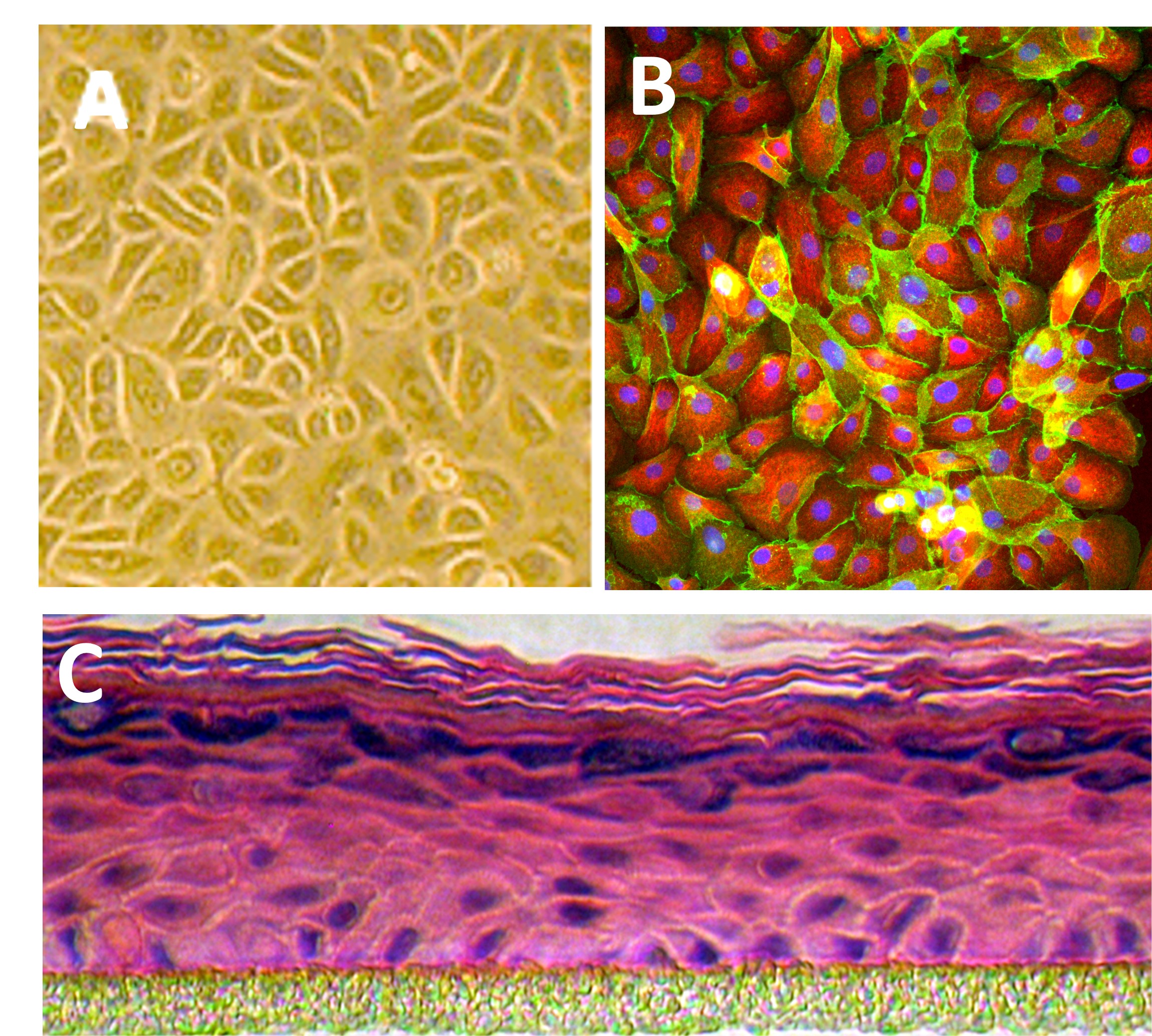
Human Epidermal Keratinocytes: HEK

Human Epidermal Keratinocytes (HEK) are keratinocyte cells from the epidermis, the outermost layer of the skin

Quantity

Description

Human Epidermal Keratinocytes (HEK) — frequently studied as normal human epidermal keratinocytes or primary epidermal keratinocytes—comprise approximately 90% of all cells in the epidermis, the outermost layer of the skin. As a highly dynamic cell type, they transition from proliferative basal cells anchored to the basement membrane up through stratified layers to form the stratum corneum. This complex process of cellular differentiation constructs the body’s primary mechanical and permeability barrier, driven by the structured assembly of keratin intermediate filament proteins (keratins). In vivo, these human epidermal keratinocytes work in close tandem with neighboring melanocytes, absorbing melanin granules and positioning them as a protective nuclear shield against damaging ultraviolet (UV) radiation.

In the laboratory, utilizing human primary cells isolated directly from tissue offers distinct advantages for modeling human skin over lines like HaCaT, which is a spontaneously immortalized, non-transformed line that can exhibit altered baseline signaling profiles. Maintaining these primary cultures requires specialized media formulations, such as optimized Human EpiVita Media, to enhance their in vitro lifespan and preserve correct physiological responses. By choosing high-quality reagents and seeding them into appropriate culture vessels, researchers can investigate the delicate balance between keratinocyte proliferation and sequential differentiation. This establishes a high-fidelity platform to discover novel therapeutic targets, evaluate topical formulations, and map complex epidermal tissue dynamics.

  • Mechanisms of Keratinocyte Differentiation and Barrier Function: A core focus of keratinocyte culture is mapping the precise genetic cascades governing keratinocyte differentiation. When primary basal keratinocytes are grown on porous inserts and exposed to an air-liquid interface (ALI), they shift from active proliferation to a highly organized stratification program. This process closely mimics the in vivo basal layer maturation, driving the chronological expression of differentiation markers such as involucrin, loricrin, and filaggrin to form a functional, three-dimensional epidermal tissue model.

  • Wound Repair, Tissue Regeneration, and Chronic Diseases: Following physical trauma or barrier disruption, human epidermal keratinocytes rapidly alter their phenotype to initiate wound repair. They downregulate rigid cell-matrix attachments, migrate across the injured provisional matrix, and proliferate to re-epithelialize the tissue. Primary models allow investigators to dissect these migratory pathways and study chronic epidermal conditions like eczema or psoriasis, where aberrant cytokine signaling disrupts normal homeostasis and impairs barrier resolution.

  • Viral Infection, Pathogen Interactions, and Host Defense: As the body’s frontline shield, the epidermis is a primary site for viral infection and microbial colonization. Researchers utilize human epidermal keratinocytes to study the entry, replication, and pathogenesis of viruses like the Human Papillomavirus (HPV), which infects basal keratinocytes typically via microabrasions. Its lifecycle is linked to keratinocyte differentiation. Furthermore, these models are deployed to characterize how the epithelium secretes antimicrobial peptides in response to pathogenic bacteria, opportunistic yeast, or structural fungi.

  • Oncogenesis, Skin Cancer, and Genetic Target Validation: Primary epidermal models provide a crucial benchmark for studying genetic instability and the initiation of non-melanoma skin cancer, such as basal cell carcinoma and squamous cell carcinoma. By utilizing an advanced gene delivery system (such as lentiviral or CRISPR-based vectors), investigators can precisely alter target gene expression within primary cells. This allows them to analyze how specific oncogenic mutations bypass normal cell-cycle checkpoints and disrupt the balance between self-renewal and terminal exhaustion.

Human Epidermal Keratinocytes (HEK) provide an excellent model to study epithelial function and disease, skin biology, toxicology and HPV infection. When grown on inserts and provided a liquid/air interface, they differentiate into a stratified squamous epithelium, forming a physiological 3D tissue. HEK comprise 90 % of all cells in the epidermis, the outermost skin layer.  They produce a barrier, the intermediate filament keratin.  Keratinocytes obtain melanin from melanocytes (HEM) and store it as protection from UV radiation.  We highly recommend optimized Human EpiVita Media to enhance the performance and in vitro lifespan of HEK.

Click thumbnails for more videos of HEK in action:

HEK from Cell Applications, Inc. have been utilized in numerous research publications, for example in basic research to investigate mechanisms of cell senescence and develop ways to extend cell life span.  Others have used HEK to design a method to isolate proteins for use in basic research, and show higher relevance of primary keratinocytes when compared to key differences exhibited by immortalized keratinocyte cell lines.  Pharmaceutical companies employ HEK to provide in vitro human skin models that assess effects of cosmetic formulations or anti-inflammatory properties of proposed anti-psoriasis drugs.  Translational research on keratinocytes benefits from their ability to model the wound healing response, or help develop serum tests for patients with blistering diseases.  HEK are also utilized to understand aggressiveness of cancer phenotypes, investigate compounds for potential topical melanoma treatments, and even develop siRNA therapy targeting oncogenes.  In addition, HEK help unravel the oncogenic potential of HPV and test approaches for treating HPV lesions.

Details

Tissue
Normal healthy human foreskin or adult skin
QC
No bacteria, yeast, fungi, mycoplasma, virus
Bioassay
Attach, spread, proliferate in Growth Med
Cryovial
500,000 HEK (Primary culture) frozen in Basal Medium w/ 10% FBS, 10% DMSO
Kit
Cryovial HEK (102-05), Epi-Vita Growth Medium (141-500a for adult; 141-500 for fetal/neonatal), Subcltr Rgnt Kit (090K)
Proliferating
In Serum-Fr Gr Med, psg 1, flasks or plates
Doublings
At least 16 in keratinocyte media
Applications
Laboratory research use only (RUO). Not for human, clinical, diagnostic or veterinary use.
Instructions HEK

Format: PDF

DOWNLOAD NOW
MSDS Cryopreserved Cells

Format: PDF

DOWNLOAD NOW

Resources

5 Important Cell Culture Rules

Format: PDF

DOWNLOAD NOW
Cell Apps Flyer Skin Cells

Format: PDF

DOWNLOAD NOW
Cell Apps Poster Primary Cells

Format: PDF

DOWNLOAD NOW
Cell Applications Inc Brochure

Format: PDF

DOWNLOAD NOW

FAQs

Extended Products

PRODUCTSIZECAT.#PRICEQUANTITY
Freezing Medium: For general cryopreservation of most primary cells. Contains FBS & DMSO.50 ml040-50$57.00
Subculture Reagent Kit: 100 ml each of HBSS, Trypsin/EDTA & Trypsin Neutralizing Solution1 Kit, 100 ml090K$73.00
Human Epidermal Cell Growth Medium, without Calcium: EpiVita Growth Medium without calcium. Calcium must be added to support cell growth.500 ml133-500$136.00
Epidermal Keratinocyte RNA (HEK RNA), Adult: Total RNA prepared from Human Epidermal Keratinocytes, adult10 ug102-R10a$418.00
Epidermal Keratinocyte RNA (HEK RNA), Adult: Total RNA prepared from Human Epidermal Keratinocytes, adult25 ug102-R25a$836.00
Epidermal Keratinocyte RNA (HEK RNA), Neonatal: Total RNA prepared from Human Epidermal Keratinocytes, neonatal10 ug102-R10n$418.00
Epidermal Keratinocyte RNA (HEK RNA), Neonatal: Total RNA prepared from Human Epidermal Keratinocytes, neonatal25 ug102-R25n$836.00
Human Epidermal Cell Growth Medium Kit: EpiVita Growth Medium Kit without calcium. Calcium must be added to support cell growth.Yields 500 ml133K-500$146.00
Human Epidermal Cell Basal Medium, without Calcium: Basal medium without calcium500 ml132-500$96.00
Human Epidermal Cell Growth Supplement: EpiVita Growth Supplement without calcium. Calcium must be added to support cell growth.5 ml (3 parts)133-GS$70.00
Polyclonal CXCR1 Rabbit Antibody: Polyclonal CXCR1 Rabbit Antibody100 ulCA0755$375.00
Polyclonal CXCR2 Rabbit Antibody: Polyclonal CXCR2 Rabbit Antibody100 ulCA0757$375.00
Human Epidermal Growth Factor (EGF): Human Epidermal Growth Factor100 ugRP1026-100$86.00
Human Epidermal Growth Factor (EGF): Human Epidermal Growth Factor500 ugRP1026-500$194.00
Human Epidermal Growth Factor (EGF): Human Epidermal Growth Factor1000 ugRP1026-1000$264.00
3-D Skin Model: HEK differentiated into stratified squamous epithelium on PCF sitting inserts. Available only in the US. Approximate turnaround time 3-5 weeks. *Shipment will be coordinated with Customer Support team.12 Sitting Inserts102-3D-12$706.00
3-D Skin Model: Cells, Media, Reagents & Inserts (See Details tab for specifics)1 Kit102K-3D$640.00
3D Skin Model: *Shipment will be coordinated with Customer Support team.24 Sitting Inserts102-3D-24$1,340.00
Human EpiVita Basal Medium: Basal medium (contains no growth supplement). Add GS before use.500 ml140-500$101.00
Human EpiVita Defined Growth Supplement: Added to Basal Medium to create Growth Medium5 ml141DGM-GS$61.00
Human EpiVita Defined Growth Medium Kit: Basal medium & growth supplement sold together packaged separatelyYields 500 ml141DGMK-500$133.00
Epidermal Keratinocyte RNA (HEK RNA), Fetal: Total RNA prepared from Human Epidermal Keratinocytes, fetal10 ug102-R10f$418.00
Epidermal Keratinocyte RNA (HEK RNA), Fetal: Total RNA prepared from Human Epidermal Keratinocytes, fetal25 ug102-R25f$836.00
Human Epidermal Cell Growth Medium Kit: EpiVita Growth Medium Kit for adult cells without calcium. Calcium must be added to support cell growth.Yields 500 ml133K-500a$154.00
Human EGF, Animal-Free: Human Epidermal Growth Factor, Animal-Free100 ugRP1026AF-100$95.00
Human EGF, Animal-Free: Human Epidermal Growth Factor, Animal-Free500 ugRP1026AF-500$213.00
Human EGF, Animal-Free: Human Epidermal Growth Factor, Animal-Free1000 ugRP1026AF-1000$290.00
Human EpiVita Serum-Free Growth Medium for Neonatal Cells without Antibiotics: All-in-one ready-to-use, standard Epithelial Cell Medium, for neonatal and fetal cells. Does not contain FBS or Antibiotics.500 ml141A-500$141.00
Human EpiVita Serum-Free Growth Medium Kit for Adult Cells, without Antibiotics: Basal medium & growth supplement sold together packaged separately, for adult cells. Does not contain FBS or Antibiotics.Yields 500 ml141AK-500a$160.00
Human EpiVita Serum-Free Growth Medium for Adult Cells, without Antibiotics: All-in-one ready-to-use, standard Epithelial Cell Medium, for adult cells. Does not contain FBS or Antibiotics.500 ml141A-500a$147.00
Human EpiVita Serum-Free Growth Medium Kit for Neonatal Cells, without Antibiotics: Basal medium & growth supplement sold together packaged separately, for neonatal and fetal cells. Does not contain FBS or Antibiotics.Yields 500 ml141AK-500$153.00
Human Epidermal Cell Growth Medium, without Calcium: EpiVita Growth Medium without calcium. Calcium must be added to support cell growth.
Size: 500 mlCat.#: 133-500Price: $136.00
Human Epidermal Cell Growth Medium Kit: EpiVita Growth Medium Kit without calcium. Calcium must be added to support cell growth.
Size: Yields 500 mlCat.#: 133K-500Price: $146.00
Human Epidermal Cell Basal Medium, without Calcium: Basal medium without calcium
Size: 500 mlCat.#: 132-500Price: $96.00
Human Epidermal Cell Growth Supplement: EpiVita Growth Supplement without calcium. Calcium must be added to support cell growth.
Size: 5 ml (3 parts)Cat.#: 133-GSPrice: $70.00
Size: 100 ulCat.#: CA0755Price: $375.00
Size: 100 ulCat.#: CA0757Price: $375.00
Size: 100 ugCat.#: RP1026-100Price: $86.00
Size: 500 ugCat.#: RP1026-500Price: $194.00
Size: 1000 ugCat.#: RP1026-1000Price: $264.00
Size: 1 KitCat.#: 102K-3DPrice: $640.00
Size: 24 Sitting InsertsCat.#: 102-3D-24Price: $1,340.00
Human EpiVita Basal Medium: Basal medium (contains no growth supplement). Add GS before use.
Size: 500 mlCat.#: 140-500Price: $101.00
Human EpiVita Defined Growth Supplement: Added to Basal Medium to create Growth Medium
Size: 5 mlCat.#: 141DGM-GSPrice: $61.00
Human EpiVita Defined Growth Medium Kit: Basal medium & growth supplement sold together packaged separately
Size: Yields 500 mlCat.#: 141DGMK-500Price: $133.00
Human Epidermal Cell Growth Medium Kit: EpiVita Growth Medium Kit for adult cells without calcium. Calcium must be added to support cell growth.
Size: Yields 500 mlCat.#: 133K-500aPrice: $154.00
Size: 100 ugCat.#: RP1026AF-100Price: $95.00
Size: 500 ugCat.#: RP1026AF-500Price: $213.00
Size: 1000 ugCat.#: RP1026AF-1000Price: $290.00
Human EpiVita Serum-Free Growth Medium for Neonatal Cells without Antibiotics: All-in-one ready-to-use, standard Epithelial Cell Medium, for neonatal and fetal cells. Does not contain FBS or Antibiotics.
Size: 500 mlCat.#: 141A-500Price: $141.00
Human EpiVita Serum-Free Growth Medium Kit for Adult Cells, without Antibiotics: Basal medium & growth supplement sold together packaged separately, for adult cells. Does not contain FBS or Antibiotics.
Size: Yields 500 mlCat.#: 141AK-500aPrice: $160.00
Human EpiVita Serum-Free Growth Medium for Adult Cells, without Antibiotics: All-in-one ready-to-use, standard Epithelial Cell Medium, for adult cells. Does not contain FBS or Antibiotics.
Size: 500 mlCat.#: 141A-500aPrice: $147.00
Human EpiVita Serum-Free Growth Medium Kit for Neonatal Cells, without Antibiotics: Basal medium & growth supplement sold together packaged separately, for neonatal and fetal cells. Does not contain FBS or Antibiotics.
Size: Yields 500 mlCat.#: 141AK-500Price: $153.00