
Peripheral Blood Mononuclear Cells: PBMC, also known as Human Mononuclear Cells from Peripheral Blood (HMNC-PB).
Human Peripheral Blood Mononuclear Cells: PBMC/HMNC-PB
Description
Human Blood and Cardiovascular Portfolio Expands at CAI – News Release
Human Peripheral Blood Mononuclear Cells (PBMC / HMNC-PB) — alternatively referred to as human PBMC or a peripheral blood mononuclear cell fraction — are a heterogeneous population of single, mononuclear circulating leukocytes isolated from the peripheral blood of human donors. This group comprises critical immune effector cells belonging to both the innate and adaptive arms of the immune system, including T cells, B cells, natural killer (NK) cells, monocytes, and dendritic cells, as well as a rare population of circulating progenitor cells. Granulocytes and erythrocytes are excluded from this fraction. Unlike immortalized cell lines, these human primary cells better retain their native cell biology, functional surface receptors, and realistic physiological responsiveness ex vivo. To maintain cell viability and support valid downstream cell-based assays, researchers often utilize PBMC cryopreserved shortly after PBMC isolation. When provided as a frozen cell count in a cryopreserved vial, managing the precise cell culture condition with human blood cell medium after thawing is essential.
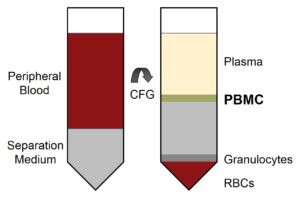
In the human body, these mononuclear leukocytes continuously circulate within normal human blood, acting as a major component of peripheral immunity and systemic immune surveillance. All components of the human PBMC fraction originate from hematopoietic stem cell lineages in the bone marrow, where they undergo initial development before entering the bloodstream; notably, T cells migrate to the thymus to undergo critical thymic maturation. A standard blood sample contains a mixture of different cell types; therefore, isolating PBMC requires separating them from more abundant components, such as red blood cells and granulocytes.
The primary biological function of the peripheral blood mononuclear cell population is to coordinate immune defense, maintain peripheral tolerance, and eliminate pathogenic or malignant threats. Within this network, adaptive lymphocytes like the CD4+ helper T cell and the CD8+ cytotoxic T cell drive highly specific, antigen-dependent memory responses. Conversely, innate effectors provide a rapid, antigen-independent inflammatory response. For instance, a natural killer cell (specifically characterized as a CD3− CD56+ NK cell) continuously scans for down-regulated major histocompatibility complex (MHC) class I molecules to eliminate virally infected or neoplastic cells. Monocytes and dendritic cells actively bridge innate and adaptive immunity by acting as professional antigen-presenting cells (APCs). A circulating monocyte (CD14+) acts as a phagocytic responder with the functional plasticity to migrate into tissues and differentiate into a macrophage or a mature dendritic cell under appropriate localized cytokine signals, helping initiate downstream adaptive cascades.
In preclinical drug development and translational immunology, isolated PBMC serve as an indispensable, high-throughput in vitro testing ground. Researchers routinely utilize these cells to map viral entry kinetics, evaluate vaccine immunogenicity, and chart the complex cytokine networks driving autoimmune disorders. They are also central to validating cancer immunotherapies, such as assessing the tumor-killing efficiency of chimeric antigen receptor (CAR) T cells, bispecific T-cell engagers (BiTEs), and immune checkpoint inhibitors.
To initiate these pathways in vitro, cell isolation and activation protocols must be carefully tailored; for example, lipopolysaccharide (LPS) is deployed to activate a monocyte or macrophage via TLR4, whereas phytohemagglutinin (PHA) or anti-CD3/anti-CD28 antibodies are used as classic T-cell mitogens. Because many circulating lymphocytes are quiescent (G0) until activated, standardizing the initial cell isolation, keeping track of total cell count, and matching healthy donor cell lots alongside patient samples helps ensure assay reproducibility across diverse multi-cellular research pipelines.
Peripheral Blood Mononuclear Cells (PBMC), also known as Human Mononuclear Cells from Peripheral Blood (HMNC-PB), are widely used in research and clinical applications every day, and provide a useful tool for studying various aspects of pathology and biology in vitro. Cell Applications PBMC are cryopreserved immediately after isolation.
- Immunology (including auto-immune disorders), infectious disease, hematological malignancies, vaccine development, transplant immunology
- High-throughput screening
- Neovascularization to improve limb ischemia and in cell therapy to repair ischemic and infracted myocardium.
- Human body defense mechanisms critical in the immune system to fight bacterial and viral infections, and function as immune surveillance network to kill tumor cells.
- The secretion of cytokines to regulate immune response and inflammation
- Biological effects on tissue and organs.
- Chemokine effects on adipocytes and muscles
Details
| Tissue | Normal healthy human peripheral blood | |
|---|---|---|
| QC | No bacteria, yeast, fungi, mycoplasma, virus | |
| Cryovial | 10,000,000 PBMC / HMNC-PB frozen right after isolation in DMEM w/ 45% FBS, 10% DMSO | |
| Kit | Cryovial Frozen PBMC / HMNC-PB, Culture Medium (615-250) | |
| Doublings | N/A – Blood cells don’t proliferate in vitro |
Resources
FAQs
Need More Help?
Visit our comprehensive FAQ page for detailed answers to common questions.
Need More Help?
Visit our comprehensive FAQ page for detailed answers to common questions.
Primary Cell FAQs Powered by Bioz