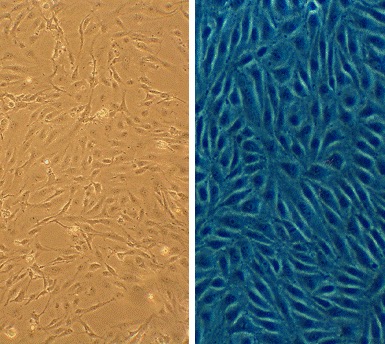
Porcine Coronary Artery Endothelial: PCAEC
Porcine Coronary Artery Endothelial Cells: PCAEC
Porcine Coronary Artery Endothelial Cells (PCAEC) are specialized endothelial cells derived from the innermost lining of swine coronary arteries.
Description
Porcine Coronary Artery Endothelial Cells (PCAEC) are specialized animal cells derived from the innermost lining of swine coronary arteries. As primary animal cells isolated from the vessel wall, they serve as a commonly used model for investigating cardiovascular physiology.
In vivo, these cells typically organize as an endothelial monolayer lining the arterial lumen, interfacing with circulating blood and interacting with underlying smooth muscle cells within the vessel wall. While endothelial cells generally contribute to maintaining cardiovascular homeostasis, regulating coronary blood flow, and modulating vascular tone, researchers recognize that endothelial phenotype and function can exhibit regional heterogeneity across different vascular sites.
PCAEC are commonly used to study artery endothelial function, metabolism, and the pathogenesis of conditions such as coronary artery disease, atherosclerosis, and hypertension. Because endothelial dysfunction often contributes to vascular pathology, researchers can culture endothelial cells under controlled passage and cell culture conditions — frequently acquired as frozen cells in vials — to explore specific experimental questions, such as:
- Investigating whether adipocyte-derived cytokines like resistin can cause endothelial dysfunction and oxidative stress linked to obesity-associated vascular disease.
- Examining how secretoneurin can activate nitric oxide synthase expression, potentially leading to endothelial relaxation.
- Assessing the anti-inflammatory and cardioprotective effects of novel drug formulations by observing cellular adhesion molecules and leukocyte interactions.
In experimental applications, maintaining robust cultures requires screening for mycoplasma and bacteria. Investigators often characterize these cell models by evaluating markers such as von Willebrand factor, comparing responses with cells from other regions like the iliac artery, and utilizing tools such as animal immunoassay kits and animal targeted antibodies to measure secreted animal proteins in contexts ranging from basic research to veterinary biologicals development.
Porcine Coronary Artery Endothelial Cells (PCAEC) provide a useful tool to study artery endothelial function and metabolism. Arterial endothelial cells play critical roles in cardiac homeostasis, and insults to the endothelial cells have been linked to a variety of vascular diseases.
PCAEC from Cell Applications, Inc. have been used to:
- Investigate a new mechanism of obesity-associated vascular disease by demonstrating that resistin, an adipocyte-derived cytokine implemented in insulin resistance and diabetes, can cause endothelial dysfunction in coronary arteries through oxidative stress and down-regulation of NO synthase
- Show that secretoneurin activates expression of NO synthase and calmodulin, leading to endothelial relaxation
- Reveal anti-inflammatory, cardioprotective effects of a novel adenosine-lidocaine drug formulation by observing adhesion and transmigration
Details
| Tissue | Normal healthy porcine coronary artery | |
|---|---|---|
| QC | No bacteria, yeast, fungi, mycoplasma | |
| Character | DiI-Ac-LDL uptake: Positive | |
| Bioassay | Attach, spread, proliferate in Growth Med | |
| Cryovial | 500,000 PAOEC (2nd passage) frozen in Basal Medium w/ 10% FBS, 10% DMSO | |
| Kit | Cryovial frozen PCAEC (P300-05), Growth Medium (P211-500), Subculture Rgnt Kit (090K) | |
| Proliferating | Shipped in Gr Med, 3rd psg (flasks or plates) | |
| Doublings | At least 12 | |
| Applications | Laboratory research use only (RUO). Not for human, clinical, diagnostic or veterinary use. |
Resources
FAQs
Need More Help?
Visit our comprehensive FAQ page for detailed answers to common questions.
Need More Help?
Visit our comprehensive FAQ page for detailed answers to common questions.
Primary Cell FAQs Powered by Bioz