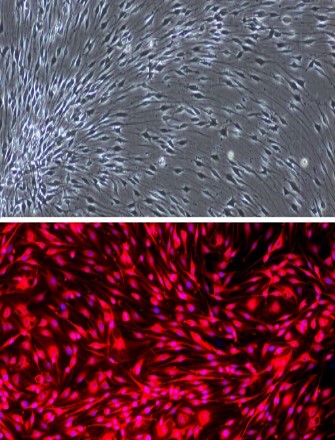
Rat Schwann Cells: RSC
Rat Schwann Cells (RSC) are glial cells of the peripheral nervous system (PNS).
Description
Rat Schwann Cells (RSC) are the principal glial cells of the peripheral nervous system (PNS), providing essential physical structural scaffolding and specialized chemical support for localized neurons. Within the complex architecture of a peripheral nerve, these cells exhibit a highly specialized relationship with axonal processes. Myelinating Schwann cells sequentially wrap around the nerve fibers of large-diameter sensory and motor neurons, synthesizing an insulating, lipid-rich myelin sheath. This structural arrangement enables robust myelination, which is interrupted at precise intervals by the nodes of Ranvier — periodic exposures of the axonal membrane to the extracellular space — allowing saltatory conduction for the rapid propagation of action potentials along the axon. Conversely, non-myelinating Schwann cells ensheath multiple small-diameter axons within Remak bundles, providing vital metabolic protection without forming a compact myelin sheath.
As a primary cell model, isolated RSC retain the functional plasticity, receptor profiles, and signaling capacities of their in vivo counterparts far more accurately than continuous or transformed glial lines. These primary schwann cells play an instrumental role in maintaining the overall morphology, baseline survival, and long-term axonal growth of peripheral axons and neurons. Cultured schwann cells possess a finite proliferative lifespan in vitro. Over extended subculturing, they experience progressive replicative senescence, a gradual loss of myelination potential, and diminished neurotrophic output. Consequently, maintaining low-passage windows is essential when utilizing these cells. Cultured schwann cells are routinely validated via immunocytochemical (ICC) staining for key lineage markers, including the calcium-binding protein S100β and p75 neurotrophin receptor (p75NTR). In cultured schwann cells, S100β serves as a definitive phenotypic marker and is recognized as one of several endogenous factors that participate in extracellular regulatory and neurotrophic mechanisms, supporting both peripheral sensory and motor neurons.
Primary RSC serve as an indispensable cellular tool for decoding the complex microenvironment of peripheral neuropathies, mechanical trauma, and axonal repair:
-
Response to Peripheral Nerve Injury and Phenotypic Plasticity: Following a traumatic peripheral nerve injury—such as a crush or transection of the sciatic nerve — Schwann cells exhibit a remarkable capacity to dedifferentiate and reprogram. In response to the nerve injury, mature myelinating cells undergo an EMT-like phenotypic reprogramming, transitioning into a specialized Schwann cell repair program. During this phase, they shed their sheaths, downregulate structural myelin protein components, and transform into highly proliferative repair Schwann cells. These specialized repair cells clear local myelin debris via autophagy and arrange themselves into elongated cellular columns known as bands of Büngner. These columns provide a physical and molecular guide template that directly facilitates axonal growth, directing regenerating growth cones across the injury site toward their original target tissues.
-
Paracrine Signaling and Acellular Exosomal Therapeutics: Beyond physical guidance, Schwann cells orchestrate nerve regeneration through the robust synthesis and secretion of neurotrophic factors, including nerve growth factor (NGF), brain-derived neurotrophic factor (BDNF), and glial cell line-derived neurotrophic factor (GDNF). High-interest workflows center on the utility of the acellular secretome, demonstrating that schwann cell derived exosomes contain a specialized cargo of microRNAs and proteins. These Schwann cell–derived exosomes are actively internalized by injured neurons to enhance axonal growth and accelerate nerve regeneration post-injury. While these exosomal platforms show immense therapeutic promise in preclinical models, their clinical translation remains experimental, and established clinical efficacy has not yet been universally demonstrated.
-
Investigational Central Nervous System (CNS) Repair: Because the central nervous system lacks the innate regenerative capacity of the PNS due to the inhibitory nature of the glial scar, researchers frequently evaluate schwann cell transplantation to bridge central lesion sites. In experimental models of spinal cord injury, schwann cell transplantation has been shown to support axon growth and bridge tissue cavities. However, critical translational challenges remain—including limited host-graft integration, variable remyelination quality, and inconsistent functional recovery outcomes. Consequently, these cell-based approaches represent an active area of investigational research rather than a proven clinical therapy for severe peripheral nerve injury conditions, traumatic brain injuries, or chronic CNS lesions.
Details
| Tissue | Normal healthy adult rat peripheral nerves | |
|---|---|---|
| QC | No bacteria, yeast, fungi, mycoplasma | |
| Character | Positive for S100β | |
| Bioassay | Attach, spread, proliferate in Gr Med | |
| Cryovial | 500,000 RSC (1st passage) frozen in Basal Medium w/ 10% FBS, 10% DMSO | |
| Kit | R842K-05a: Cryovial frozen RSC (R842-05a), Growth Medium (R825-500), Coating Solution (036-20)* Subcltr Rgnt Kit (090K). *036-20-J in R842K-05a-J | |
| Proliferating | Shipped in Gr Med, 1st psg (flasks or plates) | |
| Doublings | At least 3 | |
| Applications | Laboratory research use only (RUO). Not for human, clinical, diagnostic or veterinary use. |
Resources
FAQs
Need More Help?
Visit our comprehensive FAQ page for detailed answers to common questions.
Need More Help?
Visit our comprehensive FAQ page for detailed answers to common questions.
Primary Cell FAQs Powered by Bioz