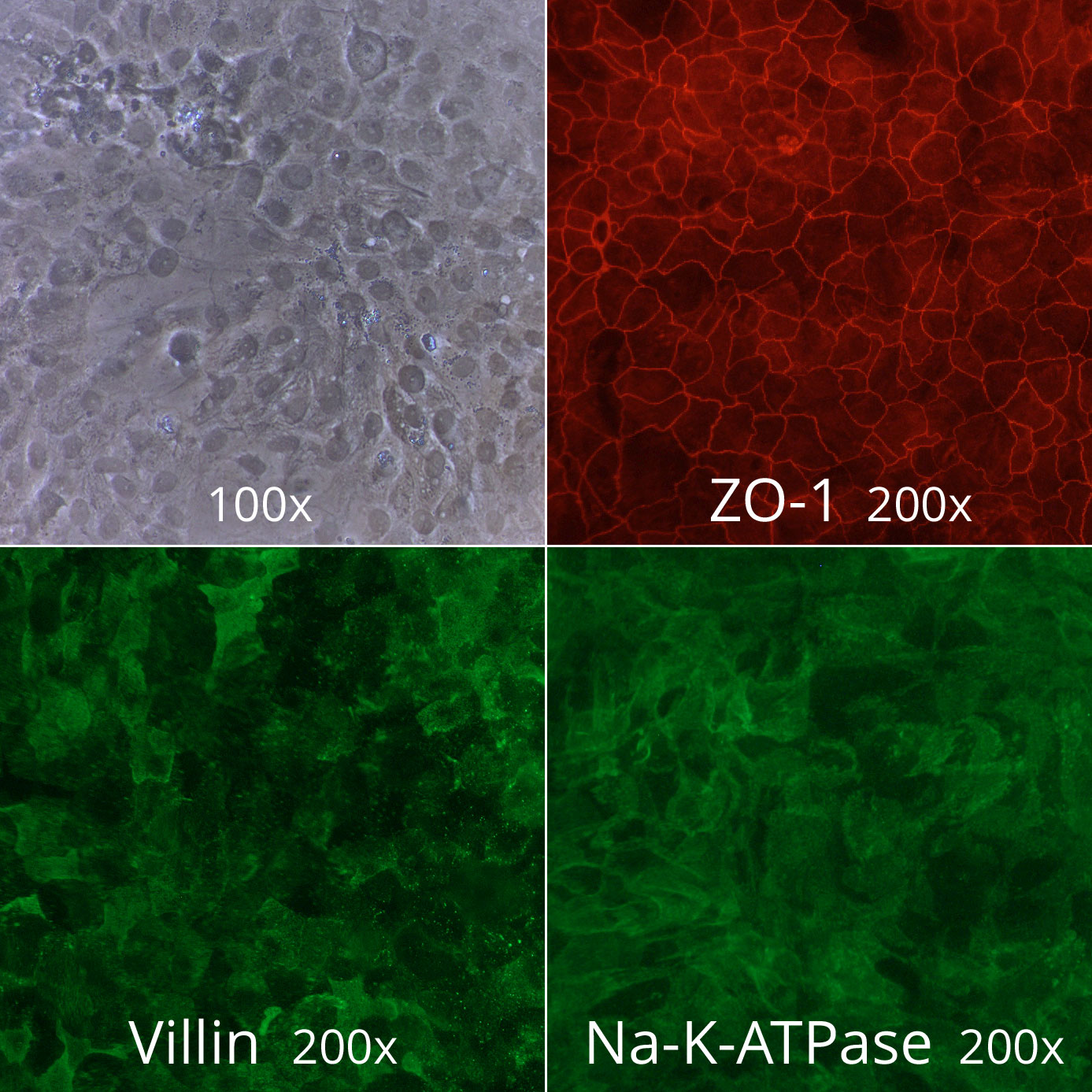
Ulcerative Colitis Gastrointestinal Epithelial Cells from Naive sample (HCnEpC-UC-N): phase contrast 100x, immunostained for ZO-1 (red), Villin (green) and Na-K-ATPase (green), 200x.
Ulcerative Colitis Gastrointestinal Epithelial Cells, Naive
Ulcerative colitis gastrointestinal epithelial cells, naive are specialized primary cells isolated from the colonic and rectal mucosa of patients with ulcerative colitis (UC).
Description
Ulcerative colitis gastrointestinal epithelial cells, naive are specialized primary cells isolated from the colonic and rectal mucosa of patients with ulcerative colitis (UC). These cells, obtained via biopsy, serve as a critical tool for investigating the pathophysiology of this chronic inflammatory bowel disease (IBD). Unlike Crohn’s disease, which often displays patchy, transmural inflammation, ulcerative colitis is characterized by continuous, uniform inflammation restricted to the mucosal lining of the colon and rectum.
These epithelial cells form a complex interface that regulates ion transport, nutrient absorption, and mucosal barrier function. In ulcerative colitis, epithelial barrier functions are frequently disrupted, often reflected in altered junctional protein expression, dysfunctional mucus interactions, and modulated transport pathways.
When researchers refer to “naive” or treatment-naïve samples, the intent is to utilize tissue that reduces confounding by the effects of specific therapeutic interventions — such as corticosteroids, immunomodulators, or biologics — that can significantly alter cellular gene expression and signaling. By utilizing samples with defined clinical histories (e.g., steroid-free or biologic-naïve status), investigators can better distinguish disease-associated epithelial programs from therapeutic side effects. However, it is important to note that maintaining these cells in their native transcriptional state is a rigorous technical challenge; isolation methods (such as organoid generation or primary epithelial sheet expansion) and culture conditions can induce phenotypic drift, requiring careful control to ensure results remain representative of the patient’s disease profile.
The accessibility of well-characterized ulcerative colitis gastrointestinal epithelial cells, naive enables researchers to study the disease through a more precise, human-relevant lens:
- Pathophysiological Investigation: These cells are essential for identifying molecular pathways associated with disease progression. Researchers use them to study how epithelial-intrinsic factors contribute to barrier dysfunction and altered signaling in response to luminal triggers, such as microbial metabolites.
- Disease Stratification: Because UC is classified by anatomical extent — ranging from proctitis to pancolitis — these cells allow for the investigation of whether specific regions of the colon exhibit distinct gene expression and functional profiles that correlate with clinical phenotypes.
- Mechanistic Testing: While primary epithelial monocultures cannot fully recapitulate the complexity of whole-organism mucosal healing, they are highly useful for testing whether candidate compounds modulate epithelial pathways associated with barrier integrity, ion transport, and the expression of inflammatory mediators.
The study of ulcerative colitis relies on the availability of high-quality, clinically annotated primary cells. Because the epithelial layer is influenced by a complex interplay of genetics, microbiome composition, and local immune signaling, the use of documented, naive primary models is vital for reducing experimental variability. By providing a baseline that avoids the confounding variables of medication, these primary cell resources enable researchers to generate robust scientific references necessary to clarify the epithelial contributions to UC and to advance the development of targeted, precision-based research strategies.
Ulcerative colitis gastrointestinal epithelial cells, naive provide a valuable research platform for isolating disease-specific epithelial behaviors from the secondary effects of pharmacological treatment. By focusing on the structural and functional changes inherent to the colonic mucosa, these cells support studies that clarify epithelial mechanisms relevant to UC/IBD and how epithelial pathways respond to perturbation and therapy candidates.
Ulcerative Colitis (UC) is a chronic inflammatory bowel disease (IBD) that causes inflammation and ulcers in the digestive tract. In contrast to Crohn’s Disease (see Treated CD and Untreated CD), which can affect any part of the GI and the entire thickness of the bowel wall, Ulcerative Colitis affects the innermost lining of the colon and rectum. Inflammation is patchy throughout the CD bowel, while inflammation is continuous and uniform in UC. Research suggests infection and abnormal immune response may trigger Ulcerative Colitis, and genetics and microbiome may be contributing factors, but mechanism of disease pathology is unclear.
To better understand Ulcerative Colitis and disease treatment, Cell Applications offers researchers access to a first-of-kind biobank of UC Epithelial Cells. These Ulcerative Colitis cells originate from colon (Cn) and Rectum (Re) tissue samples, and includes different types of UC. Ulcerative Colitis is classified by location, and include: Proctitis (rectum), Proctosigmoiditis (rectum and sigmoid colon), Left-sided colitis (rectum, sigmoid, descending colon), and Pancolitis (entire colon).
For your convenience, the Epithelial Cell Total Kit includes all the reagents you need for gastrointestinal epithelial cell culture. Along with a cryovial of 500,000 diseased epithelial cells, the Total Kit includes optimized cell culture medium, thawing medium, and coating solution. Cells can be cultured up to 7 days. Cells cannot be passaged and should be plated directly into the experimental system.
Details
| Tissue | Human colon (Cn) or rectum (Re) of untreated Ulcerative Colitis. | |
|---|---|---|
| QC | No bacteria, yeast, fungi, mycoplasma, virus. | |
| Bioassay | Attach, spread, in Culture Medium. | |
| Cryovial | 500,000 HCnEpC-UC-N or HReEpC-UC-N in Freezing Medium. | |
| Kit | Cryovial frozen HCnEpC-UC-N (732Cn-UC-N-05a) or HReEpC-UC-N (732Re-UC-N-05a), with Culture Med (716DC-50), Coating Solution (025-05), Thawing Solution (716T-20). | |
| Cultured | Shipped in flasks or plates in medium. | |
| Doublings | Cells can be cultured up to 7 days. Cells do not divide, and cannot be passaged. | |
| Applications | Laboratory research use only (RUO). Not for human, clinical, diagnostic or veterinary use. |
Resources
FAQs
Need More Help?
Visit our comprehensive FAQ page for detailed answers to common questions.
Need More Help?
Visit our comprehensive FAQ page for detailed answers to common questions.
Primary Cell FAQs