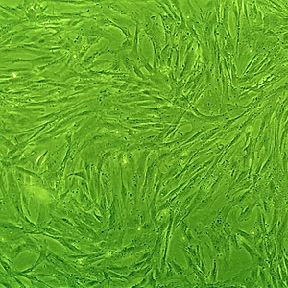
Bovine Renal Artery Smooth Muscle Cells, BRASMC. Isolated from the vessels that supply blood to the kidneys.
Bovine Renal Artery Smooth Muscle Cells: BRASMC
Bovine Renal Artery Smooth Muscle Cells (BRASMC) are specialized animal cells derived from the tunica intima and tunica media of normal bovine renal arteries.
Description
Bovine Renal Artery Smooth Muscle Cells (BRASMC) are specialized animal cells derived from the tunica intima and tunica media of normal bovine renal arteries. As a primary vascular smooth muscle cell type found within the vessel wall and vascular wall, they provide a valuable model for investigating renal hemodynamics and vascular physiology.
In vivo, these cells contribute to the structural integrity and regulation of blood flow through small renal arteries, arterioles, and larger blood vessels. Renal vascular smooth muscle cells possess unique physiological properties, such as being uniquely refractory to angiotensin stimulation, which may play a protective role in how the kidney regulates blood pressure through the renin-angiotensin system.
In laboratory research, BRASMC are commonly used to study mechanisms of vascular disease, cardiovascular disease, and vascular remodeling. Typically cryopreserved at the second passage, these cells can be successfully cultured and propagated through at least 12 population doublings under controlled cell growth conditions. Researchers can use these models to explore processes such as:
- Investigating how agents like cyclosporine can induce smooth muscle contraction associated with increases in the phosphorylation of specific contractile regulatory proteins.
- Examining cellular proliferation, differentiation, and the maintenance of a contractile phenotype.
- Analyzing extracellular matrix interactions, calcium signaling, and phenotypic comparisons with other populations like endothelial cells, epidermal keratinocytes, and peripheral blood components.
Investigators often characterize these cultures using smooth muscle markers (e.g., α-actin) and standard contamination QC (mycoplasma, etc.).
Bovine Renal Artery Smooth Muscle Cells (BRASMC) are derived from tunica intima and tunica media of normal bovine renal arteries. They are cryopreserved at second passage and can be cultured and propagated at least 12 population doublings. Studies show cyclosporine-induced renal artery smooth muscle contraction is associated with increases in the phosphorylation of specific contractile regulatory proteins. The renal artery smooth muscle is uniquely refractory to angiotensin stimulation and may be protective in the role of the kidney in regulating blood pressure through the renin-angiotensin system.
Details
| Tissue | Normal healthy bovine renal artery | |
|---|---|---|
| QC | No bacteria, yeast, fungi, mycoplasma, virus | |
| Character | Smooth muscle specific α-actin positive | |
| Bioassay | Attach, spread, proliferate in Growth Med | |
| Cryovial | 500,000 BRASMC (2nd passage) frozen in Basal Medium w/ 10% FBS, 10% DMSO | |
| Kit | Cryovial frozen BRASMC (B950-05), Growth Medium (B311-500), Subcltr Rgnt Kit (090K) | |
| Proliferating | Shipped in Gr Med, 3rd psg (flasks or plates) | |
| Population | At least 12 |
Resources
FAQs
Need More Help?
Visit our comprehensive FAQ page for detailed answers to common questions.
Need More Help?
Visit our comprehensive FAQ page for detailed answers to common questions.
Primary Cell FAQs