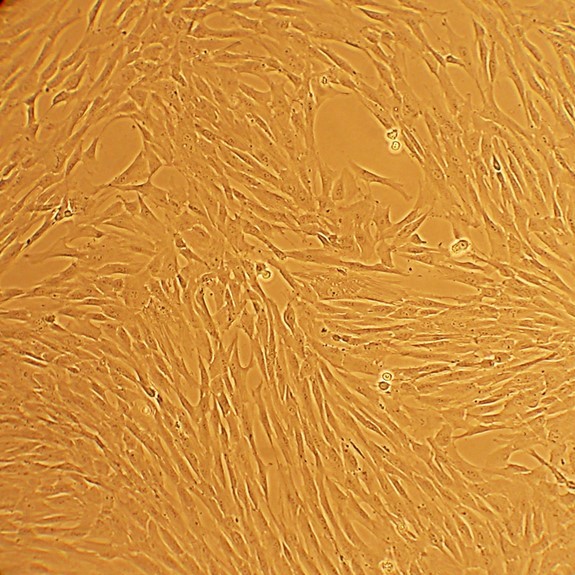
Human Mesenchymal Stem Cells from Umbilical Cord: HMSC-UC
Human Mesenchymal Stem Cells from Umbilical Cord (HMSC-UC) are primary multipotent cells isolated from full-term, healthy umbilical cord tissues.
Description
Human Mesenchymal Stem Cells from Umbilical Cord (HMSC-UC) — also commonly referred to as umbilical cord-derived mesenchymal stem/stromal cells (UC-MSC) or umbilical cord stem cells in the literature — are primary multipotent cells isolated from full-term, healthy umbilical cord tissues. The scientific field routinely navigates a nomenclature debate between the terms “mesenchymal stem cells” and “mesenchymal stromal cells”; some international regulatory guidelines prefer “stromal cells” for heterogeneous primary isolates because uniform, single-cell stemness criteria are not always met.
Isolated from a temporary perinatal organ, HMSC-UC are often described as exhibiting a developmentally immature phenotype compared to adult tissue sources, such as bone marrow or adipose tissue. However, calling them strictly intermediate between pluripotent embryonic stem cells and adult sources is an oversimplification; their actual potency, epigenetic state, and immunobiology differ fundamentally from pluripotent lines and vary based on the specific compartment harvested. Unlike an immortalized cell line, their population-doubling capacity is finite, displaying a progressive decline in cell proliferation kinetics and differentiation fidelity with increasing passage numbers. When expanded in optimized culture media, these plastic-adherent cells maintain rapid growth and high cell viability.
In the newborn anatomy, these cells are distributed within distinct structural zones of the human umbilical cord. They can be harvested from specific compartments, including Wharton’s jelly (the gelatinous umbilical cord matrix), the perivascular zone surrounding the umbilical vessels, or isolated from the whole cord tissue composite. Because they are isolated from a tissue source traditionally discarded as medical waste, they bypass the invasive harvesting procedures associated with human bone marrow aspirates and avoid the ethical constraints surrounding embryonic tissue.
It is a common point of clarification in stem cell research that while they share the perinatal niche with cell types found in umbilical cord blood, HMSC-UC are completely distinct from hematopoietic stem cells and circulating mononuclear cell fractions, which do not exhibit plastic adherence. To preserve these valuable neonatal cell lines for multi-donor validation and tissue engineering, standardizing cell isolation protocols and utilizing specialized newborn stem cell banking or broader stem cell banking repositories is common practice.
The primary biological function of HMSC-UC in vivo is to maintain the structural integrity of the umbilical tissue bed and provide structural and paracrine support to the developing fetal vasculature. As multipotent cells, they possess a broad capacity for differentiation into specific lineage-like cells. Under appropriate environmental cues, they undergo osteogenic differentiation to become bone-like osteoblasts, or chondrogenic differentiation to form chondrocytes. However, standard in vitro protocols generate these lineage-like phenotypes rather than fully mature, integrated structures without extensive conditioning.
Beyond structural differentiation, their therapeutic mechanism operates primarily via potent paracrine signaling rather than robust, long-term engraftment. When stimulated by localized inflammatory cytokines, they adaptively alter their secretome to modulate immune responses. They characteristically suppress T-cell activation and alter macrophage polarization, making them an attractive candidate for minimizing immune rejection in mismatch contexts. They achieve this by releasing a dense cocktail of anti-inflammatory cytokines, growth factors, and extracellular vesicle (EV) structures that blunt tissue fibrosis and support endogenous tissue repair.
In translational medicine, orthopedics, and regenerative medicine, HMSC-UC function as a valuable, low-immunogenicity human-background platform. Investigators widely deploy these primary cells in preclinical cellular therapy workflows to model joint degeneration, develop cartilage repair matrices, and test biomaterial scaffolds designed for bone regeneration. Researchers also extensively utilize their high-yield secretome to explore acellular therapeutic paradigms, isolating each extracellular vesicle to characterize its regulatory microRNA and protein cargo.
While explored in experimental cell transplant protocols or for direct transdifferentiation into distinct lineages like neuronal cells or endothelial networks, researchers must remain cautious. Reports of direct differentiation into fully mature, electrophysiologically functional neuronal cells or functional tissues remain limited and context-dependent. The real-world efficacy of these approaches remains strictly experimental, and their universal clinical efficacy and safety profiles are under active investigation and not yet established as routine human therapies.
Details
| Tissue | Normal healthy umbilical cord (HMSC-UC) | |
|---|---|---|
| QC | No bacteria, yeast, fungi, mycoplasma, virus | |
| Character | Bone mineralization in Osteoblast Differentiation Med, Lipid accumulation in Adipocyte Diff Medium | |
| Bioassay | Attach, spread, proliferate in Growth Med | |
| Cryovial | 500,000 HMSC frozen in Freezing Medium w/ 10% FBS, 10% DMSO | |
| Kit | Cryovial frozen HMSC (492UC-05n), Growth Medium (419-500), Subcltr Rgnt Kit (090K) | |
| Proliferating | Shipped in Gr Med, 3rd psg (flasks or plates) | |
| Doublings | At least 10 | |
| Applications | Laboratory research use only (RUO). Not for human, clinical, diagnostic or veterinary use. |
Resources
FAQs
Need More Help?
Visit our comprehensive FAQ page for detailed answers to common questions.
Need More Help?
Visit our comprehensive FAQ page for detailed answers to common questions.
Primary Cell FAQs