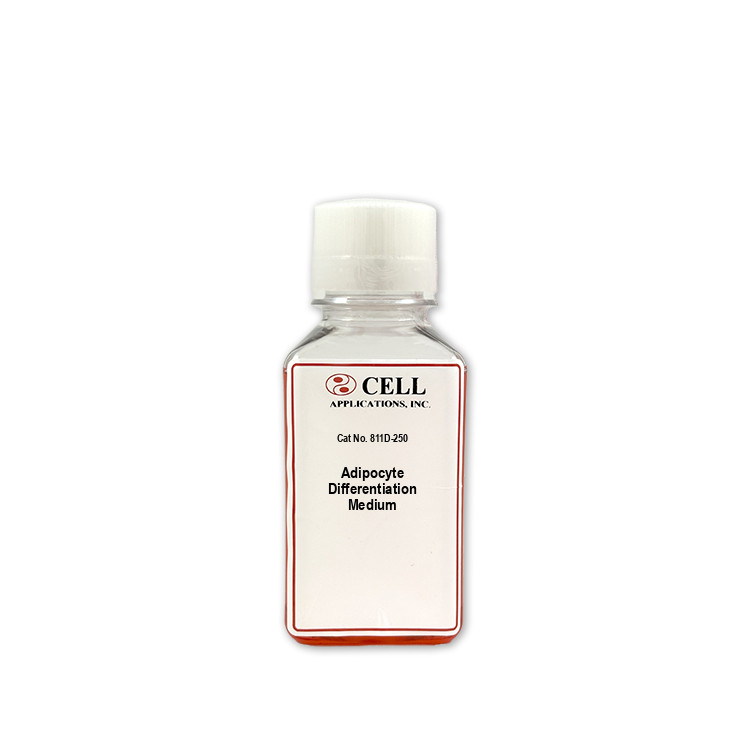
Human Adipocyte Differentiation Medium promotes the transition of Preadipocytes into Adipocytes.
Human Preadipocyte Differentiation Medium
HPAd Differentiation Medium: Add to preadipocytes and mesenchymal stem cells to differentiate into adipocytes
Size: 250 ml
Type: Differentiation Medium
Price: $135.00
Description

- Human
Human Preadipocyte Differentiation Medium is a specialized preadipocyte medium designed to promote adipocyte differentiation of human preadipocytes and selected human mesenchymal stem cell populations. The formulation is intended for use with human preadipocytes, pre-screened human preadipocytes, bone-marrow-derived mesenchymal stem cells, adipose-derived stem cells, dedifferentiated fat cells, and mesenchymal stem cells derived from placenta or umbilical cord. These cell types represent adipogenic progenitors or multipotent stromal cells that can be directed toward the adipocyte lineage under appropriate culture conditions.
Preadipocytes and adipose-derived stromal cells are found within adipose tissue, particularly in the stromal vascular fraction surrounding blood vessels and mature adipocytes. Adipose tissue contains multiple interacting cell populations, including tissue derived preadipocytes, human stromal vascular cells, endothelial cells, pericytes, immune cells, and adipose derived stem cells. During the developmental process of adipogenesis, preadipocytes undergo growth arrest, lineage commitment, and morphological maturation into mature adipocytes. The resulting differentiated adipocyte develops one or more intracellular lipid droplets and acquires the ability to store and mobilize triglycerides.
Human adipocytes have an important function in energy storage, endocrine signaling, and metabolic homeostasis. They store excess energy as neutral lipid and release fatty acids during periods of energy demand. Adipocytes also secrete signaling molecules, including leptin, adiponectin, and inflammatory mediators, that influence appetite, insulin sensitivity, immune activity, and whole-body lipid metabolism. Dysregulated adipocyte development, adipocyte lipolysis, inflammation, or lipid accumulation can contribute to obesity, diabetes, insulin resistance, hyperlipidemia, and increased adipose tissue mass.
This differentiation medium provides the extracellular and biochemical signals required to initiate and support human adipocyte differentiation in vitro. Adipogenic induction commonly involves coordinated changes in insulin signaling, cyclic AMP activity, glucocorticoid signaling, and PPARγ-dependent transcriptional programs. These pathways promote adipogenic transcription factor expression, including activation of C/EBPβ, C/EBPδ, C/EBPα, and PPARγ, followed by increased expression of adipogenic genes such as FABP4, LPL, ADIPOQ, and LEP. The medium may contain insulin, glucocorticoid or other induction factors, vitamins, and other formulation-specific components that support differentiation; researchers should consult the product documentation for the exact composition and recommended use.
Human Preadipocyte Differentiation Medium enables researchers to generate reproducible adipocyte-like cultures for studies of adipogenesis, lipid storage, glucose and fatty-acid handling, adipocyte lipolysis, endocrine signaling, inflammation, and metabolic disease. Differentiated cultures can be evaluated by changes in morphology, neutral lipid staining, lipid-droplet size and number, triglyceride content, insulin responsiveness, and gene expression. Because donor source, tissue depot, age, metabolic status, passage number, and culture conditions can influence adipogenic potential, different cell populations may display different lipid accumulations and distinct differentiation kinetics.
These human cell models support experiments involving obesity, diabetes, hyperlipidemia, tissue engineering, drug discovery, and toxicology. They can also be used to investigate inflammatory mechanisms, including TNF-α induced apoptosis, although apoptosis should be measured directly rather than inferred from reduced differentiation or cell number. The medium is intended to support the transition from preadipocytes or mesenchymal stem cells to adipocytes; it is not a universal stem cell maintenance medium and should not be assumed to preserve an undifferentiated stem-cell state.
Medium carefully optimized for the characteristics and requirements unique to the differentiation of Human Preadipocytes into Adipocytes. Attention to detail ensures ideal cell health, viability, performance, physiology, morphology, consistency and data.
Use with:
- Human Preadipocytes: HPAd
- Human Preadipocytes: Pre-Screened for Adipogenesis Signaling
- Human Mesenchymal Stem Cells: HMSC-BM
- Human Mesenchymal Stem Cells, Adipose-derived: HMSC-Ad
- Human Mesenchymal Stem Cells, Dedifferentiated: HMSC-DFAT
- Human Mesenchymal Stem Cells from Placenta: HMSC-PL
- Human Mesenchymal Stem Cells from Umbilical Cord: HMSC-UC
Details
CAI media are tested for sterility in order to confirm no bacteria, yeast or fungi contaminate the solutions. The products undergo further quality control for correct pH, osmolality and lack of endotoxins. A panel of different bioassays affirm the media sustain a proper environment for expected cell-type-specific culture, growth, plating, karyotype, physiology, morphology, viability, population doublings, surface markers, cryopreservation, differentiation and/or induction.
Laboratory research use only (RUO). Not for human, clinical, diagnostic or veterinary use.
 Powered by Bioz