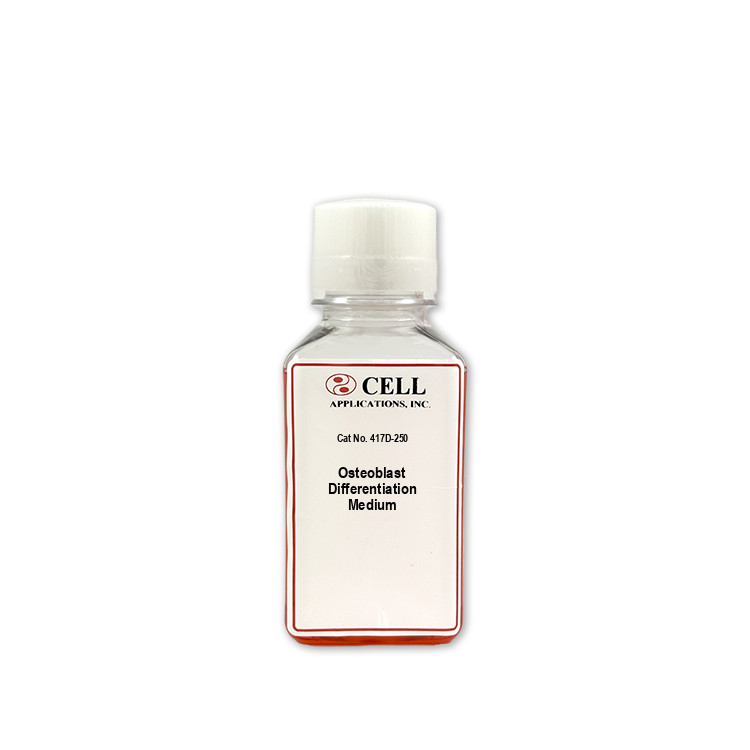
Human Osteoblast Differentiation Medium
Human Osteoblast Differentiation Medium
HOb Differentiation Medium: Promotes cells to change from one type to another, more specialized
Size: 250 ml
Price: $169.00
Description

Human Osteoblast Differentiation Medium is a specialized osteogenic differentiation medium formulated to support the directed osteogenic differentiation of human mesenchymal stem cells (HMSC). It is typically used with HMSC isolated from tissues such as bone marrow, adipose tissue, dental pulp, or other mesenchymal sources. These cells can proliferate under expansion conditions and, when exposed to appropriate osteogenic differentiation media, acquire characteristics of osteoblasts, the matrix-producing cells responsible for bone formation.
Osteoblasts are found on bone surfaces and originate from mesenchymal progenitor cells. Their primary function is to synthesize and organize the organic extracellular matrix of bone, including type I collagen, and to promote the deposition of mineral. During maturation, some osteoblasts become bone-lining cells or are surrounded by the matrix they produce and differentiate into osteocytes. Osteocytes reside within small spaces in mineralized bone and function as mechanosensory and regulatory cells that help coordinate bone remodeling and mineral homeostasis.
Human Osteoblast Differentiation Medium provides a controlled culture environment containing supplements that support the transition of human MSC toward an osteogenic phenotype. The formulation is intended to promote osteogenic gene expression, extracellular-matrix production, alkaline-phosphatase activity, and subsequent mineralization. Depending on the source and passage history of the cells, osteogenic induction may also influence cell morphology, proliferation, and the expression of proteins associated with osteoblast development.
This medium is useful for studying the cellular mechanisms of bone formation and remodeling, comparing the osteogenic potential of human MSC preparations, and evaluating the effects of biomaterials, drugs, growth factors, mechanical stimulation, and disease-associated conditions. Researchers may use differentiated cultures for osteogenic marker analysis, mineral-deposition assays, alkaline-phosphatase detection, immunostaining, microscopy, gene-expression studies, and other methods of cellular characterization. Such applications support research in bone biology, osteoporosis, skeletal development, regenerative medicine, and tissue engineering.
Osteogenic differentiation models are also used to assess how three-dimensional scaffolds, hydrogels, coatings, and other biomaterials influence bone-forming activity. In these systems, the medium helps provide biochemical conditions that complement the physical and mechanical properties of the material. Results from in vitro cultures can be compared with findings from in vivo studies, although an in vitro osteogenic response does not by itself establish functional bone formation in vivo.
The osteogenic response can vary according to donor, tissue source, cell isolation method, passage number, expansion conditions, and culture format. Human MSC should therefore be characterized before induction and evaluated using multiple endpoints rather than relying on a single detection method. Appropriate controls are especially important when distinguishing osteogenic differentiation from changes associated with general proliferation or nonspecific stress. Chondrocytes, for example, are a different skeletal cell type that produces cartilage matrix and should not be interpreted as osteoblasts solely on the basis of morphological changes.
For reproducible experiments, researchers should follow the product protocol in accordance with the recommended culture conditions, including cell density, medium changes, incubation parameters, and handling instructions. If the product requires temporary storage or handling at room temperature, exposure should be limited to the period specified in the product documentation, with the medium otherwise stored as directed. The use of consistent conditions supports comparison across experiments, improves interpretation of the result, and facilitates reporting in a scientific publication.
Human Osteoblast Differentiation Medium is intended for research use only and is not intended to diagnose, treat, or prevent disease in humans or animals.
Medium carefully optimized for the characteristics and requirements unique to the differentiation of osteoblasts. Attention to detail ensures ideal cell health, viability, performance, physiology, morphology, consistency and data.
Use with:
- Human Osteoblasts-Osteoarthritis: HOb-OA
- Human Osteoblasts-Rheumatoid Arthritis: HOb-RA
- Human Osteoblasts: HOb
- Human Mesenchymal Stem Cells: HMSC-BM
- Human Mesenchymal Stem Cells, Adipose-derived: HMSC-Ad
- Human Mesenchymal Stem Cells, Dedifferentiated: HMSC-DFAT
- Human Mesenchymal Stem Cells, Placental: HMSC-PL
- Human Mesenchymal Stem Cells, Umbilical Cord: HMSC-UC
 Powered by Bioz