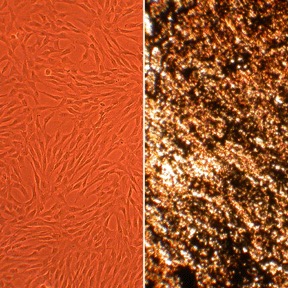
Human Osteoblasts: HOb
Human Osteoblasts (HOb) are primary specialized bone cells responsible for bone matrix synthesis and subsequent mineralization from fetal or adult human bone tissue.
Description
Human Osteoblasts (HOb) are primary specialized bone cells responsible for bone matrix synthesis and subsequent mineralization. Sourced as primary human cells from fetal or adult human bone tissue, these cells provide a more physiologically accurate experimental model than a transformed continuous cell line or an osteoblast cell line (such as MG-63 or Saos-2), which often harbor mutations that disrupt native signaling. When selecting a tissue source, investigators must account for developmental differences: fetal cells typically have higher proliferative capacity and a higher baseline rate of cell growth than adult cells, whereas adult-derived cells are often chosen to better model age-related skeletal characteristics.
To maintain high cell viability, support cell proliferation, and preserve their phenotypic identity in vitro, HOb require specialized osteoblast growth medium. Quality control validation of these primary cultures routinely involves verifying that the cells are free of contaminants such as mycoplasma, and testing for classic markers of the osteoblast function phenotype. This includes evaluating their capacity for osteoblast differentiation and mineral deposition. However, mineral deposition in vitro depends heavily on supplied osteogenic supplements (such as -glycerophosphate, ascorbate, and dexamethasone). Researchers routinely validate their outcomes using multiple orthogonal functional assays.
In the living organism, this cell type is found along the growing or remodeling surfaces of the skeleton, situated within the periosteum and the endosteum of bone tissue. They originate from the differentiation of multipotent mesenchymal stem cells located in the bone marrow and periosteal niches. In the native bone microenvironment, HOb operate within a tightly integrated cellular network. They work in coordinated networks with bone-resorbing osteoclasts and osteocytes — which are terminally embedded osteoblast-lineage cells that act as mechanosensors and major regulators of bone remodeling via signaling pathways like RANKL and osteoprotegerin (OPG). To facilitate disease-specific research, specialized tissue repositories also isolate HOb from donors afflicted with joint diseases, providing primary cells that natively manifest the pathological signaling configurations of osteoarthritis or rheumatoid arthritis.
The primary biological function of a human osteoblast is to drive osteogenesis, bone morphogenesis, and structural bone repair. During the bone remodeling cycle, HOb balance the resorptive activity of osteoclasts by synthesizing the organic components of the bone matrix, which is primarily composed of type I collagen and major non-collagenous proteins such as osteocalcin, osteopontin, and bone sialoprotein. Following matrix deposition, these cells orchestrate mineral deposition by utilizing alkaline phosphatase. This enzyme increases the local concentration of free phosphate while simultaneously reducing pyrophosphate, a potent inhibitor of hydroxyapatite crystallization. In vitro, this mineralizing capacity is functionally quantified by tracking elevated ALP activity and visualizing matrix calcification using alizarin red or von Kossa staining after appropriate chemical induction.
In translational orthopedics, endocrinology, and oncology, HOb function as a valuable human-background platform for evaluating skeletal biology and mapping disease mechanisms. Investigators routinely deploy these cells to trace the gene expression cascades and nuclear factors governed by bone morphogenetic proteins (BMPs), growth factors, and pro-inflammatory cytokines. They serve as a vital screening model to investigate mechanisms behind bone loss, periodontitis, and osteoporosis. While matrix metalloproteinases (MMPs) derived from multiple surrounding cell types — including chondrocytes, synoviocytes, and infiltrating immune cells — drive joint degradation, researchers utilize HOb to analyze how osteoblast-specific MMP production contributes to localized extracellular matrix breakdown. In orthopedic tissue engineering and dentistry, HOb are extensively paired with novel biomaterial scaffolds to optimize implant osseointegration and analyze surface adhesion mechanics.
Furthermore, these primary cultures function as essential non-malignant controls in oncology pipelines to evaluate target selectivity. For example, when screening small-molecule therapies or drug delivery vehicles against osteosarcoma, researchers track candidate compounds in parallel across malignant lines and healthy HOb to ensure anti-cancer efficacy without inducing severe cytotoxicity in healthy bone cells. While some traditional laboratories expand these cells using standard basal media supplemented with 10% fetal bovine serum (10% FBS), modern high-throughput drug screening and functional genomics workflows increasingly favor fully defined, serum-free osteoblast growth medium to eliminate donor-serum variability and establish highly reproducible experimental baselines.
- Actions, signaling pathways and cross-talk of growth factors, cytokines and interleukins
- Nuclear factors and gene expression
- Cell proliferation and differentiation
- Bone formation, morphogenesis, and bone morphogenic proteins
- Mechanisms behind bone disorders and defects including bone loss, osteoporosis, osteoclast inhibition, periodontitis, arthritis and related matrix metalloproteinase production
- Cancers, such as osteosarcoma and oncogenes. For the pharmaceutical industry, the cells have been pivotal in developing
- New pharmaceutical treatment strategies and drug delivery methods
- Orthopedic implants and tissue engineering have also been positively impacted by osteoblast research
Details
| Tissue | Normal healthy human bone | |
|---|---|---|
| QC | No bacteria, yeast, fungi, mycoplasma, virus | |
| Character | Bone mineralization (Kossa stain) | |
| Bioassay | Attach, spread, proliferate in Growth Med | |
| Cryovial | 500,000 HOb (2nd passage) frozen in Basal Medium w/ 10% FBS, 10% DMSO | |
| Kit | Cryovial frozen HOb (406-05), Growth Medium (417-500), Subcltr Rgnt Kit (090K) | |
| Proliferating | Shipped in Gr Med, 3rd psg (flasks or plates) | |
| Doublings | At least 10 | |
| Applications | Laboratory research use only (RUO). Not for human, clinical, diagnostic or veterinary use. |
Resources
FAQs
Need More Help?
Visit our comprehensive FAQ page for detailed answers to common questions.
Need More Help?
Visit our comprehensive FAQ page for detailed answers to common questions.
Primary Cell FAQs Powered by Bioz