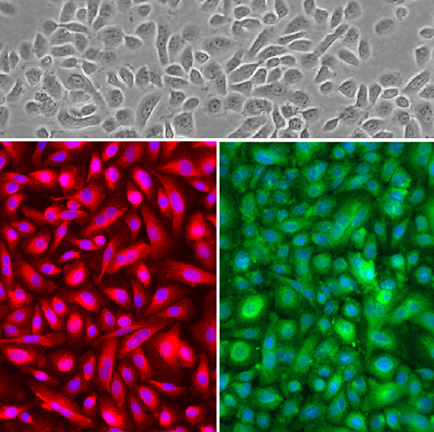
Human Small Airway Epithelial Cells (HSAEpC) play important roles in gas exchange, immune response and barrier function. They are available cryopreserved, as fresh proliferating cells, or in convenient kits containing media and subculture reagents. Staining: CK18 (red) and CK19 (green).
Human Small Airway Epithelial Cells: Asthma: HSAEpC-AS
Human Small Airway Epithelial Cells from donors with asthma (HSAEpC-AS) are specialized primary epithelial populations isolated from the distal portion of the lung tissue in the bronchiole area of the respiratory tract from donors with asthma.
Description
News Release
Human Small Airway Epithelial Cells from donors with asthma (HSAEpC-AS) are specialized primary epithelial populations isolated from the distal portion of the lung tissue in the bronchiole area of the respiratory tract. Located in an airway region critical to airway defense and remodeling-related epithelial functions, these primary cells provide an in vitro model to study epithelial mechanisms that may contribute to bronchial hyperresponsiveness in asthma, including aspects relevant to severe asthma and disease-associated structural changes.
Compared to healthy controls, primary cultures derived from asthmatic donors allow investigators to analyze epithelial barrier dysfunction, altered gene transcription, and inflammatory signaling cascades. Research utilizing these cells frequently evaluates:
- Mucin Dynamics and Secretion: Investigating key disease-associated markers, including altered mucin production (e.g., MUC5B/MUC5AC) where observed, which contribute to the mechanisms underlying mucus accumulation in small airways.
- Cellular Heterogeneity and Plasticity: Examining the contribution of specialized resident basal cells (when maintained or differentiated under appropriate culture systems) and differentiated epithelial phenotypes to impaired repair and structural remodeling.
- Comparative Respiratory Disease Modeling: Exploring overlapping epithelial pathways shared with other chronic conditions — such as chronic obstructive pulmonary disease (COPD) and cystic fibrosis — to understand how epithelial alterations affect overall respiratory health.
Researchers employ advanced analytical workflows to assess how these cells respond to environmental triggers, allergens, and therapeutic interventions (ranging from traditional inhaler delivery formulations to novel biologic treatments).
Human Small Airway Epithelial Cells (HSAEpC) are isolated from the distal portion of lung tissue in the bronchiole area of the respiratory tract. Located in a region critical to gas exchange and immune response, HSAEpC provide an in vitro model to research cell biology, immunology and pharmaceutical drug discovery. The small (pulmonary) epithelium forms a continuous lining in the airways, offering mechanical and immunological barriers against the external environment, physically protecting the underlying submucosa.
Below, HSApC from Cell Applications are stained with ACE2 and KRT5. Ongoing research suggests ACE2 is the cellular receptor utilized by SARS-CoV-2, the coronavirus that causes COVID-19, for cell entry.
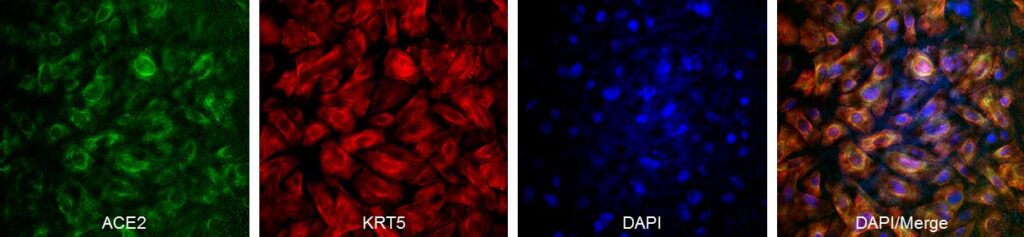
- SAEpC ACE2 KRT5 staining 200504_0
For general cell biology and airway function, the cells provide insights into pulmonary fluid balance, vascular and airway homeostasis and even the lung microbiome. Other work highlights epithelial cell junction integrity, and maintenance of the alveolar barrier integrity that provides first line host defense against inhaled pathogens. HSAEpC help unravel inflammatory signaling pathways, transcription factors and gene expression cascades. Decades of work in lung remodeling, wound healing and repair of surface airway epithelium damage have more recently paved the way to lung organoids and 3D models of small airway epithelium.
Primary HSAEpC offer physiological relevance to the study of respiratory infection, recognition, and immune responses to bacteria, viruses and other foreign invaders like nanoparticles, air pollution and cigarette smoke. Such insults trigger production of chemokines, cytokines and lipids that mediate inflammation and recruit inflammatory cells. HSAEpC dysregulation has also be studied in terms of apoptosis, superoxide production and the effects of hypoxia or radiation.
HSAEpC are targeted in chronic diseases like bronchiolitis, asthma, COPD, cystic fibrosis, pulmonary hypertension and lung cancer. Accordingly, the cells find increasing applications for drug discovery assays, in the hope to identify new therapeutic options to treat or prevent airway disorders. Such tests included compound screening, toxicology, drug uptake and response, in formats ranging from standard 2D assays and microplates to 3D tissue models and airway-on-a-chip technology.
Cell Applications offers a wide panel of cells for use in asthma research and airway drug development, such as Bronchial & Tracheal Epithelial Cells, Pulmonary & Lung Microvascular Endothelial cells and others. Multiple donor profiles and lots are available. Asthma (AS) is a chronic disease that inflames and narrows air passageways in the lungs. This airflow obstruction, which can flare up at any time, causes shortness of breath and can be life-threating in severe cases. Asthma often starts during childhood, and while there’s no cure, scientists and pharmaceutical companies have made strides in understanding, treating and managing the disease.
Details
| Tissue | Human small airway of lung (Asthma (AS)) | |
|---|---|---|
| QC | No bacteria, yeast, fungi, mycoplasma, virus | |
| Bioassay | Attach, spread, proliferate in Growth Med | |
| Cryovial | 500,000 HSAEpC-AS (1st passage) frozen in Basal Med w/ 10% FBS, 10% DMSO | |
| Kit | Cryovial frozen HSAEpC-AS (532AS-05a), Gr Med (512-500), Subculture Rgnt Kit (090K) | |
| Proliferating | Shipped in Gr Med, 3rd psg (flasks or plates) | |
| Doublings | At least 6 | |
| Applications | Laboratory research use only (RUO). Not for human, clinical, diagnostic or veterinary use. |
Resources
FAQs
Need More Help?
Visit our comprehensive FAQ page for detailed answers to common questions.
Need More Help?
Visit our comprehensive FAQ page for detailed answers to common questions.
Primary Cell FAQs