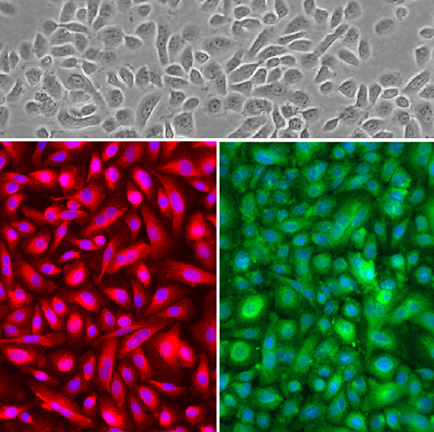
Human Small Airway Epithelial Cells (HSAEpC) play important roles in gas exchange, immune response and barrier function. They are available cryopreserved, as fresh proliferating cells, or in convenient kits containing media and subculture reagents. Staining: CK18 (red) and CK19 (green).
Human Small Airway Epithelial Cells: Type 2 Diabetes: HSAEpC-T2D
Human Small Airway Epithelial Cells from donors with Type 2 Diabetes (HSAEpC-T2D) are primary epithelial cells isolated from the distal lung region of the respiratory tract, including bronchioles and the airway surface epithelium from donors with Type 2 Diabetes.
Description
News Release
Human Small Airway Epithelial Cells from donors with Type 2 Diabetes (HSAEpC-T2D) are primary epithelial cells isolated from the distal lung region of the respiratory tract, including bronchioles and the airway surface epithelium. As a defined cell type that forms a continuous barrier in the airways, HSAEpC-T2D are used to model how small airway epithelial functions — such as barrier integrity, mucosal defense, and coordinated epithelial responses — may be altered in the presence of diabetes-associated disease biology. Because these donor-derived cells retain aspects of airway epithelium state, they provide a relevant in vitro platform for investigating diabetes-related susceptibility to airway inflammation and airway diseases.
HSAEpC-T2D support study of differentiation-dependent airway biology, including the transition and function of basal cells and ciliated cells that drive airway surface epithelium behavior. In this context, researchers can examine how chronic disease conditions influence epithelial cell differentiation programs and how growth factor–regulated signaling pathways contribute to airway surface homeostasis, regenerative medicine applications, and epithelial responses during lung development and tissue repair. The distal lung environment is particularly relevant for modeling pulmonary inflammation, host defense, and epithelial-immune interactions that occur after exposure to pathogens, as well as factors such as airway diseases that contribute to impaired airway function in patients with diabetes.
In vitro, HSAEpC-T2D can be used to explore how diabetes status (and associated metabolic changes) intersects with pulmonary inflammation and epithelial responses that influence disease progression in distal lung disorders, including chronic obstructive pulmonary disease. By connecting donor-associated disease context with measurable changes in epithelial cell biology — such as differentiation state, epithelial regeneration capacity, and inflammatory signaling — HSAEpC-T2D enable mechanistic studies that may inform prevention and therapeutic strategies for airway diseases, while providing a human cell type foundation for translational research in lung health.
Human Small Airway Epithelial Cells (HSAEpC) are isolated from the distal portion of lung tissue in the bronchiole area of the respiratory tract. Located in a region critical to gas exchange and immune response, HSAEpC provide an in vitro model to research cell biology, immunology and pharmaceutical drug discovery. The small (pulmonary) epithelium forms a continuous lining in the airways, offering mechanical and immunological barriers against the external environment, physically protecting the underlying submucosa.
Below, HSApC from Cell Applications are stained with ACE2 and KRT5. Ongoing research suggests ACE2 is the cellular receptor utilized by SARS-CoV-2, the coronavirus that causes COVID-19, for cell entry.
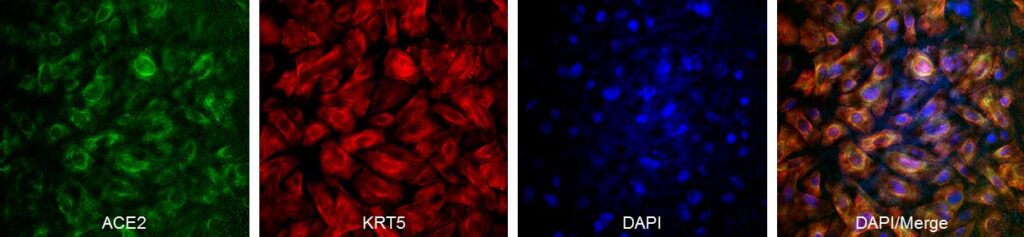
- SAEpC ACE2 KRT5 staining 200504_0
For general cell biology and airway function, the cells provide insights into pulmonary fluid balance, vascular and airway homeostasis and even the lung microbiome. Other work highlights epithelial cell junction integrity, and maintenance of the alveolar barrier integrity that provides first line host defense against inhaled pathogens. HSAEpC help unravel inflammatory signaling pathways, transcription factors and gene expression cascades. Decades of work in lung remodeling, wound healing and repair of surface airway epithelium damage have more recently paved the way to lung organoids and 3D models of small airway epithelium.
Primary HSAEpC offer physiological relevance to the study of respiratory infection, recognition, and immune responses to bacteria, viruses and other foreign invaders like nanoparticles, air pollution and cigarette smoke. Such insults trigger production of chemokines, cytokines and lipids that mediate inflammation and recruit inflammatory cells. HSAEpC dysregulation has also be studied in terms of apoptosis, superoxide production and the effects of hypoxia or radiation.
HSAEpC are targeted in chronic diseases like bronchiolitis, asthma, COPD, cystic fibrosis, pulmonary hypertension and lung cancer. Accordingly, the cells find increasing applications for drug discovery assays, in the hope to identify new therapeutic options to treat or prevent airway disorders. Such tests included compound screening, toxicology, drug uptake and response, in formats ranging from standard 2D assays and microplates to 3D tissue models and airway-on-a-chip technology.
Type 2 Diabetes (T2D) Cellular Disease Models For T2D research and drug discovery, Cell Applications offers multiple cell types, isolated from donors where genetics and lifestyle factors contributed to insulin resistance and high blood sugar levels.
Details
| Tissue | Human small airway of lung (Type 2 Diabetes (T2D)) | |
|---|---|---|
| QC | No bacteria, yeast, fungi, mycoplasma, virus | |
| Bioassay | Attach, spread, proliferate in Growth Med | |
| Cryovial | 500,000 HSAEpC-T2D (1st passage) frozen in Basal Med w/ 10% FBS, 10% DMSO | |
| Kit | Cryovial frozen HSAEpC-T2D (532T2D-05a), Gr Med (512-500), Subculture Rgnt Kit (090K) | |
| Proliferating | Shipped in Gr Med, 3rd psg (flasks or plates) | |
| Doublings | At least 6 | |
| Applications | Laboratory research use only (RUO). Not for human, clinical, diagnostic or veterinary use. |
Resources
FAQs
Need More Help?
Visit our comprehensive FAQ page for detailed answers to common questions.
Need More Help?
Visit our comprehensive FAQ page for detailed answers to common questions.
Primary Cell FAQs