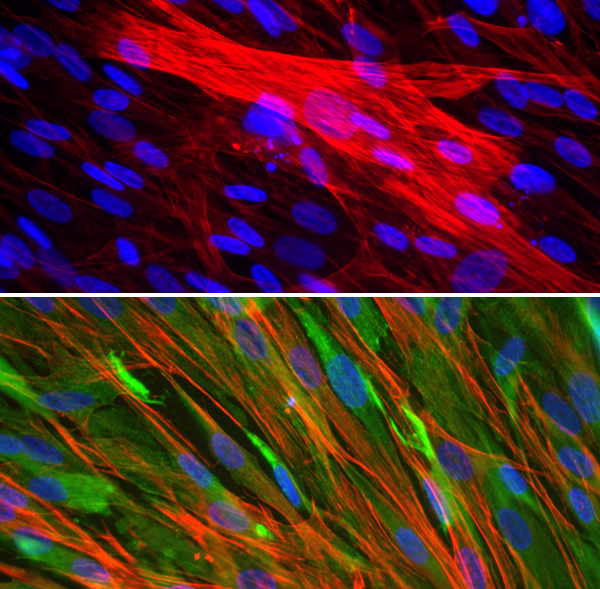
Rabbit Skeletal Muscle Cells: RbSkMC. Fixed and Immunostained for actin & DAPI (Upper) and for actin, desmin & DAPI (Lower).
Rabbit Skeletal Muscle Cells: RbSkMC
Rabbit Skeletal Muscle Cells (RbSkMC) are skeletal muscle cells obtained from the skeletal muscle tissue of healthy rabbits (Oryctolagus cuniculus).
Description

- Sarcomeric Organization: During maturation, RbSkMC align and fuse to form elongated myotubes, synthesizing dense actin filaments and thick filament assemblies. The development of the sarcoplasmic reticulum and other internal organelles is critical for functional contraction.
- Tissue Integration: In the organism, these fibers work in concert with connective tissue, adipose tissue, and the skeleton to facilitate movement and maintain systemic homeostasis. Studying this development provides insights into muscle growth that can be compared against the regenerative potential of stem cells or the structural integrity required for bone health.
Beyond structural roles, RbSkMC are essential for dissecting molecular pathways governing insulin sensitivity and metabolic health.
- Glucose Kinetics: Because skeletal muscle is a primary site for glucose disposal, researchers leverage RbSkMC to track insulin signaling and glucose transporter translocation. This work is pivotal for understanding how localized cellular changes correlate with broader systemic conditions.
- Comparative Pathobiology: Researchers utilize these cells to study the underlying mechanisms of Duchenne muscular dystrophy and other myopathies. By observing how a single muscle cell responds to metabolic or structural stress, investigators can better map the pathways leading to disease, providing a valuable complement to studies performed on human tissues or genetically modified rodent models.
RbSkMC offer unique utility across diverse sectors, ranging from advanced regenerative medicine to agricultural research.
- Agricultural and Food Science: In the meat science sector, these cells serve as a model for understanding musle fibre integrity and post-mortem biochemistry. Researchers utilize RbSkMC cultures to investigate how environmental stress and cellular enzyme systems govern protein quality and tissue breakdown, providing data that helps optimize agricultural productivity.
- Translational Potential: Whether mapping the effects of growth factors on fiber development or validating new therapeutics for muscle wasting, RbSkMC remain a foundational tool for researchers who require a reliable, well-characterized model to bridge the gap between in vitro discovery and physiological application.
Rabbit Skeletal Muscle Cells (RbSkMC) provide a useful system to study muscular function and disease, and serve as a model of human diseases. Skeletal Muscle Cells also play an instrumental role in the glucose metabolism and diabetes. The image shows Confocal Microscopy (L) and fluorescent imaging (R) of RbSkMC.
Details
| Tissue | Normal healthy rabbit limb skeletal muscle | |
|---|---|---|
| QC | No bacteria, yeast, fungi, mycoplasma | |
| Bioassay | Attach, spread, proliferate in Growth Med | |
| Cryovial | 500,000 RbSkMC (1st passage) frozen in Basal Medium w/ 10% FBS, 10% DMSO | |
| Kit | Cryovial frozen RbSkMC (Rb150-05), Growth Medium (Rb151-500), Subcltr Rgnt Kit (090K) | |
| Proliferating | Shipped in Gr Med, 2nd psg (flasks or plates) | |
| Doublings | At least 15 | |
| Applications | Laboratory research use only (RUO). Not for human, clinical, diagnostic or veterinary use. |
Resources
FAQs
Need More Help?
Visit our comprehensive FAQ page for detailed answers to common questions.
Need More Help?
Visit our comprehensive FAQ page for detailed answers to common questions.
Primary Cell FAQs Powered by Bioz