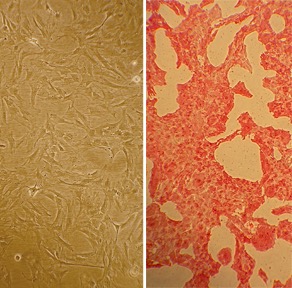
Rat Pulmonary Artery Smooth Muscle Cells: RPASMC (L), immunolabeled for smooth muscle-specific alpha-actin by ABC method (R).
Rat Pulmonary Artery Smooth Muscle Cells: RPASMC
Rat Pulmonary Artery Smooth Muscle Cells (RPASMC) are primary smooth muscle cell populations isolated from the pulmonary vasculature.
Description
Rat Pulmonary Artery Smooth Muscle Cells (RPASMC) are primary smooth muscle cell populations isolated from the pulmonary vasculature, identified/validated by positive immunostaining for smooth muscle α-actin (α-SMA). These primary vascular smooth muscle cells (frequently compared with human pulmonary artery models, adjacent adventitial fibroblasts, or alternative stromal cell types) provide a useful in vitro model to study cellular and molecular mechanisms of pulmonary hypertension and pulmonary arterial hypertension characterized by hyperproliferation of pulmonary artery smooth muscle cells.
To maintain experimental integrity and culture fidelity, rigorous handling protocols require storing stocks in liquid nitrogen and rapidly thawing them in a warm water bath (~37°C) prior to gentle dilution in pre-warmed medium. Periodic quality control assays should be conducted to ensure culture purity across experimental passages. Researchers employ various analytical techniques to monitor target mRNA expression and protein expression profiles, evaluating how different factors influence downstream signaling pathway activity and fundamental biological processes.
In previous studies, Rat Pulmonary Artery Smooth Muscle Cells (RPASMC) have played an important role in investigating the underlying mechanisms of pulmonary vascular remodeling and vascular pathobiology:
Hypoxia and Hyperproliferation: Studies utilizing these cultures have explored how hypoxia and diverse chemical or mechanical stimuli trigger pathological responses, including enhanced cell proliferation, RPASMC proliferation, and phenotypic switching. Investigators analyze how changes in specific gene and protein networks drive this hyperproliferative, synthetic phenotype.
Signaling Networks and Experimental Intervention: By testing compounds across different concentrations, studies evaluate the potential inhibition of aberrant growth pathways, yielding mechanistic insights relevant to pulmonary vascular disease processes.
Cellular Mechanisms and Pathobiology: While advanced structural pathologies such as plexiform lesions require complex in vivo or multilineage systems rather than isolated monolayers, these in vitro models help elucidate discrete smooth muscle responses — such as specific aspects of angiogenesis signaling pathways or matrix interactions — contributing to broader vascular research frameworks.
By modeling these responses, Rat Pulmonary Artery Smooth Muscle Cells (RPASMC) serve as a practical platform for exploring broader biomedical concepts mapped across literature MeSH terms, contributing to foundational discovery in pulmonary vascular disease.
Rat Pulmonary Artery Smooth Muscle Cells (RPASMC) provide a useful in vitro model to study cellular and molecular mechanisms of pulmonary hypertension characterized by hyperproliferation of pulmonary artery smooth muscle cells.
Characterization: positive for smooth muscle cell specific alpha-actin expression
Details
| Tissue | Normal healthy rat pulmonary artery | |
|---|---|---|
| QC | No bacteria, yeast, fungi, mycoplasma | |
| Character | Smooth muscle specific α-actin positive | |
| Bioassay | Attach, spread, proliferate in Growth Med | |
| Cryovial | 500,000 RPASMC (2nd passage) frozen in Basal Medium w/ 10% FBS, 10% DMSO | |
| Kit | Cryovial frozen RPASMC (R352-05a), Growth Medium (R311-500), Subcltr Rgnt Kit (090K) | |
| Proliferating | Shipped in Gr Med, 3rd psg (flasks or plates) | |
| Doublings | At least 12 | |
| Applications | Laboratory research use only (RUO). Not for human, clinical, diagnostic or veterinary use. |
Resources
FAQs
Need More Help?
Visit our comprehensive FAQ page for detailed answers to common questions.
Need More Help?
Visit our comprehensive FAQ page for detailed answers to common questions.
Primary Cell FAQs Powered by Bioz