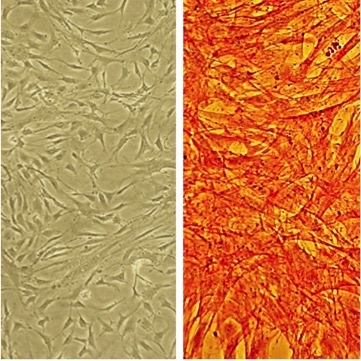
Bovine Pulmonary Artery Smooth Muscle Cells, BPASMC (L) immunolabeled for smooth muscle-specific alpha-actin using ABC method (R).
Bovine Pulmonary Artery Smooth Muscle Cells: BPASMC
Bovine Pulmonary Artery Smooth Muscle Cells (BPASMC) are specialized primary smooth muscle cells isolated from the medial layer of the pulmonary vasculature.
Description
Bovine Pulmonary Artery Smooth Muscle Cells (BPASMC) are specialized primary smooth muscle cells isolated from the medial layer of the pulmonary vasculature, characterized by positive expression of smooth muscle specific alpha-actin. These primary vascular smooth muscle cells (often evaluated alongside human pulmonary artery models or compared to adjacent endothelial cells) provide a valuable experimental system for investigating vascular physiology, tone regulation, and the cellular mechanism driving vascular remodeling.
To maintain experimental integrity and culture fidelity, rigorous quality control — including screening for contaminants such as mycoplasma and bacteria — must be performed in accordance with established protocols, ensuring that stocks thawed from a frozen vial do not exceed recommended passage limits. Researchers employ various analytical techniques, including immunofluorescence staining (utilizing a specific primary antibody) and quantitative analysis, to characterize cellular phenotypes, structural features, and signaling dynamics.
Bovine Pulmonary Artery Smooth Muscle Cells and related vascular smc models are frequently utilized in vascular disease research to explore complex pathological pathways involved in pulmonary vascular disease and arterial disease:
- Pulmonary Hypertension and Hyperproliferation: Studies utilizing Bovine Pulmonary Artery Smooth Muscle Cells (BPASMC) have provided insights into models of pulmonary hypertension, where conditions like chronic lung hypoxia can drive abnormal proliferation. Research has demonstrated that this shift toward a hyperproliferative, proliferative phenotype can be influenced by alterations in regulatory protein expression, enhanced survival signaling, and evasion of normal apoptosis.
- Inflammatory and Signaling Mechanisms: Under pro-inflammatory conditions and broader inflammation related to cell growth, these cells have been used to study PKC-dependent pathways governing matrix metalloproteinase activation and other growth-related events. Investigators examine how upstream triggers alter phosphorylation cascades, driving structural alterations in the vessel wall.
- Hemodynamics and Disease Progression: Beyond biochemical stimuli, researchers investigate how mechanical forces — such as cyclic stretch and fluid shear stress — interact with local cellular pathways to modulate smooth muscle cell proliferation, contributing to the overall progression of vascular lesions.
By modeling these mechanisms, Bovine Pulmonary Artery Smooth Muscle Cells (BPASMC) serve as a practical platform for exploring broader concepts relevant to pulmonary disease, providing insight into shared signaling parallels and translational models that may inform studies across experimental and clinical patients populations.
Bovine Pulmonary Artery Smooth Muscle Cells (BPASMC) from Cell Applications, Inc. have been used in studies relevant to
- Pulmonary hypertension characterized by hyperproliferation of pulmonary artery smooth muscle cells, the process shown to be mediated by hypoxia-induced expression of Bcl-xl
- Additionally, they were used to elucidate the PKC-α dependent mechanisms of proMMP-2 activation and other signaling events in smooth muscle cells under pro-inflammatory conditions related to cell growth
Characterization: positive for smooth muscle cell specific alpha-actin expression
Details
| Tissue | Normal healthy bovine pulmonary artery | |
|---|---|---|
| QC | No bacteria, yeast, fungi, mycoplasma | |
| Character | Smooth muscle specific α-actin positive | |
| Bioassay | Attach, spread, proliferate in Growth Med | |
| Cryovial | 500,000 BPASMC (2nd passage) frozen in Basal Medium w/ 10% FBS, 10% DMSO | |
| Kit | Cryovial frozen BPASMC (B352-05), Growth Medium (B311-500), Subcltr Rgnt Kit (090K) | |
| Proliferating | Shipped in Gr Med, 3rd psg (flasks or plates) | |
| Doublings | Can be cultured at least 16 doublings | |
| Applications | Laboratory research use only (RUO). Not for human, clinical, diagnostic or veterinary use. |
Resources
FAQs
Need More Help?
Visit our comprehensive FAQ page for detailed answers to common questions.
Need More Help?
Visit our comprehensive FAQ page for detailed answers to common questions.
Primary Cell FAQs Powered by Bioz