
Human Bronchial/Tracheal Epithelial Cell Media is a specialized cell culture system optimized to support the growth, attachment, and maintenance of human bronchial/tracheal epithelial cells in vitro. It is used for primary bronchial/tracheal epithelial cells and bronchial epithelial cells derived from normal human lung tissue, including cells obtained from normal human lung and maintained as an epithelial cell culture aimed at preserving epithelial morphology, viability, and physiologically relevant responses. In vivo, airway epithelial cells line the airway surface and function to help protect against inhaled pathogens and particulates, while also coordinating barrier activity and signaling at the epithelium–microenvironment interface. Their behavior is tightly linked to airway extracellular matrix proteins, epithelial architecture, and the health of the cell monolayer in culture.
This media is supplied as a complete all-in-one growth medium or an epithelial cell basal medium used in conjunction with a Human Bronchial/Tracheal Epithelial Cell Growth Supplement, creating a complete medium and supporting epithelial function in a controlled cell culture format. The described system is typically configured to be serum-compatible and growth-factor-supported, using a DMEM-based basal formulation as a nutrient foundation and adding epithelial-specific growth components through the growth supplement to support proliferation and sustained culture. Human Bronchial/Tracheal Epithelial Cell Media is supplied in convenient formats and is intended to be used under appropriate sterile conditions to minimize risk from mycoplasma and other microbial contaminants such as bacteria and fungi; sterile liquid medium handling helps support consistent results for scientists working on airway biology. Antibiotic supplementation (e.g., penicillin) may be provided as part of the culture setup, and the system is used with culture conditions appropriate for maintaining airway epithelial integrity over time.
In research, human airway epithelial cultures supported by this cell culture media are used to study inflammatory mechanisms and epithelial remodeling relevant to asthma, to evaluate barrier and signaling responses, and to model epithelial–matrix interactions in a reproducible manner. The media system is also used to support experimental workflows that require consistent epithelial health over time — enabling investigators to assess epithelial responses to stimuli, study extracellular matrix–dependent behaviors, and generate high-quality samples for downstream molecular and functional assays. For applications requiring supportive cell contact and stable growth environments, epithelial culture can also be performed with feeder layers, allowing investigators to maintain robust cultures for longer-term studies focused on airway physiology and pathobiology. Together, these properties help support translational investigations in airway disease and enable research on epithelial responses with reliable maintenance of function and a culture environment designed to protect epithelial cells under normal growth conditions.
Medium carefully optimized for the characteristics and requirements unique to Human Bronchial and Tracheal Epithelial Cells. Attention to detail ensures ideal cell health, viability, performance, physiology, morphology, consistency and data. As with the majority of our epithelial cell media, this product contains no serum.
Use with:
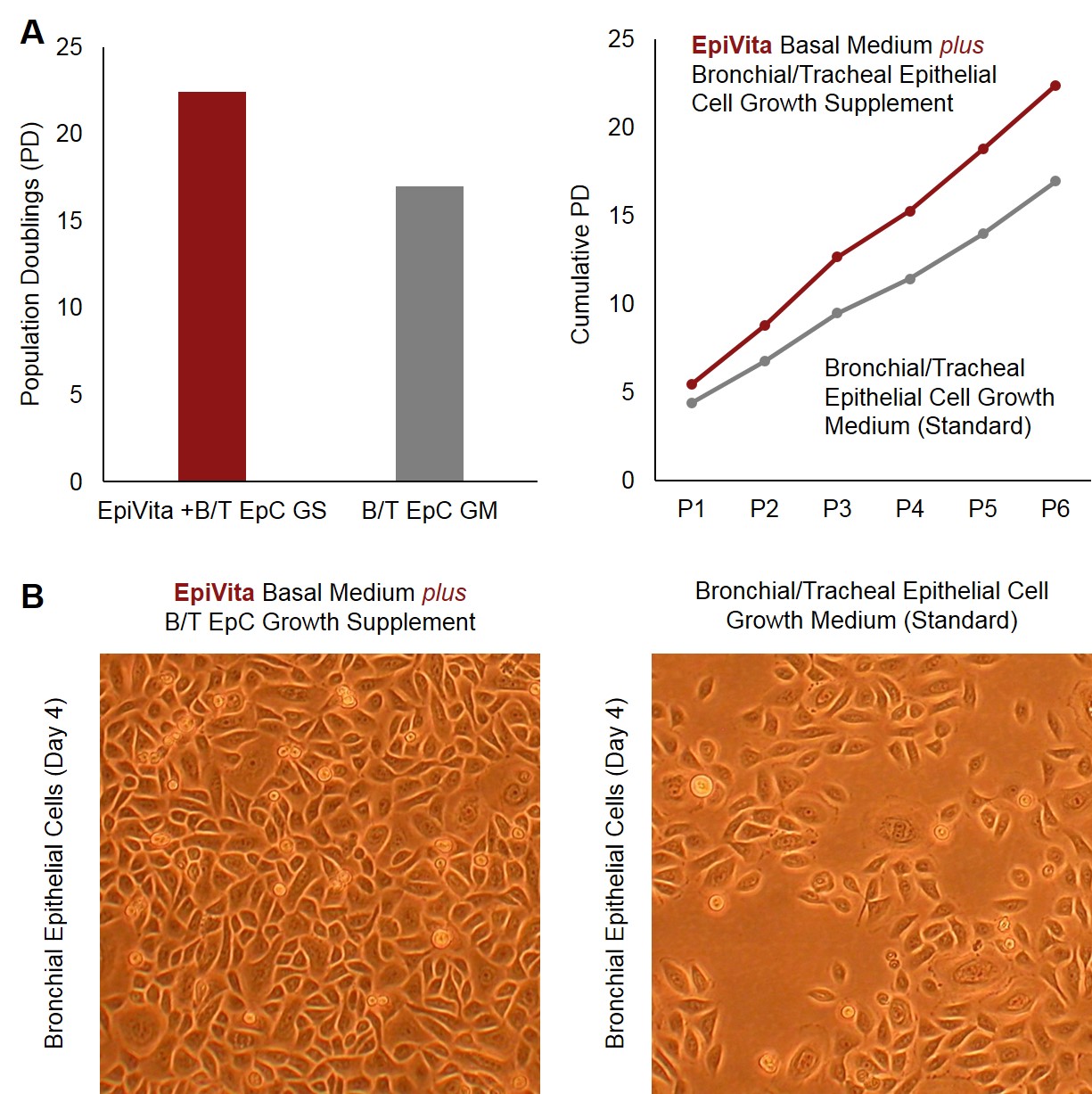
EpiVita Basal Medium (See image in “Details” tab), used in conjunction with Human Bronchial/Tracheal Epithelial Cell Growth Supplement, provides excellent culture conditions for HBEpC and HTEpC. This robust and versatile basal medium is animal origin-free, and contains essential & non-essential amino acids, vitamins, other organic compounds, trace minerals and inorganic salts. Available only from Cell Applications, top-performing EpiVita Basal Medium (plus supplement), outperforms competitor formulations by a wide margin. Manufactured in a GMP certified facility, EpiVita is an ideal choice for fundamental life science studies, pharmaceutical drug discovery & toxicity assay, and translational research aimed at taking discoveries from the bench to the clinic.
Laboratory research use only (RUO). Not for human, clinical, diagnostic or veterinary use.
 Powered by Bioz