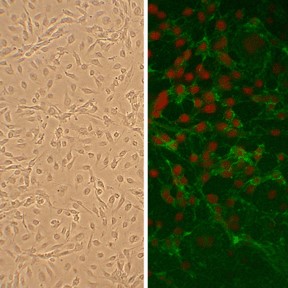
Human Subclavian Artery Endothelial Cells: HScAEC (L). HScAEC immunolabeled with Anti-CD31 antibodies (green); nuclei are counterstained with PI (red) (R).
Human Subclavian Artery Endothelial Cells: HScAEC
Human Subclavian Artery Endothelial Cells (HScAEC) are specialized primary endothelial cells derived from the human subclavian artery.
Description
Human Subclavian Artery Endothelial Cells (HScAEC) are specialized primary endothelial cells derived from the human subclavian artery. As part of the inner lining of large-caliber arteries, they can be used as a model to investigate regional vascular biology, regional endothelial heterogeneity, and site-specific responses within the arterial tree.
In vivo, endothelial cells across various arteries — including the subclavian artery, aorta, carotid, coronary, and brachiocephalic arteries — exhibit distinct functional properties and gene expression profiles. Research indicates that blood vessels from different tissues and representative vascular beds are highly heterogeneous, with this diversity associated with differential leukocyte interactions during inflammatory responses. Variations in the N-glycosylation of vascular adhesion molecules and signaling pathways under resting and activated inflammatory conditions may reflect this regional heterogeneity, findings that are consistent with observations regarding why specific vascular beds display differential susceptibility to diseases.
Studying primary cells from well-defined sources helps mitigate experimental complications arising from genetic variability, age, and donor lifestyle. Because of the complex heterogeneity that exists between different donors and across distinct vascular beds within the same individual, researchers often utilize panels of endothelial cells derived from multiple origins or single cells to validate new findings.
In developmental and cardiovascular research, HScAEC and related endothelial populations — such as lymphatic endothelial cells and arterial endothelial cells — can be used to investigate vascular development, blood flow dynamics, and endothelial cell differentiation pathways in relevant contexts. These models also support comparative studies involving other cardiovascular cell types, including vascular smooth muscle cells, pericytes, stromal cells, and cardiomyocytes, as well as investigations into organ-specific endothelial cells from tissues like the lung, liver bud, kidney, and bone marrow.
Human Subclavian Artery Endothelial Cells (HScAEC), along with human aortic (HAOEC), carotid artery (HCtAEC), coronary artery (HCAEC) and brachiocephalic artery (HBcAEC), all from Cell Applications, Inc., have been used to:
- Demonstrate that not only blood vessels from different tissues are highly heterogeneous, they also interact differently with leukocytes during the inflammation response
- The authors further showed that differential N-glycosylation of commonly expressed vascular adhesion molecules may be responsible for this heterogeneity, as well as for modulation of signaling under resting and activated inflammatory conditions
- This also explains why specific vascular beds may be more or less susceptible to particular diseases or stimuli. Importantly, if cells from different sources were used, these results could not be convincingly validated due to a number of uncontrolled variables, such as age, race, genetic variability or life style choices of the donors. To eliminate the donor-to-donor variability, the scientists took advantage of the great variety of primary cells offered by Cell Applications, including the option of ordering a panel of endothelial cells obtained from different vascular beds of the same donor!
Because of the complex heterogeneity that exists not only between different donors, but even between different vascular beds in the same individual, it would be prudent to confirm any new findings on primary cell lots coming from several different origins.
Details
| Tissue | Normal healthy human subclavian artery | |
|---|---|---|
| QC | No bacteria, yeast, fungi, mycoplasma, virus | |
| Character | Factor VIII-related Ag, DiI-Ac-LDL uptake | |
| Bioassay | Attach, spread, proliferate in Growth Med | |
| Cryovial | 500,000 HScAEC frozen in Basal Medium w/ 10% FBS, 10% DMSO | |
| Kit | Cryovial frozen HScAEC (3010-05a), Growth Medium (212-500), Subculture Rgnt Kit (090K) | |
| Proliferating | Shipped in Growth Med (flasks or plates) | |
| Doublings | At least 5 | |
| Applications | Laboratory research use only (RUO). Not for human, clinical, diagnostic or veterinary use. |
Resources
FAQs
Need More Help?
Visit our comprehensive FAQ page for detailed answers to common questions.
Need More Help?
Visit our comprehensive FAQ page for detailed answers to common questions.
Primary Cell FAQs