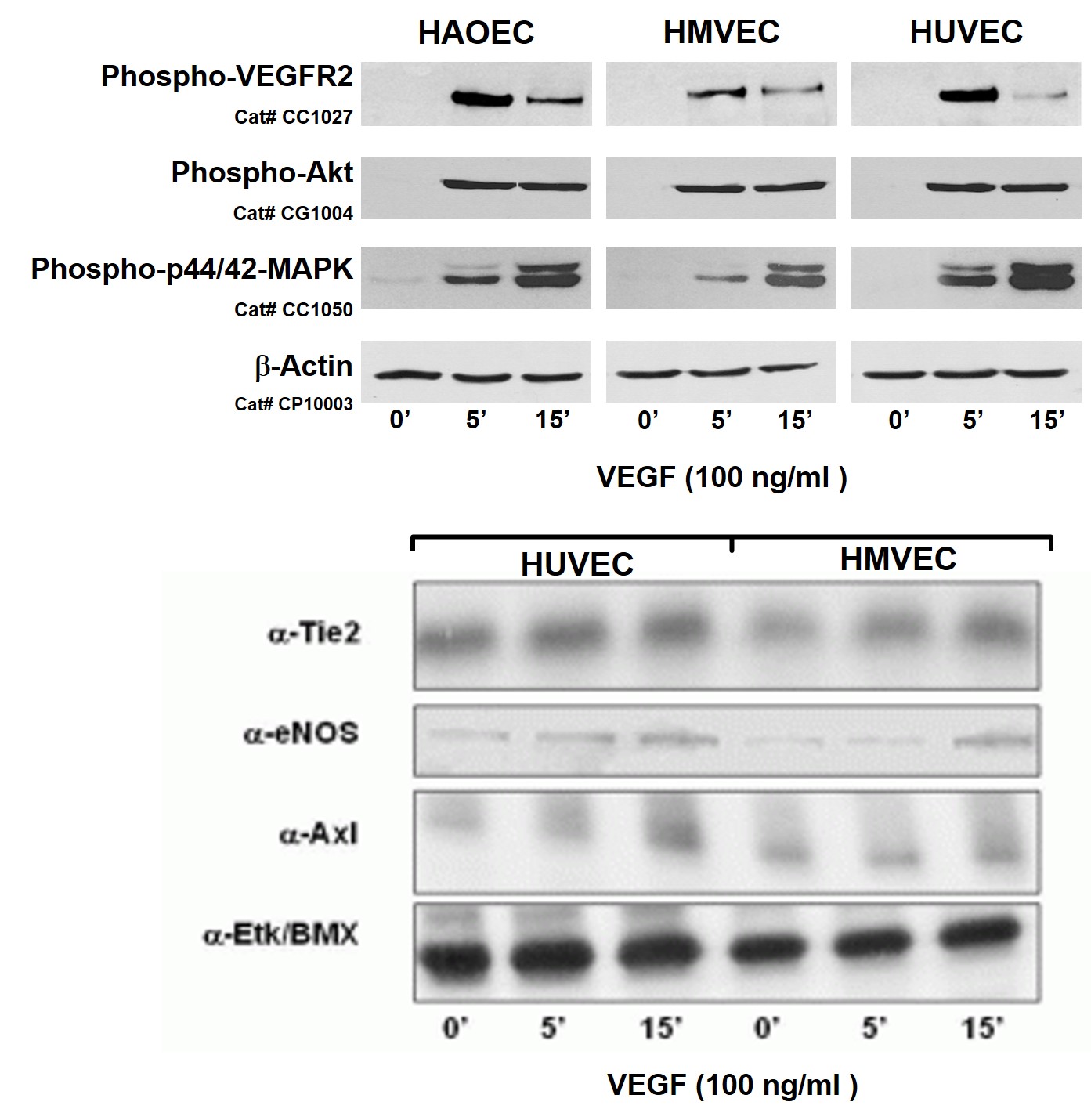
Pre-Screened Endothelial Cells Top: Activation of VEGFR-2 signaling in HAOEC, HUVEC and HMVEC by 100 ng/ml VEGF for 0, 5 or 15 minutes. VEGFR-2 autophosphorylation probed w/ phospho-VEGFR-2 (Y1175) specific Ab, Akt activation detected by phospho-Akt (S473) specific antibody, and MAP kinase activation detected using phospho-p44/42 MAP kinase (T202/Y204) Ab. Bottom: Pre-screened
...Human Umbilical Vein Endothelial Cells: S-HUVEC: Pre-Screened
Human Umbilical Vein Endothelial Cells (HUVEC) are primary vascular endothelial cells isolated from the endothelial lining of the umbilical vein within the human umbilical cord expressing the following important biomarkers: Tie2, eNOS, Axl, Etk/Bmx.
Description
Human Umbilical Vein Endothelial Cells: Pre-Screened (S-HUVEC) are primary endothelial cells isolated from the inner lining of the vein within human umbilical cord tissue. While other populations like Human Microvascular Endothelial Cells (HMVEC) and Human Aortic Endothelial Cells (HAOEC) represent specialized arterial or capillary niches, the HUVEC cell is the most widely utilized cell type for exploring macrovascular physiology and vascular biology.
Unlike a transformed cell line or an immortalized cell line, which can suffer from genetic drift and altered phenotypic behaviors, these primary cells retain their physiological relevance. To eliminate the high biological variability typical of un-validated primary tissue isolates, S-HUVEC lots are systematically pre-screened to ensure uniform, stimulation-dependent responses. They are available either as a single donor lot to study individual genetic variations or as a multi-donor pool lot to ensure a generalized human background. To maintain excellent cell viability, the cryopreserved cell pellet must be carefully resuspended into a single-cell cell suspension and seeded into an appropriate culture vessel or flask containing optimized endothelial cell growth medium supplemented with essential antimicrobials.
The pre-screening protocol evaluates the cellular machinery of S-HUVEC to ensure the core signaling networks governing vascular homeostasis and the function of the vascular endothelium remain uncompromised:
- VEGFR-2 Activation: Vascular Endothelial Growth Factor Receptor-2 (VEGFR-2) is the primary receptor mediating VEGF actions in vascular endothelial cells. Upon ligand binding, VEGF induces receptor dimerization and tyrosine kinase autophosphorylation. This activates critical downstream pathways, including the phosphorylation of Akt (regulating survival and nitric oxide production) and p44/42-MAPK (ERK1/2, regulating cell proliferation and proliferation kinetics).
- Endothelial Marker Expression: Validated S-HUVEC lots display characteristic cobble-stone morphology at confluence and show robust positive staining for definitive endothelial markers. This includes the vwf factor viii complex (von Willebrand factor stabilizing Coagulation Factor VIII), which manages thromboresistance and platelet adhesion within blood vessels. Screening also confirms the stable presence or activation of key vascular co-regulators like Tie2, eNOS, Axl, and the non-receptor tyrosine kinase Etk/Bmx.
In cell culture, S-HUVEC serve as an essential and highly reproducible functional model for evaluating early morphogenic events:
- Tube-Formation Dynamics: Pre-screened lots are verified to undergo robust cell migration and alignment to form interconnected, capillary-like tubular networks during in vitro angiogenesis assays.
- Metabolic and Shear Responses: Because the umbilical vessel natively experiences distinct hemodynamics, these cells are sensitive to mechanical and metabolic changes. They allow researchers to model the early stages of vascular disease, investigating how conditions like altered lipid metabolism or low serum culture environments induce endothelial dysfunction.
Because establishing functional microvasculature is a critical step in tissue engineering, S-HUVEC are standard components in advanced multicellular platforms.
- Co-Culture Engineering: To drive the vascularization of engineered constructs, these cells are frequently co-cultured with specialized lineages, such as fibroblasts, mesenchymal cells, or stem cell populations including neural stem cells.
- Translational Screening: Investigators leverage S-HUVEC to optimize clinical transfection protocols, validate xeno-free media matrices, and benchmark the endothelial lineage commitment of alternative platforms using directed stem cell differentiation kits. By providing a non-drifting, pre-validated human background, these cells ensure experimental reproducibility across complex physiological and pharmacological workflows.
Human Umbilical Vein Endothelial Cells: Pre-Screened for Angiogenesis & VEGF Signaling – The most commonly used human endothelial cells are Human Umbilical Vein Endothelial Cells, (HUVEC), Human Microvascular Endothelial Cells (HMVEC) and Human Aortic Endothelial Cells (HAOEC). At Cell Applications, select lots of HUVEC, HMVEC, HLMVEC, and HAOEC have been pre-screened to demonstrate stimulation-dependent angiogenesis and key endothelial cell signaling pathways (phosphorylation of VEGFR, Akt, MAPK, and expression of Tie2, eNOS, Axl and Etk/Bmx. Other cell types can be pre-screened by customer request.
VEGF-Stimulated Signaling in Pre-Screened Endothelial Cells -VEGF receptor-2 (VEGFR-2) is a major VEGF of endothelial cells. VEGFR-2-mediated signaling plays a critical role in angiogenesis, including regulation of proliferation, differentiation, cell movement, and survival of endothelial cells. VEGF-induced receptor dimerization triggers activation of VEGFR-2 tyrosine kinase and autophosphorylation at a specific set of tyrosine residues, which serve as docking sites for downstream signaling components leading to activation of downstream signaling molecules, including phosphorylation of Akt and p44/42-MAPK.
Details
Expression of Signaling Biomarkers in Pre-Screened Endothelial Cells. Prescreened Endothelial Cells from Cell Applications, Inc. express the following important biomarkers:
- Tie2, a receptor tyrosine kinase critical for the angiogenic remodeling, sprout formation, survival of endothelial cells and vessel stabilization processes
- eNOS (endothelial Nitric Oxide Synthase), the enzyme that producse NO which is an important signaling molecule that regulates a diverse range of physiological events and is required for normal endothelial function
- Axl, a receptor tyrosine kinase whose ligand is the survival factor Gas6 (growth arrest-specific gene 6 product), is implicated in cell survival, leukocyte transmigration and neointima formation
- Etk/Bmx (Endothelial/epithelial Tyrosine Kinase), a member of the Btk family, participates in signal transduction stimulated by growth factor receptors, cytokine receptors, G-protein-coupled receptors, antigen receptors, and integrins, and has been implicated in cell adhesion, migration, proliferation and survival.
Resources
FAQs
Need More Help?
Visit our comprehensive FAQ page for detailed answers to common questions.
Need More Help?
Visit our comprehensive FAQ page for detailed answers to common questions.
Primary Cell FAQs Powered by Bioz