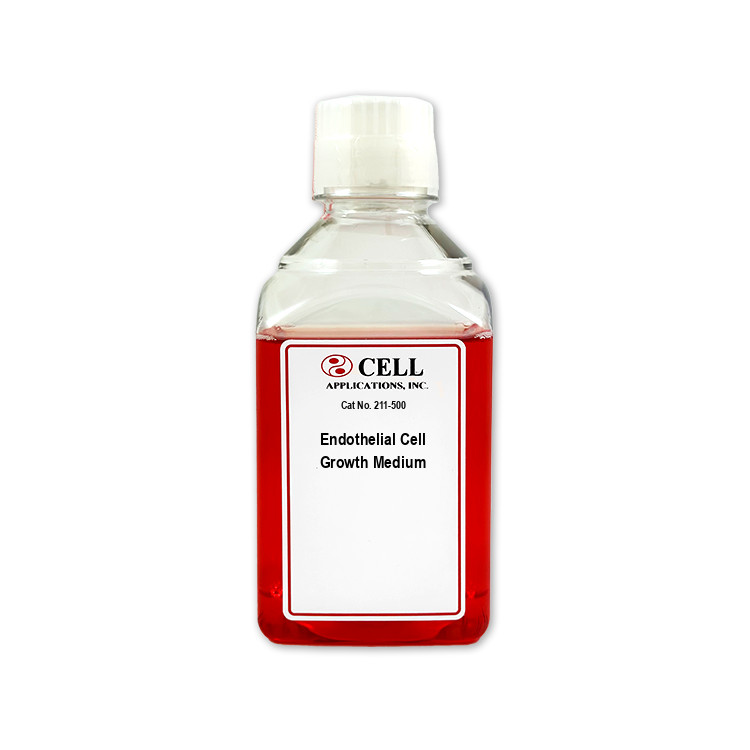
Choose the Human Endothelial Cell Medium best suited for your specific applications. Optimized for in vitro culture of a variety of Endothelial Cells from aorta, artery and vein. EGM (Cat# 211-500) is optimized for angiogenesis and other more physiological studies (does not contain VEGF). EGM v2 (Cat# 213-500) is enriched
...
Choose the Human Endothelial Cell Medium best suited for your specific applications. Optimized for in vitro culture of a variety of Endothelial Cells from aorta, artery and vein. EGM (Cat# 211-500) is optimized for angiogenesis and other more physiological studies (does not contain VEGF). EGM v2 (Cat# 213-500) is enriched with growth factors for accelerated growth, and includes VEGF, FBS, EGF, bFGF, IGF, Ascorbic acid, Hydrocortisone, Heparin.
Human Endothelial Cell Media
Human EC Growth Medium: All-in-one ready-to-use. Optimized and best-suited for angiogenesis and other physiological studies. For accelerated growth, use Cat# 213-500.
Human EC Growth Medium Kit: Basal medium & growth supplement sold together packaged separately. Optimized and best-suited for angiogenesis and other physiological studies. For accelerated growth, use Cat# 213-500.
Yields 500 ml
211K-500
$167.00
Human EC Basal Medium: Basal medium (contains no growth supplement). Add Supplement before use.
500 ml
210-500
$108.00
Human EC Growth Supplement: Added to Basal Medium to create Growth Medium. The complete Growth Medium (equivalent to Cat# 211-500) is optimized and best-suited for angiogenesis and other physiological studies. For accelerated growth, use Cat# 213-500.
Human EC Growth Medium Kit: Basal medium & growth supplement sold together packaged separately. Optimized and best-suited for angiogenesis and other physiological studies. For accelerated growth, use Cat# 213-500.
Size: Yields 500 mlCat.#: 211K-500Price:$167.00
Human EC Basal Medium: Basal medium (contains no growth supplement). Add Supplement before use.
Size: 500 mlCat.#: 210-500Price:$108.00
Human EC Growth Supplement: Added to Basal Medium to create Growth Medium. The complete Growth Medium (equivalent to Cat# 211-500) is optimized and best-suited for angiogenesis and other physiological studies. For accelerated growth, use Cat# 213-500.
Human Endothelial Cell Media are cell culture media formulated to support the robust growth and maintenance of endothelial cell phenotype and function in vitro, enabling reproducible propagation of primary cells and other endothelial cell sources used across angiogenesis, vascular biology, and translational research. These endothelial cell growth medium systems are typically prepared as an endothelial cell growth supplement added to a corresponding basal medium (a cell culture medium kit), and are designed to preserve key endothelial markers and behaviors, including sustained expression of junction and activation-associated markers under both basal and stimulated conditions. In particular, Human Endothelial Cell Media are used for culture of human endothelial cell types derived from large and conduit vessels as well as microvascular-associated sources, including human primary cells such as human endothelial cells from the aorta, artery, and pulmonary vasculature (e.g., HAOEC, HFAEC, HPAEC), as well as umbilical vein–derived endothelial cells (HUVEC). Endothelial cells in vivo line the inner surface of blood vessels and play central roles in barrier function, regulation of leukocyte trafficking, and angiogenesis; in research settings, maintaining these properties is essential for faithfully modeling vascular growth and inflammation responses in controlled cell biologics workflows that also include molecular biology readouts and phenotypic imaging.
In research and drug discovery, endothelial cell growth media are used to establish and maintain monolayers or vascular-like structures for assays that interrogate angiogenic signaling, adhesion molecule induction, and endothelial activation by inflammatory mediators. For example, endothelial monolayers cultured in optimized media can be exposed to cytokines or growth factors to quantify changes in activation markers and functional phenotypes, or co-cultured with other cell types (such as stromal support cells) to evaluate angiogenic sprouting and vessel formation readouts. Human endothelial cell culture also supports genetically modified endothelial systems, including experiments involving transfection or viral delivery tools—such as lentiviral vectors—to study endothelial-specific gene regulation, including endothelial specific adenoviral overexpression and related perturbations. These approaches are widely used in contexts spanning normal vascular biology and disease modeling, including tumor endothelial cell culture for systems relevant to colorectal cancer and other solid tumors, where endothelial behavior is influenced by tumor-derived factors and extracellular matrix dynamics.
Endothelial cell media formulations also support a range of experimental design options through compatible media variants and supplements, including options that omit defined components depending on the desired experimental control (for example, specialized media supplement formulations and individual supplements used to manage serum dependence, growth factor exposure, or experimental timing). In many endothelial workflows, the formulation includes recombinant growth factor components such as epidermal growth factor and other endothelial-supporting factors used to accelerate or standardize propagation depending on the study aims.
Media were optimized for the robust growth and the maintenance of phenotypic and functional characteristics of Endothelial Cells in culture. Media were designed with attention to detail that ensures the consistency of cell health, viability, performance, physiology, morphology and function.
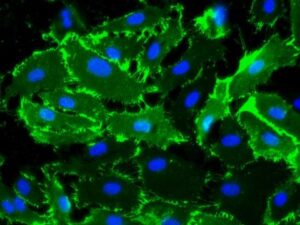
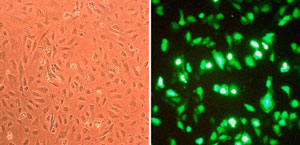
Convenient, non-toxic transfection of HAOEC with GFP plasmid.
Client Testimonial
According to Sara Lynn Farwell, Ph.D. Candidate, Cell & Molecular Bio. at Lehigh University: “CAI’s Endothelial Cell Growth Medium is reliable for our experiments, as well as general culturing. There must be magic in their media, because when we had problems with other formulations, the CAI product fixed the issues!”
Head-to-Head Comparison Peer-Reviewed Article and Video
“Fastest colony outgrowth and most colonies occurred in Cell Applications medium.”
See the video below:
Note that endothelial Cell Defined Medium is designed for maintaining the monolayer of endothelial cells at 100% confluent culture. It does not contain the growth factors VEGF, FGF or PDGF, nor does it contain serum, but is instead supplemented with defined components to allow metabolic and growth factor studies without interference of extraneous factors.
Details
CAI media are tested for sterility in order to confirm no bacteria, yeast or fungi contaminate the solutions. The products undergo further quality control for correct pH, osmolality and lack of endotoxins. A panel of different bioassays affirm the media sustain a proper environment for expected cell-type-specific culture, growth, plating, karyotype, physiology, morphology, viability, population doublings, surface markers, cryopreservation, differentiation and/or induction.
Laboratory research use only (RUO). Not for human, clinical, diagnostic or veterinary use.
HUVEC Conditioned Medium: HUVEC Conditioned Medium
5 ml
211CM-05
$66.00
Human EC Serum-Free Defined Medium: Defined medium without serum designed to maintain endothelial cell monolayers in confluent cultures. Not for cell growth.
HUVEC Conditioned Medium: HUVEC Conditioned Medium
Size: 5 mlCat.#: 211CM-05Price:$66.00
Human EC Serum-Free Defined Medium: Defined medium without serum designed to maintain endothelial cell monolayers in confluent cultures. Not for cell growth.

 Powered by Bioz