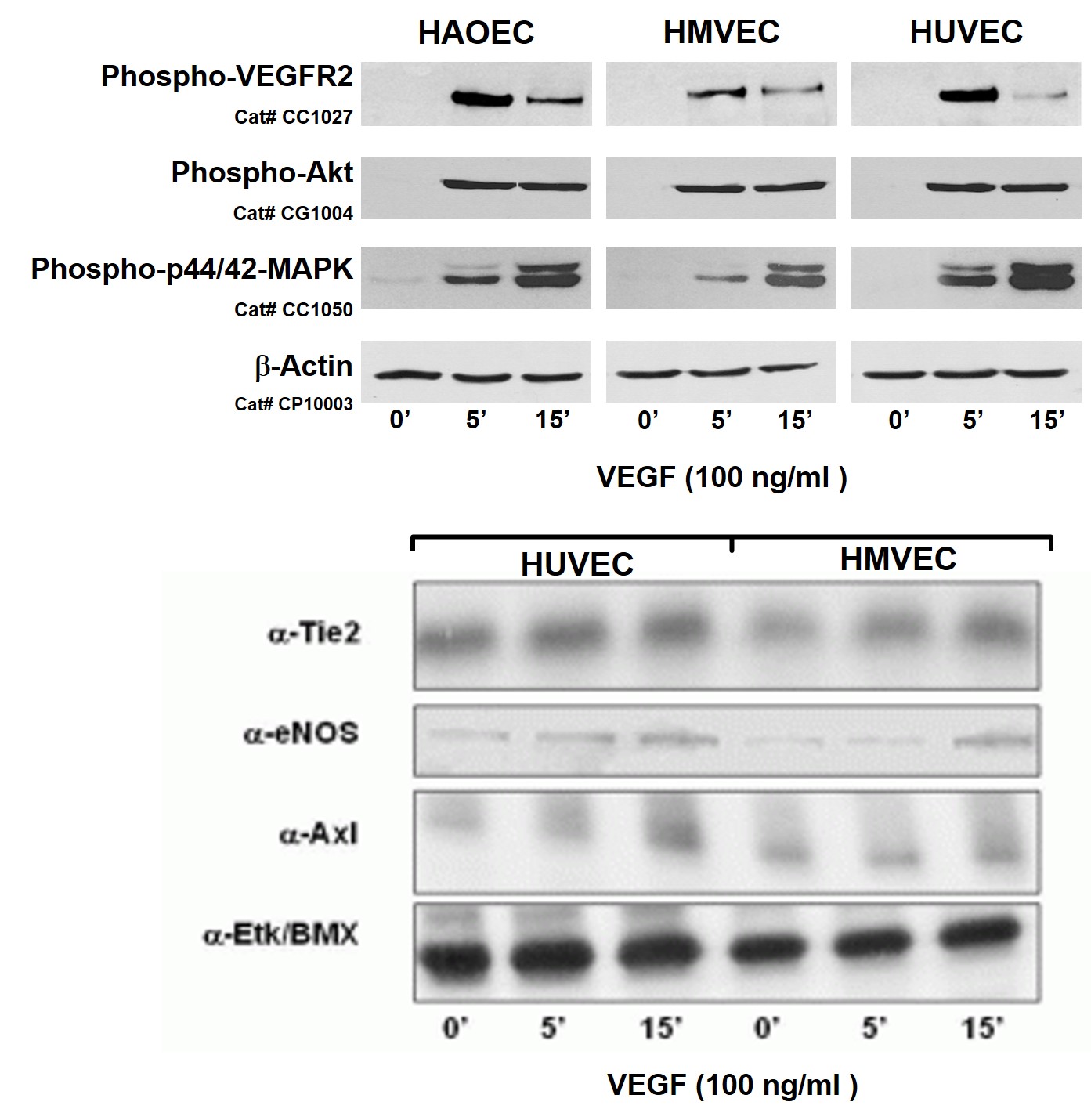
Pre-Screened Endothelial Cells Top: Activation of VEGFR-2 signaling in HAOEC, HUVEC and HMVEC by 100 ng/ml VEGF for 0, 5 or 15 minutes. VEGFR-2 autophosphorylation probed w/ phospho-VEGFR-2 (Y1175) specific Ab, Akt activation detected by phospho-Akt (S473) specific antibody, and MAP kinase activation detected using phospho-p44/42 MAP kinase (T202/Y204) Ab. Bottom: Pre-screened
...Human Dermal Microvascular Endothelial Cells: S-CADMEC/HMVEC: Pre-Screened
Human Dermal Microvascular Endothelial Cells (CADMEC / HMVEC) are primary endothelial cells isolated from human skin capillaries and rigorously pre-screened to ensure robust stimulation-dependent angiogenesis and verified activity across key endothelial cell signaling pathways.
Description
Human Dermal Microvascular Endothelial Cells: Pre-Screened represent a specialized subset of primary cell isolates designed for rigorous investigations into vascular dynamics. While macrovascular models such as Human Umbilical Vein Endothelial Cells (HUVEC) and Human Aortic Endothelial Cells (HAOEC) are widely utilized, microvascular populations like Human Dermal Microvascular Endothelial Cells (historically trademarked as CADMEC™ by Cell Applications, Inc.) offer a physiologically relevant model of the microcirculation. These select lots are rigorously pre-screened to ensure robust stimulation-dependent angiogenesis and verified activity across key endothelial cell signaling pathways, including the phosphorylation of VEGFR, Akt, and MAPK, alongside the expression of critical markers such as Tie2, eNOS, Axl, and Etk/Bmx.
Microvascular endothelial cells play an indispensable role in tissue homeostasis, regulating vascular permeability, leukocyte trafficking, and the formation of new capillary networks. Because these cells are particularly sensitive to environmental cues, ensuring consistent phenotypic performance requires strict quality controls:
- Angiogenic Competence: Pre-screened lots are selected based on demonstrated responsiveness to pro-angiogenic stimuli (such as VEGF), making them ideal for studying the molecular cascades that drive capillary sprouting and vessel maturation.
- Functional Responsiveness: These populations are routinely utilized to model complex physiological processes, including wound healing responses and cellular adaptation to localized oxidative stress.
- Quality Assurance and Safety: Maintaining the integrity of these cultures requires rigorous testing to ensure they remain free of contaminants such as mycoplasma, which can severely disrupt metabolic and signaling pathways.
Pre-screened microvascular endothelial cells are essential for advancing translational vascular biology:
- Angiogenesis Assays: Researchers rely on pre-characterized lots to evaluate the efficacy of pro-angiogenic therapeutics or anti-angiogenic oncology drugs, ensuring that experimental outputs reflect true microvascular behavior rather than donor-to-donor variability.
- Dermal and Tissue Engineering: These cells are fundamental in modeling cutaneous microcirculation, studying how the microenvironment influences cell proliferation and tissue repair during injury.
- Inflammation and Signaling Studies: By providing a reliable baseline of receptor expression and phosphorylation kinetics, these pre-screened lines enable precise mapping of endothelial responses to pathological stimuli.
In microvascular research, the physiological state of the endothelium can change over time; therefore, monitoring passage number and utilizing pre-screened, batch-validated primary isolates are critical for maintaining experimental fidelity. By minimizing functional variability and verifying baseline signaling competence before use, researchers can significantly reduce experimental noise. This rigorous standardization ensures that data generated from these models remains robust, reproducible, and reflective of human microvascular biology.
Human Dermal Microvascular Endothelial Cells: Pre-Screened provide a high-fidelity, functionally validated platform for studying angiogenesis, signal transduction, and microvascular physiology. By offering demonstrated responsiveness to VEGF and other key angiogenic drivers, these specialized cells empower investigators to generate reliable, reproducible insights critical for therapeutic development and vascular research.
Human Dermal Microvascular Endothelial Cells: Pre-Screened for Angiogenesis & VEGF Signaling – The most commonly used human endothelial cells are Human Umbilical Vein Endothelial Cells, (HUVEC), Human Microvascular Endothelial Cells (HMVEC) and Human Aortic Endothelial Cells (HAOEC). At Cell Applications, select lots of HUVEC, HMVEC, and HAOEC have been pre-screened to demonstrate stimulation-dependent angiogenesis and key endothelial cell signaling pathways (phosphorylation of VEGFR, Akt, MAPK, and expression of Tie2, eNOS, Axl and Etk/Bmx. Other cell types can be pre-screened by customer request. Human Dermal Microvascular Endothelial Cells (CADMEC / HMVEC) from Cell Applications, Inc. were trademarked by Cell Applications, Inc. over 20 years ago, when they were first offered, and CADMEC™ stands for “Cell Applications’ Dermal Microvascular Endothelial Cells”.
VEGF-Stimulated Signaling in Pre-Screened Endothelial Cells -VEGF receptor-2 (VEGFR-2) is a major VEGF of endothelial cells. VEGFR-2-mediated signaling plays a critical role in angiogenesis, including regulation of proliferation, differentiation, cell movement, and survival of endothelial cells. VEGF-induced receptor dimerization triggers activation of VEGFR-2 tyrosine kinase and autophosphorylation at a specific set of tyrosine residues, which serve as docking sites for downstream signaling components leading to activation of downstream signaling molecules, including phosphorylation of Akt and p44/42-MAPK.
Details
Expression of Signaling Biomarkers in Pre-Screened Endothelial Cells. Prescreened Endothelial Cells from Cell Applications, Inc. express the following important biomarkers:
- Tie2, a receptor tyrosine kinase critical for the angiogenic remodeling, sprout formation, survival of endothelial cells and vessel stabilization processes
- eNOS (endothelial Nitric Oxide Synthase), the enzyme that producse NO which is an important signaling molecule that regulates a diverse range of physiological events and is required for normal endothelial function
- Axl, a receptor tyrosine kinase whose ligand is the survival factor Gas6 (growth arrest-specific gene 6 product), is implicated in cell survival, leukocyte transmigration and neointima formation
- Etk/Bmx (Endothelial/epithelial Tyrosine Kinase), a member of the Btk family, participates in signal transduction stimulated by growth factor receptors, cytokine receptors, G-protein-coupled receptors, antigen receptors, and integrins, and has been implicated in cell adhesion, migration, proliferation and survival.
Resources
FAQs
Need More Help?
Visit our comprehensive FAQ page for detailed answers to common questions.
Need More Help?
Visit our comprehensive FAQ page for detailed answers to common questions.
Primary Cell FAQs Powered by Bioz