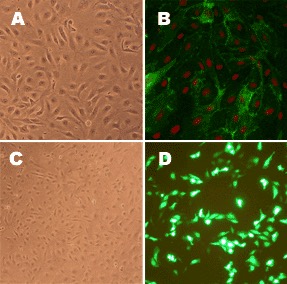
Human Pulmonary Artery Endothelial Cells: HPAEC (A). HPAEC immunolabeled for CD31/PECAM (Cat# CB13678); nuclei stained with PI (red) (B). HPAEC transfected with GFP plasmid DNA using the Cytofect™ Endothelial Cell Transfection Kit (C,D).
Human Pulmonary Artery Endothelial Cells: Asthma: S-HPAEC-AS: Pre-Screened
Pre-Screened Human Pulmonary Artery Endothelial Cells from donors with asthma (S-HPAEC-AS) are primary, pre-screened endothelial cells isolated directly from the large macrovascular segment of the human pulmonary artery from donors with asthma.
Description
Pre-Screened Human Pulmonary Artery Endothelial Cells from donors with asthma (S-HPAEC-AS) provide an excellent model system to study pulmonary circulation, cardiovascular function, and disease mechanisms. As specialized vascular endothelial cells derived from the pulmonary artery, they form the inner lining of large blood vessels that transport deoxygenated blood from the heart to the lungs for oxygenation.
In vivo, these cells play a critical role in regulating vascular tone, maintaining blood fluidity, modulating fibrinolysis, and balancing the local release of vasoactive molecules. Because endothelial function varies significantly across different vascular beds — and between macrovascular and microvascular cells from the same organ — researchers emphasize confirming experimental findings using cell lots obtained from multiple origins.
Asthma is a chronic inflammatory disease that inflames and narrows air passageways in the lungs, causing airflow obstruction, shortness of breath, and life-threatening flare-ups. In clinical research and basic cell biology, Pre-Screened Human Pulmonary Artery Endothelial Cells (HPAEC) from donors with asthma can be used to investigate pulmonary vascular/endothelial aspects that may be altered in asthma and asthma-associated inflammation. Investigators can utilize these cells to study mechanisms relevant to:
- Endothelial dysfunction and aberrant protein expression linked to inflammatory events and pulmonary hypertension.
- The impact of pro-inflammatory cytokines, such as tumor necrosis factor and tumor necrosis factor alpha, on target cells and intercellular signaling.
- Pathways leading to apoptosis, altered cellular interactions with blood platelets, and conditions such as chronic obstructive pulmonary disease (COPD), acute lung injury, and pulmonary artery aneurysm.
Maintaining experimental fidelity requires growing cultures in specialized endothelial cell medium while rigorously screening for mycoplasma and other forms of infection. Researchers frequently analyze cellular phenotypes and surface markers using flow cytometry, comparing findings across diverse pathological contexts — including chronic obstructive lung disease, embolism, lung cancer, and interactions with airway epithelium, mesenchymal cells, and inflammatory cells — to support the development of novel therapeutic inhibitors and activators.
Human Pulmonary Artery Endothelial Cells (HPAEC) provide an excellent model system to study many aspects of cardiovascular function and disease, including diabetes-associated complications, mechanisms of endothelial dysfunction caused by environment, oxidative stress, hypoxia and inflammation, as well as mode of action of various natural compounds and drug candidates.
Note that several publications describe the differences between endothelial cells from different vascular beds and between macro- and micro-vascular cells from the same organ, highlighting the importance of confirming any new findings on cell lots obtained from several different origins. Cell Applications, Inc. offers the widest variety of endothelial cells, and is well equipped to meet this need.
HPAEC from Cell Applications have been used to investigate or demonstrate
- Vasculoprotective effects of propofol, demonstrating its potential for treating pulmonary arterial hypertension
- Hits from a high-throughput screening assay and discover anziaic acid inhibits bacterial activity
- Endothelin-1 is released by endothelial cells during acute crisis in sickle cell anemia, increases vascular constriction
- Pollutant particles cause vascular dysfunction by up-regulating clotting-related genes
- Central role of AMP-activated protein kinase in normal endothelial barrier function can be disrupted, causing endothelial hyperpermeability and lung injury
- Anti-inflammatory and cardioprotective effects of resveratrol
- cGMP prevents oxidant-induced damage to the endothelial barrier function
- Radiation causes endothelial cell senescence due to up-regulation of proliferative signaling in the presence of cell cycle arrest
- Vanadium exposure causes pulmonary vasoconstriction mediated in part by the inhibition of endothelial NO production
- Cytotoxic effects of a novel pore-forming protein, proposed as an anti-tumor agent
- Effects of Bone Morphogenic Protein-4, helping to explain why its upregulation leads to atherosclerosis and hypertension
- Macro-vascular pulmonary endothelial cells accumulate HIF-1 under hypoxic conditions
- Transportation of bioactive lipids and its silencing by siRNA
Cell Applications offers a wide panel of cells for use in asthma research and airway drug development, such as Bronchial & Tracheal Epithelial Cells, Pulmonary & Lung Microvascular Endothelial cells and others. Multiple donor profiles and lots are available. Asthma (AS) is a chronic disease that inflames and narrows air passageways in the lungs. This airflow obstruction, which can flare up at any time, causes shortness of breath and can be life-threating in severe cases. Asthma often starts during childhood, and while there’s no cure, scientists and pharmaceutical companies have made strides in understanding, treating and managing the disease.
Details
| Tissue | Human pulmonary artery from donor with Asthma | |
|---|---|---|
| QC | No bacteria, yeast, fungi, mycoplasma, virus | |
| Character | VIII-related Ag expression, DiI-Ac-LDL uptake | |
| Bioassay | Attach, spread, proliferate in Growth Med | |
| Cryovial | 500,000 S-HPAEC-AS (2nd passage) frozen in Basal Medium w/ 10% FBS, 10% DMSO | |
| Kit | Cryovial frozen S-HPAEC (S302AS-05a), Growth Medium (211-500), Subculture Rgnt Kit (090K) | |
| Proliferating | Shipped in Gr Med, 3rd psg (flasks or plates) | |
| Doublings | At least 15 | |
| Applications | Laboratory research use only (RUO). Not for human, clinical, diagnostic or veterinary use. |
Resources
FAQs
Need More Help?
Visit our comprehensive FAQ page for detailed answers to common questions.
Need More Help?
Visit our comprehensive FAQ page for detailed answers to common questions.
Primary Cell FAQs